

New land restoration guide to unify afforestation efforts

1 / 3
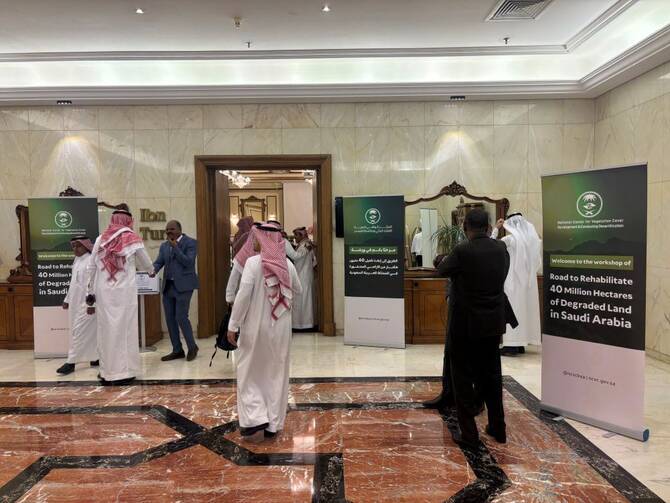
Attendees arrive at the national workshop on rehabilitating degraded lands, a key pillar of the Saudi Green Initiative. (AN Photo/Waad Hussain)
2 / 3
Experts, officials, and stakeholders gather in Riyadh to discuss Saudi Arabia’s roadmap to restoring 40 million hectares of degraded land. (Supplied/@ncvcksa)
3 / 3
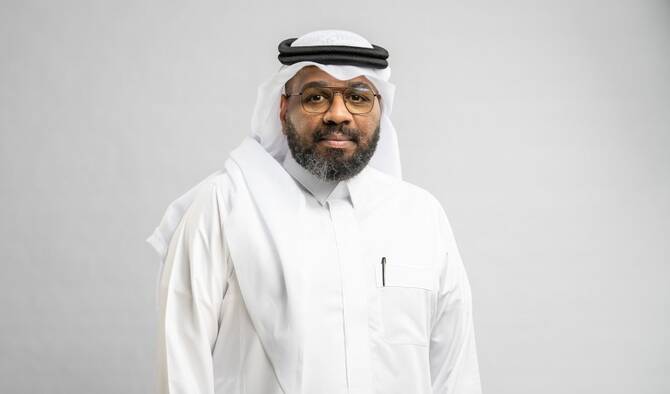
Sameer Maleakah, director of the center’s afforestation department, highlighted the Kingdom’s ambitious environmental restoration goals.
Short Url
Updated 07 May 2025
Follow

New land restoration guide to unify afforestation efforts

  • National Center for Vegetation Cover publishes official Land Restoration Guide for Non-Agricultural Areas
  • It supports goal of planting 10 billion trees, the equivalent of rehabilitating 40m hectares of degraded land

RIYADH: Saudi Arabia has taken another step toward its ambitious afforestation goals with the publication of the official Land Restoration Guide for Non-Agricultural Areas.

The guide is a comprehensive manual that will serve as a unified reference to direct environmental restoration projects across the Kingdom.

It aims to ensure sustainable land management practices and support the goals of the Saudi Green Initiative, one of which is to plant 10 billion trees — the equivalent of rehabilitating 40 million hectares of degraded land.

The National Center for Vegetation Cover Development and Combating Desertification announced its publication on Wednesday with an event titled “The Road to Restoring 40 Million Hectares.”

Organized under the national afforestation program, the event brought together a range of experts to align on best practices and scientific approaches to land rehabilitation.

Sameer Maleakah, director of the center’s afforestation department, highlighted the Kingdom’s ambitious environmental restoration goals.

“So far, we’ve restored over 313,000 hectares across various regions of the Kingdom,” Maleakah told Arab News. “But it’s not just about planting. Restoration begins with protecting the degraded areas — those affected by overgrazing, illegal logging, or desertification caused by human activities.

“We return these areas to their natural state, and once restored, they foster biodiversity, richer vegetation and denser tree cover. These sites then serve as natural parks or forests — whether mountainous or valley-based,” he added.

Maleakah also highlighted the importance of inclusive action. “It’s crucial to involve local communities, civil society organizations and take full advantage of existing legislation, rainfall and cloud-seeding technologies to ensure success.”

The center’s CEO, Dr. Khalid Al-Abdulkader, echoed the importance of the program in his opening remarks, saying that land restoration is not only vital for environmental sustainability, but also plays a major role in food security, combating climate change and supporting rural livelihoods.

With more than 141 million trees planted to date and restoration efforts underway using rainfall and treated water, the center continues to position the afforestation program as a long-term investment in Saudi Arabia’s ecological and developmental future.


Saudi foreign minister joins Arab leaders and EU chiefs to discuss regional escalation

Updated 3 sec ago
Follow

Saudi foreign minister joins Arab leaders and EU chiefs to discuss regional escalation

  • They exchange views on the spread of conflict in the Middle East following the US and Israeli strikes on Iran that began 11 days ago
  • Leaders discuss joint actions to enhance regional and international security; EU officials express solidarity with countries affected by Iranian attacks

RIYADH: The Saudi foreign minister, Prince Faisal bin Farhan, joined leaders from Gulf Cooperation Council member states, as well as Egypt, Lebanon, Iraq, Syria, Turkiye and Armenia, in a teleconference to discuss the escalation of the conflict in the region.

The purpose of the meeting was to exchange views on the spread of attacks in the Middle East following the US and Israeli strikes against Iran that began on Feb. 28. Tehran retaliated by launching missile and drones against targets in several countries in the region.

The leaders condemned the “cowardly attacks” that have affected several countries, including the targeting of civilians, vital facilities and diplomatic missions, the Saudi Press Agency reported.

Other participants in the meeting included Antonio Costa, president of the European Council, and Ursula von der Leyen, president of the European Commission, who expressed full solidarity with affected countries.

The leaders also discussed joint actions to enhance regional and international security, protect civilians and uphold the principles of the UN Charter.

Several representatives from the Saudi Foreign Ministry also took part in the meeting, including Abdulrahman Al-Rassi, the undersecretary for multilateral international affairs; Nasser Al-Ghannoum, director general of the ministry’s General Department of Asian Affairs; and Talal Al-Enezi, director of the European Union department.