


New land restoration guide to unify afforestation efforts

1 / 3
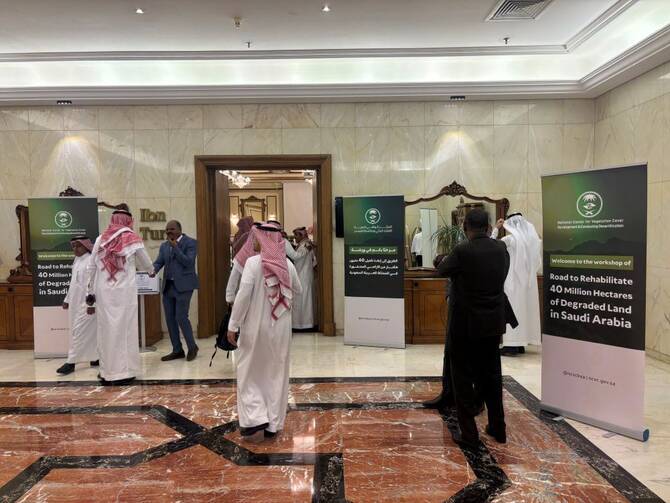
Attendees arrive at the national workshop on rehabilitating degraded lands, a key pillar of the Saudi Green Initiative. (AN Photo/Waad Hussain)
2 / 3
Experts, officials, and stakeholders gather in Riyadh to discuss Saudi Arabia’s roadmap to restoring 40 million hectares of degraded land. (Supplied/@ncvcksa)
3 / 3
Sameer Maleakah, director of the center’s afforestation department, highlighted the Kingdom’s ambitious environmental restoration goals.
Short Url
Updated 07 May 2025
Follow

New land restoration guide to unify afforestation efforts

  • National Center for Vegetation Cover publishes official Land Restoration Guide for Non-Agricultural Areas
  • It supports goal of planting 10 billion trees, the equivalent of rehabilitating 40m hectares of degraded land

RIYADH: Saudi Arabia has taken another step toward its ambitious afforestation goals with the publication of the official Land Restoration Guide for Non-Agricultural Areas.

The guide is a comprehensive manual that will serve as a unified reference to direct environmental restoration projects across the Kingdom.

It aims to ensure sustainable land management practices and support the goals of the Saudi Green Initiative, one of which is to plant 10 billion trees — the equivalent of rehabilitating 40 million hectares of degraded land.

The National Center for Vegetation Cover Development and Combating Desertification announced its publication on Wednesday with an event titled “The Road to Restoring 40 Million Hectares.”

Organized under the national afforestation program, the event brought together a range of experts to align on best practices and scientific approaches to land rehabilitation.

Sameer Maleakah, director of the center’s afforestation department, highlighted the Kingdom’s ambitious environmental restoration goals.

“So far, we’ve restored over 313,000 hectares across various regions of the Kingdom,” Maleakah told Arab News. “But it’s not just about planting. Restoration begins with protecting the degraded areas — those affected by overgrazing, illegal logging, or desertification caused by human activities.

“We return these areas to their natural state, and once restored, they foster biodiversity, richer vegetation and denser tree cover. These sites then serve as natural parks or forests — whether mountainous or valley-based,” he added.

Maleakah also highlighted the importance of inclusive action. “It’s crucial to involve local communities, civil society organizations and take full advantage of existing legislation, rainfall and cloud-seeding technologies to ensure success.”

The center’s CEO, Dr. Khalid Al-Abdulkader, echoed the importance of the program in his opening remarks, saying that land restoration is not only vital for environmental sustainability, but also plays a major role in food security, combating climate change and supporting rural livelihoods.

With more than 141 million trees planted to date and restoration efforts underway using rainfall and treated water, the center continues to position the afforestation program as a long-term investment in Saudi Arabia’s ecological and developmental future.


What makes the Taif Rose such a precious fragrance product?

Perfume artisan involvement aligns with Jazan Festival’s initiative repositioning traditional crafts as dynamic. (SPA)
Updated 6 sec ago
Follow

What makes the Taif Rose such a precious fragrance product?

  • These farms produce nearly 550 million roses annually, all harvested during a brief season of no more than 45 days, from early March to the end of April

TAIF: Taif roses, renowned for their exceptional aroma and the meticulous care required in cultivation, harvesting, and processing, are among the Kingdom’s most valuable natural perfume products and stand out as prominent agricultural and cultural symbols deeply connected to the region’s heritage and tourism.

Taif rose farms, numbering over 910 and spread across Al-Hada, Al-Shafa, Wadi Muharram, Al-Wahat, Al-Wahit, and Wadi Liya, are home to approximately 1,144,000 rose bushes covering about 270 hectares of agricultural land. 

FASTFACT

Taif rose farms, numbering over 910 and spread across Al-Hada, Al-Shafa, Wadi Muharram, Al-Wahat, Al-Wahit, and Wadi Liya, are home to approximately 1,144,000 rose bushes covering about 270 hectares of agricultural land.

These farms produce nearly 550 million roses annually, all harvested during a brief season of no more than 45 days, from early March to the end of April.

This harvest yields around 20,000 tolas of Taif rose oil. Producing a single tola requires approximately 12,000 roses, which are picked manually at dawn and distilled within 24 hours to preserve the purity and quality of the scent before reaching the market.