


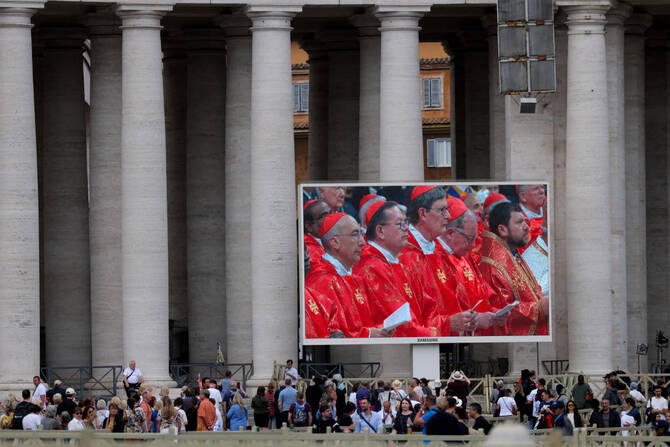

VATICAN CITY: Roman Catholic cardinals will begin the task on Wednesday of electing a new pope, locking themselves away from the world until they choose the man they hope can unite a diverse but divided global Church.
In a ritual dating back to medieval times, the cardinals will file into the Vatican’s frescoed Sistine Chapel after a public Mass in St. Peter’s Basilica and start their secret conclave for a successor to Pope Francis, who died last month.
No pope has been elected on the first day of a conclave for centuries, so voting could continue for several days before one of the red-hatted princes of the Church receives the necessary two-thirds majority to become the 267th pontiff.
There will be only one ballot on Wednesday. Thereafter, the cardinals can vote as many as four times a day.
They will burn their ballots, with black smoke from a chimney on the roof of the chapel marking an inconclusive vote, while white smoke and the peeling of bells signalling that the 1.4-billion member church has a new leader.
The pope’s influence reaches well beyond the Catholic Church, providing a moral voice and a call to conscience that no other global leader can match.
At a Mass in St. Peter’s Basilica on Wednesday morning before entering the conclave, the cardinals prayed that God would help them find a pope who would exercise “watchful care” over the world.
In a sermon, Italian Cardinal Giovanni Battista Re told his peers they must set aside “every personal consideration” in choosing the new pontiff and keep in mind “only ... the good of the Church and of humanity.”
Re, the dean of the College of Cardinals, is 91 and will not enter the conclave, which is reserved for cardinals under the age of 80.
Cardinals in recent days have offered different assessments of what they are looking for in the next pontiff.
While some have called for continuity with Francis’ vision of greater openness and reform, others have said they want to turn the clock back and embrace old traditions. Many have indicated they want a more predictable, measured pontificate.
A record 133 cardinals from 70 countries will enter the Sistine Chapel, up from 115 from 48 nations in the last conclave in 2013 — growth that reflects Francis’ efforts to extend the reach of the Church to far-flung regions with few Catholics.
No clear favorite has emerged, although Italian Cardinal Pietro Parolin and Filipino Cardinal Luis Antonio Tagle are considered the front-runners.
NO EAVESDROPPING
However, if it quickly becomes obvious that neither can win, votes are likely to shift to other contenders, with the electors possibly coalescing around geography, doctrinal affinity or common languages.
Among other potential candidates are France’s Jean-Marc Aveline, Hungary’s Peter Erdo, American Robert Prevost and Italy’s Pierbattista Pizzaballa.
Re suggested the cardinals should look for a pope who respected the diversity within the Church. “Unity does not mean uniformity, but a firm and profound communion in diversity,” he said in his sermon.
As in medieval times, the cardinals will be banned from communicating with outsiders during the conclave, and the Vatican has taken high-tech measures to ensure secrecy, including jamming devices to prevent any eavesdropping.
The average length of the last 10 conclaves was just over three days and none went on for more than five days. A 2013 conclave lasted just two days.
The cardinals will be looking to wrap things up quickly again this time to avoid giving the impression that they are divided or that the Church is adrift.
Some 80 percent of the cardinals who enter the Sistine Chapel on Wednesday were appointed by Francis, increasing the possibility that his successor will in some way continue his progressive policies despite strong pushback from traditionalists.
Among their considerations will be whether they should seek a pope from the global south where congregations are growing, as they did in 2013 with the Argentinian Francis, hand back the reins to Europe or even pick a first US pope.


