Vatican conclave to pick new pope, world awaits white smoke

1 / 2
Dean of the College of Cardinals, Cardinal Giovanni Battista Re, presides over the Holy Mass, celebrated for the election of the new pope, in St. Peter's Basilica, at the Vatican, May 7, 2025. (Reuters)
2 / 2
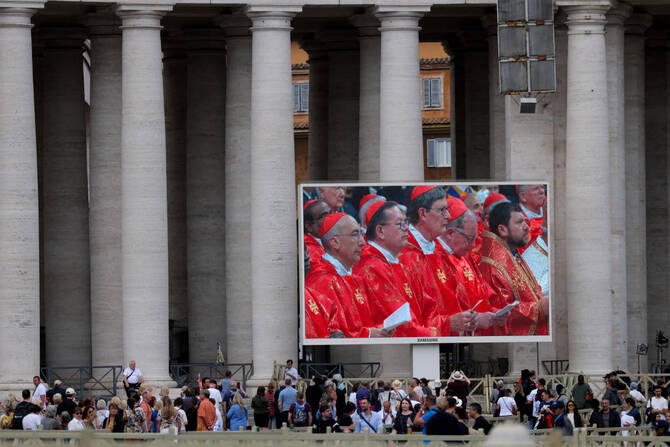
People watch a Holy Mass on a large sceen in Saint Peter's Square in the Vatican on the first day of the conclave to elect the next pope, as seen from Rome, Italy, May 7, 2025. (Reuters)
Short Url
Updated 07 May 2025
Follow

Vatican conclave to pick new pope, world awaits white smoke

  • Cardinals vote in the Sistine Chapel, cut off from world
  • New pope unlikely to emerge before Thursday or Friday
  • Lead cardinal tells peers to set aside personal desires

VATICAN CITY: Roman Catholic cardinals will begin the task on Wednesday of electing a new pope, locking themselves away from the world until they choose the man they hope can unite a diverse but divided global Church.
In a ritual dating back to medieval times, the cardinals will file into the Vatican’s frescoed Sistine Chapel after a public Mass in St. Peter’s Basilica and start their secret conclave for a successor to Pope Francis, who died last month.
No pope has been elected on the first day of a conclave for centuries, so voting could continue for several days before one of the red-hatted princes of the Church receives the necessary two-thirds majority to become the 267th pontiff.
There will be only one ballot on Wednesday. Thereafter, the cardinals can vote as many as four times a day.
They will burn their ballots, with black smoke from a chimney on the roof of the chapel marking an inconclusive vote, while white smoke and the peeling of bells signalling that the 1.4-billion member church has a new leader.
The pope’s influence reaches well beyond the Catholic Church, providing a moral voice and a call to conscience that no other global leader can match.
At a Mass in St. Peter’s Basilica on Wednesday morning before entering the conclave, the cardinals prayed that God would help them find a pope who would exercise “watchful care” over the world.
In a sermon, Italian Cardinal Giovanni Battista Re told his peers they must set aside “every personal consideration” in choosing the new pontiff and keep in mind “only ... the good of the Church and of humanity.”
Re, the dean of the College of Cardinals, is 91 and will not enter the conclave, which is reserved for cardinals under the age of 80.
Cardinals in recent days have offered different assessments of what they are looking for in the next pontiff.
While some have called for continuity with Francis’ vision of greater openness and reform, others have said they want to turn the clock back and embrace old traditions. Many have indicated they want a more predictable, measured pontificate.
A record 133 cardinals from 70 countries will enter the Sistine Chapel, up from 115 from 48 nations in the last conclave in 2013 — growth that reflects Francis’ efforts to extend the reach of the Church to far-flung regions with few Catholics.
No clear favorite has emerged, although Italian Cardinal Pietro Parolin and Filipino Cardinal Luis Antonio Tagle are considered the front-runners.

NO EAVESDROPPING
However, if it quickly becomes obvious that neither can win, votes are likely to shift to other contenders, with the electors possibly coalescing around geography, doctrinal affinity or common languages.
Among other potential candidates are France’s Jean-Marc Aveline, Hungary’s Peter Erdo, American Robert Prevost and Italy’s Pierbattista Pizzaballa.
Re suggested the cardinals should look for a pope who respected the diversity within the Church. “Unity does not mean uniformity, but a firm and profound communion in diversity,” he said in his sermon.
As in medieval times, the cardinals will be banned from communicating with outsiders during the conclave, and the Vatican has taken high-tech measures to ensure secrecy, including jamming devices to prevent any eavesdropping.
The average length of the last 10 conclaves was just over three days and none went on for more than five days. A 2013 conclave lasted just two days.
The cardinals will be looking to wrap things up quickly again this time to avoid giving the impression that they are divided or that the Church is adrift.
Some 80 percent of the cardinals who enter the Sistine Chapel on Wednesday were appointed by Francis, increasing the possibility that his successor will in some way continue his progressive policies despite strong pushback from traditionalists.
Among their considerations will be whether they should seek a pope from the global south where congregations are growing, as they did in 2013 with the Argentinian Francis, hand back the reins to Europe or even pick a first US pope.


Bondi Beach shooting suspect conducted firearms training with his father, Australian police say

Updated 11 sec ago
Follow

Bondi Beach shooting suspect conducted firearms training with his father, Australian police say

MELBOURNE, Australia: A man accused of killing 15 people at Sydney’s Bondi Beach conducted firearms training in an area of New South Wales state outside of Sydney with his father, according to Australian police documents released on Monday.
The documents, made public following Naveed Akram’s video court appearance from a Sydney hospital where he has been treated for an abdominal injury, said the two men recorded footage justifying the meticulously planned attack.
Officers wounded Akram at the scene of the Dec. 14 shooting and killed his father, 50-year-old Sajid Akram.
The state government confirmed Naveed Akram was transferred Monday from a hospital to a prison. Authorities identified neither facility.
The 24-year-old and his father began their attack by throwing four improvised explosive devices toward a crowd celebrating an annual Jewish event at Bondi Beach, but the devices failed to explode, the documents said.
Police described the devices as three aluminum pipe bombs and a tennis ball bomb containing an explosive, gunpowder and steel ball bearings. None detonated, but police described them as “viable” IEDs.
The pair had rented a room in the Sydney suburb of Campsie for three weeks before they left at 2:16 a.m. on the day of the attack. CCTV recorded them carrying what police allege were two shotguns, a rifle, five IEDs and two homemade Daesh group flags wrapped in blankets.
Police also released images of the gunmen shooting from a footbridge, providing them with an elevated vantage point and the protection of waist-high concrete walls.
The largest IED was found after the gunbattle near the footbridge in the trunk of the son’s car, which had been left draped with the flags.
Authorities have charged Akram with 59 offenses, including 15 counts of murder, 40 counts of causing harm with intent to murder in relation to the wounded survivors and one count of committing a terrorist act.
The antisemitic attack at the start of the eight-day Hanukkah celebration was Australia’s worst mass shooting since a lone gunman killed 35 people in Tasmania state in 1996.
The New South Wales government introduced draft laws to Parliament on Monday that Premier Chris Minns said would become the toughest in Australia.
The new restrictions would include making Australian citizenship a condition of qualifying for a firearms license. That would have excluded Sajid Akram, who was an Indian citizen with a permanent resident visa.
Sajid Akram also legally owned six rifles and shotguns. A new legal limit for recreational shooters would be a maximum of four guns.
Police said a video found on Naveed Akram’s phone shows him with his father expressing “their political and religious views and appear to summarise their justification for the Bondi terrorist attack.”
The men are seen in the video “condemning the acts of Zionists” while they also “adhere to a religiously motivated ideology linked to Islamic State,” police said, using another term for the Daesh Group.
Video shot in October shows them “firing shotguns and moving in a tactical manner” on grassland surrounded by trees, police said.
“There is evidence that the Accused and his father meticulously planned this terrorist attack for many months,” police allege.
An impromptu memorial that grew near the Bondi Pavilion after the massacre, as thousands of mourners brought flowers and heartfelt cards, was removed Monday as the beachfront returned to more normal activity. The Sydney Jewish Museum will preserve part of the memorial.
Victims’ funerals continued Monday with French national Dan Elkayam’s service held in the nearby suburb of Woollahra, at the heart of Sydney’s Jewish life. The 27-year-old moved from Paris to Sydney a year ago.
The health department said 12 people wounded in the attack remained in hospitals on Monday.