ISLAMABAD: United Nations (UN) chief Antonio Guterres said on Monday that Pakistan and India must exert “maximum restraint” as the Organization of Islamic Cooperation (OIC) expressed “deep concern” over the deteriorating security environment in South Asia, amid soaring tensions between the two neighbors over an attack in the disputed Kashmir region.
New Delhi has blamed Islamabad for backing the attack that killed 26 tourists in Indian-administered Kashmir’s Pahalgam town on April 22. Islamabad has denied the charge, with both sides announcing tit-for-tat measures.
There have been fears that India may conduct limited strikes close to its border with Pakistan, while the Pakistan military said on Monday that it had conducted a second missile test since the standoff began.
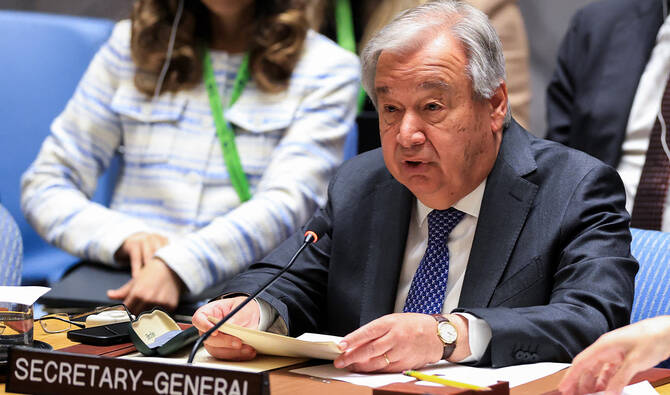
Guterres told reporters in New York that Pakistan-India relations had reached “a boiling point,” condemning the April 22 attack and calling for those responsible to be brought to justice through “credible and lawful means.”
“It is also essential, especially at this critical hour, to avoid a military confrontation that could easily spin out of control,” he said.
“Now is the time for maximum restraint and stepping back from the brink. Make no mistake: a military solution is no solution.”
No group has claimed responsibility for the April 22 attack in Indian-administered Kashmir, where several outfits have waged an insurgency since 1989.
Pakistan has denied any involvement and called for a credible, international probe into it as international pressure continues to pile on both New Delhi and Islamabad to de-escalate.
Separately, the OIC Group in New York, which represents the OIC’s interests and voice at the UN, expressed its “deep concern” over the situation in South Asia, exacerbated by India’s “unfounded allegations” against Pakistan, which it said were “inflaming tensions in an already volatile region.”
“The OIC Group reiterates its principled position against, and condemnation of terrorism in all its forms and manifestations, committed by whomsoever and wherever; and reaffirms its unequivocal rejection of all attempts to associate any country, race, religion, culture or nationality with terrorism,” it said in a statement.
“The Group commends the offer of good offices made by the UN Secretary General and calls upon the international community, including the United Nations Security Council and influential states, to take immediate and credible measures to de-escalate the situation.”
Bitter foes Pakistan and India, which were carved out of the Subcontinent at the bloody end of British rule in 1947, have fought multiple wars, including two over Kashmir.
Indian Prime Minister Narendra Modi has given his military “full operational freedom” to respond to the Pahalgam attack and Islamabad has warned it will hit back in kind against any aggression.
Speaking to reporters, Guterres said he was ready to offer his good offices to both countries to defuse tensions.
“The United Nations stands ready to support any initiative that promotes de-escalation, diplomacy, and a renewed commitment to peace,” he added.


![]()

UN urges ‘maximum restraint’ as OIC group voices concern over India-Pakistan standoff
Short Url
https://arab.news/nj887
UN urges ‘maximum restraint’ as OIC group voices concern over India-Pakistan standoff
- Relations between the nuclear-armed neighbors have plummeted after India accused Pakistan of backing an attack in Kashmir that killed 26 tourists
- Pakistan has denied the allegation and called for a credible, international probe as pressure mounts on both New Delhi and Islamabad to de-escalate
Latest updates


© 2026 SAUDI RESEARCH & PUBLISHING COMPANY, All Rights Reserved And subject to Terms of Use Agreement.