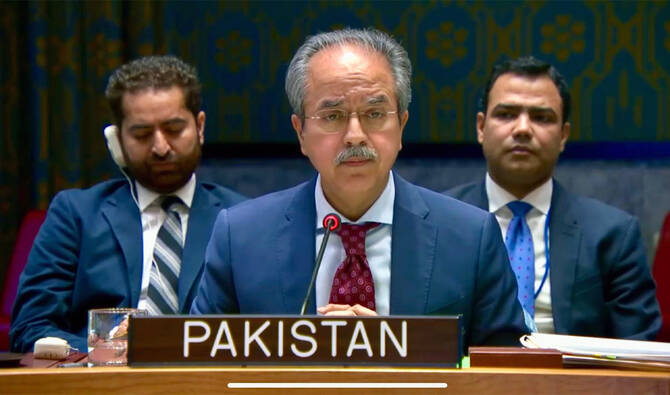
ISLAMABAD: Pakistan’s Deputy Prime Minister and Foreign Minister, Ishaq Dar, has tasked the country’s envoy to the United Nations (UN) to take measures to summon a Security Council meeting for a briefing on heightened tensions with India since an attack in Indian-administered Kashmir, the Pakistani foreign ministry said on Sunday.
Tensions have soared between Pakistan and India to the highest point in recent years after New Delhi blamed the attack, which killed 26 tourists in Pahalgam on April 22, on Islamabad. Pakistan has denied the allegation and called for a credible international investigation.
The nuclear-armed rivals have since expelled each other’s diplomats and citizens, ordered the border shut and closed their airspace to each other. New Delhi has also suspended a crucial water-sharing treaty with Islamabad, amid reports of skirmishes along their de facto border in Kashmir.
The Pakistani foreign ministry said Islamabad has decided to formally brief the UNSC on the current situation in South Asia and Dar has instructed Asim Iftikhar Ahmad, Pakistan’s permanent representative to the UN, to arrange for it.
“Pakistan will inform the UN Security Council about India’s aggressive actions, provocations and inflammatory statements,” the foreign ministry said. “Pakistan will clarify how India’s aggressive actions are jeopardizing peace and security in South Asia and beyond the region.”
Islamabad will specifically highlight at the UNSC meeting India’s suspension of the Indus Waters Treaty, which ensures water for 80 percent of Pakistani farmland, according to its foreign ministry.
India suspended the 1960 World Bank-mediated treaty a day after the Pahalgam attack, saying the suspension would last until “Pakistan credibly and irrevocably abjures its support for cross-border terrorism.” Pakistan has described the suspension of treat as an “act of war.”
Public anger has swelled in India and Prime Minister Narendra Modi has vowed to pursue the attackers “to the ends of the earth.” A Pakistani minister has said that Islamabad has “credible intelligence” that India is planning to attack Pakistan within days.
Pakistani and Indian troops have exchanged fire along their de facto border in Kashmir. The disputed region is split between India and Pakistan and claimed by both in its entirety. The two countries have fought two wars and one limited conflict over the Himalayan territory.
Top Pakistani leaders have reached out to foreign capitals and senior officials in China, United States, United Kingdom, Saudi Arabia, Iran, Egypt and other countries, amid fears that India’s possible actions over the April 22 attack may lead to a wider conflict in the region.
“This important diplomatic move is part of Pakistan’s efforts to present accurate facts to the international community,” the foreign ministry added.


Pakistan decides to brief UN Security Council on recent standoff with India
https://arab.news/mgygq
Pakistan decides to brief UN Security Council on recent standoff with India

- Relations between the nuclear-armed neighbors have plummeted after India accused Pakistan of backing an attack in Kashmir that killed 26 tourists
- Islamabad has rejected the allegation and has reached out to foreign capitals and officials amid fears India may conduct limited strikes against it

Pakistan calls for new global cricket body, says ICC ‘hostage to Indian politics’
- Pakistan’s government has barred its team from playing against India in World Cup fixture on Feb.15
- India generates largest share of cricket’s commercial revenue, enjoying overarching influence in the sport
ISLAMABAD: Pakistan’s Defense Minister Khawaja Asif called for a new global cricket governing body on Tuesday, saying that the International Cricket Council (ICC) has become hostage to Indian political interests amid a fresh row between the neighbors ahead of the T20 World Cup 2026.
Pakistan’s government announced earlier this week that it has cleared its national men’s team to play the upcoming World Cup, scheduled to be held in India and Sri Lanka from Feb. 7. However, Islamabad said the national team will boycott its upcoming fixture against India on Feb. 15 without mentioning a reason. The ICC responded by saying that Pakistan’s decision was “not in the interest of the global game or the welfare of fans worldwide, including millions in Pakistan.”
Pakistan’s dispute with the ICC can be traced back to it expressing displeasure recently at the cricket body’s decision to replace Bangladesh with Scotland for the World Cup. Bangladesh had requested the global governing body shift its matches to any another venue outside India owing to security concerns, as political tensions surge Delhi and Dhaka surge.
“A new international organization of cricket is needed to keep the spirit of the gentleman’s game alive,” Asif wrote on social media platform X. “ICC has become hostage to Indian political interests in South Asia.”
India generates the largest share of cricket’s commercial revenue and hence enjoys overarching influence over the sport. Critics argue that this financial contribution translates into decisive leverage within the ICC.
A large part of that revenue comes from the Indian Premier League (IPL), the sport’s most lucrative T20 cricket competition, which is run by the Board of Control for Cricket in India (BCCI). Between 2024 and 2027, the IPL is projected to earn $1.15 billion, nearly 39 percent of the ICC’s total annual revenue, according to international media reports.
The ICC is headed by Jay Shah, the son of Indian Home Minister Amit Shah. The ICC chair is expected to be independent from any cricket board and hence take impartial decisions.
India and Pakistan engaged in a military confrontation that lasted for four days in May last year before Washington brokered a ceasefire. Militaries of the two countries pounded each other with drones, missiles, fighter jets and exchanged artillery fire in what was the worst fighting between them since 1999.
These bilateral tensions have made their way to cricket, with India refusing to shake hands with Pakistani cricketers during the September 2025 Asia Cup tournament between both sides. The two teams met for three matches, all of which India won, and did not shake hands before or after the fixtures.
The two countries have not played a full bilateral series since 2012–13 due to political tensions. They meet largely at neutral venues.


