

Missile launched from Yemen lands near Israel’s main airport

1 / 2
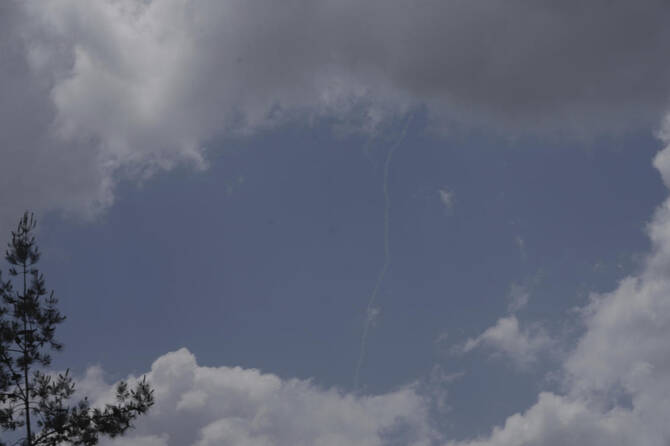
Contrails from the Israeli Iron Dome air defense system fires to intercept projectiles that were launched from Yemen, seen from Highway 1 between Tel Aviv, Israel and Jerusalem, Friday, May 2, 2025. (AP)
2 / 2
Israeli security forces inspect the site where the Israeli military said a projectile fired by Yemen's Houthi rebels landed in the area of Ben Gurion International Airport near Tel Aviv, Israel, on Sunday, May 4, 2025. (AP)
Short Url
Updated 04 May 2025
Follow

Missile launched from Yemen lands near Israel’s main airport

  • Yemen's Houthis claim missile attack on Israel's main airport
  • Sirens were activated in Tel Aviv and other areas in the country

TEL AVIV: A missile landed inside the perimeter of Israel’s main airport on Sunday, wounding six people, halting flights and gouging a wide crater, in an attack claimed by Yemen’s Iran-backed Houthi militants.
The Israeli military said “several attempts were made to intercept” the missile that was launched from Yemen, a rare Houthi attack that penetrated Israel’s air defenses.
A video issued by Israel’s police force showed officers standing on the edge of a deep crater with the control tower visible in the distance behind them. No damage was reported to airport buildings or runways.
The police reported a “missile impact” at Ben Gurion airport, Israel’s main international gateway.
An AFP photographer said the missile hit near the parking lots of Terminal 3, the airport’s largest, with the crater less than a kilometer (0.6 miles) away from the closest tarmac.
“You can see the area just behind us: a crater was formed here, several dozen meters (yards) wide and several dozen meters deep,” central Israel’s police chief, Yair Hezroni, said in the video shared by the force.
It was not immediately clear whether the impact was caused by the Yemeni missile or by an interceptor.
The attack was claimed by Yemen’s Houthis, who say they act in support for Palestinians in war-ravaged Gaza.
“The missile force of the Yemeni armed forces carried out a military operation targeting Ben Gurion airport” with a “hypersonic ballistic missile,” the Houthis said in a statement, referring to their own forces.
Israel’s Magen David Adom emergency service said it had treated at least six people with light to moderate injuries.
An AFP journalist inside the airport at the time of the attack said he heard a “loud bang” at around 9:35 am (0635 GMT), adding the “reverberation was very strong.”
“Security staff immediately asked hundreds of passengers to take shelter, some in bunkers,” the AFP journalist said.
“Many passengers are now waiting for their flights to take off, and others are trying to find alternative flights.”
An incoming Air India flight was diverted to Abu Dhabi, an airport official told AFP.
A passenger said the attack, which came shortly after air raid sirens sounded across parts of the country, caused panic.
“It is crazy to say but since October 7 we are used to this,” said the passenger, who did not want to be named, referring to the 2023 Hamas attack on Israel that sparked the war in Gaza.
“A missile might come at any time and life stops for some time. Today at the airport there was panic and even I was scared, because the blast was big.”

Israel’s airport authority said that “departures and arrivals have resumed” at Ben Gurion, a short while after they had been interrupted due to the missile fire.
The airport “is open and operational,” the aviation authority said in a statement.
Defense Minister Israel Katz threatened a forceful response, saying: “Anyone who hits us, we will hit them seven times stronger.”

The armed wing of Palestinian Islamist group Hamas praised the missile attack on Israel's airport that was claimed by the Houthis.

“Yemen... escalates its attacks on the heart of the illegitimate Zionist entity, surpassing the most advanced defense systems in the world and striking its targets with precision,” Abu Obeida, spokesman for the Ezzedine al-Qassam Brigades, said in a statement. 


Syrian military tells civilians to evacuate contested area east of Aleppo amid rising tensions

Updated 15 January 2026
Follow

Syrian military tells civilians to evacuate contested area east of Aleppo amid rising tensions

  • Syria’s military has announced it will open a “humanitarian corridor” for civilians to evacuate from an area in Aleppo province
  • This follows several days of intense clashes between government forces and the Kurdish-led Syrian Democratic Forces

DAMASCUS: Syria’s military said it would open a corridor Thursday for civilians to evacuate an area of Aleppo province that has seen a military buildup following intense clashes between government and Kurdish-led forces in Aleppo city.
The army’s announcement late Wednesday — which said civilians would be able to evacuate through the “humanitarian corridor” from 9 a.m. to 5 p.m. Thursday — appeared to signal plans for an offensive in the towns of Deir Hafer and Maskana and surrounding areas, about 60 kilometers (40 miles) east of Aleppo city.
The military called on the Kurdish-led Syrian Democratic Forces and other armed groups to withdraw to the other side of the the Euphrates River, to the east of the contested zone.
Syrian government troops have already sent troop reinforcements to the area after accusing the SDF of building up its own forces there, which the SDF denied. There have been limited exchanges of fire between the two sides, and the SDF has said that Turkish drones carried out strikes there.
The government has accused the SDF of launching drone strikes in Aleppo city, including one that hit the Aleppo governorate building on Saturday shortly after two Cabinet ministers and a local official held a news conference there.
The tensions in the Deir Hafer area come after several days of intense clashes last week in Aleppo city that ended with the evacuation of Kurdish fighters and government forces taking control of three contested neighborhoods. The fighting killed at least 23 people, wounded dozens more, and displaced tens of thousands.
The fighting broke out as negotiations have stalled between Damascus and the SDF, which controls large swaths of northeast Syria, over an agreement to integrate their forces and for the central government to take control of institutions including border crossings and oil fields in the northeast.
Some of the factions that make up the new Syrian army, which was formed after the fall of former President Bashar Assad in a rebel offensive in December 2024, were previously Turkiye-backed insurgent groups that have a long history of clashing with Kurdish forces.
The SDF for years has been the main US partner in Syria in fighting against the Daesh group, but Turkiye considers the SDF a terrorist organization because of its association with the Kurdistan Workers’ Party, or PKK, which has waged a long-running insurgency in Turkiye. A peace process is now underway.
Despite the long-running US support for the SDF, the Trump administration has also developed close ties with the government of interim Syrian President Ahmad Al-Sharaa and has pushed the Kurds to implement the integration deal. Washington has so far avoided publicly taking sides in the clashes in Aleppo.
The SDF in a statement warned of “dangerous repercussions on civilians, infrastructure, and vital facilities” in case of a further escalation and said Damascus bears “full responsibility for this escalation and all ensuing humanitarian and security repercussions in the region.”
Adm. Brad Cooper, commander of US Central Command, said in a statement Tuesday that the US is “closely monitoring” the situation and called for “all parties to exercise maximum restraint, avoid actions that could further escalate tensions, and prioritize the protection of civilians and critical infrastructure.” He called on the parties to “return to the negotiating table in good faith.”
Al-Sharaa blasts the SDF
In a televised interview aired Wednesday, Al-Sharaa praised the “courage of the Kurds” and said he would guarantee their rights and wants them to be part of the Syrian army, but he lashed out at the SDF.
He accused the group of not abiding by an agreement reached last year under which their forces were supposed to withdraw from neighborhoods they controlled in Aleppo city and of forcibly preventing civilians from leaving when the army opened a corridor for them to evacuate amid the recent clashes.
Al-Sharaa claimed that the SDF refused attempts by France and the US to mediate a ceasefire and withdrawal of Kurdish forces during the clashes due to an order from the PKK.
The interview was initially intended to air Tuesday on Shams TV, a broadcaster based in Irbil — the seat of northern Iraq’s semi-autonomous Kurdish region — but was canceled for what the station initially said were technical reasons.
Later the station’s manager said that the interview had been spiked out of fear of further inflaming tensions because of the hard line Al-Sharaa took against the SDF.
Syria’s state TV station instead aired clips from the interview on Wednesday. There was no immediate response from the SDF to Al-Sharaa’s comments.