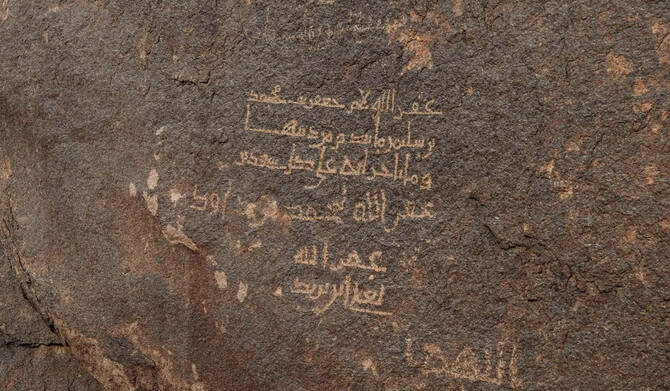

RIYADH: Hidden in the creek of Al-Tharwa Mountain, south of King Fahd Park in the Najran region, lies a living archive that tells the story of early Islamic art.
The mountain’s rocky features abound with prominent archaeological evidence of Islamic calligraphy in its earliest stages.
The rocks preserve rare Islamic inscriptions that serve as a historic record reflecting the ancient past and the richness of the Islamic civilization.
These inscriptions represent the precision and beauty of early Islamic art and calligraphy, revealing a significant transitional phase in the history of Arabic art and scripts.
This transforms Al-Tharwa Mountain into an open-air museum which narrates chapters from the beginnings of Islamic civilization.
Dr. Salem bin Ahmad bin Tairan, professor of Semitic languages, ancient writings, and archaeology at King Saud University, said: “Islamic inscriptions are an important and fundamental source for studying Islamic history and civilization.
“Najran abounds with a large number of such inscriptions dating back to the early Islamic period.
“Through the archaeological survey of inscriptions and ancient writings in the region, more than 200 Kufic Islamic inscriptions have been identified and documented across several sites, most notably Al-Tharwa Mountain in Saqam, south of Wadi Najran, where 33 Islamic inscriptions were found, 26 of which belong to members of a single family.”
Although these inscriptions are undated, the style of the script and the names of the individuals mentioned indicate that they date back to the second and third centuries AH.
Most of these inscriptions contain religious phrases and prayers, expressing belief in death, trust in God, monotheism, and blessings upon the Prophet, along with the signatures of their authors.
Abdullah Al-Suqour, a member of the Najran Tourist Club and a certified tour guide, explained that Al-Tharwa Mountain is considered an important archaeological and tourism landmark because of the historic evidence it contains, confirming the significance of early Islamic inscriptions which are distinguished by their beauty, organization, and precise linguistic structures.
He noted that among these inscriptions are some written by women, who engraved their names on the mountain’s rocks in commemorative and religious phrases — a sign of a civilized period in which education spread to all segments of society.
Al-Suqour added that Al-Tharwa Mountain is a prominent cultural destination which holds a rich cultural heritage of early Islamic inscriptions.
These archaeological treasures adorn the mountain, standing as some of the rarest evidence of the early development of engraving and Islamic calligraphy in the southern Arabian Peninsula.