

India’s new deepwater port announces presence on global maritime map

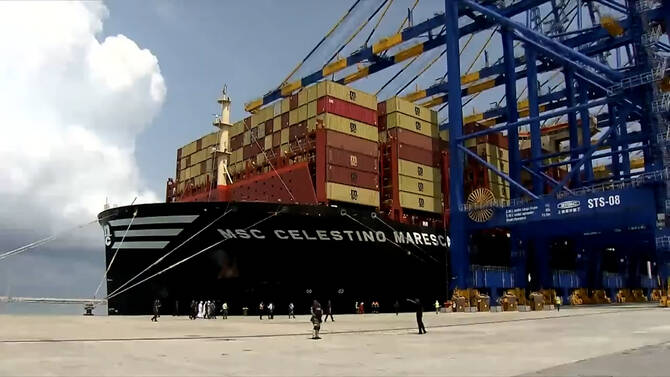
A view of Vizhinjam International Seaport in Kerala, India on May 2, 2025 (PM of India YouTube channel)
Short Url
Updated 02 May 2025
Follow

India’s new deepwater port announces presence on global maritime map

  • Port will triple India’s cargo handling capacity and reduce foreign transshipment dependence
  • Critics say project comes at high environmental and human cost

NEW DELHI: India on Friday registered its presence on the global maritime map with the inauguration of its first deepwater multipurpose seaport at Vizhinjam in the southern Indian state of Kerala.

Prime Minister Narendra Modi commissioned the Vizhinjam port, built at a cost of $1.04 billion under a public-private partnership with business conglomerate the Adani Group and the Kerala government holding the majority stake.

Late last year, the port began limited operations and received MSC Turkiye — one of the world’s largest cargo ships with a capacity of more than 24,000 containers — making it the first port in India to handle a vessel of that size.

The port is to be built in four phases by 2028 at a total cost of 180 billion Indian rupees ($2.11 billion). In full-page advertisements in several national and local dailies a day before the inauguration, the Adani Group — considered close to Modi — said the port is only 10 nautical miles from global shipping routes and will have an annual capacity of up to 5 million TEUs (20ft equivalent units).

TEU is a unit of measurement used to quantify the capacity of container ships and terminals. It represents the volume of a standard 20-foot shipping container and is a common way to express the cargo-carrying capacity of vessels and facilities.

“The existing capacity of this transshipment hub will triple in the coming time,” Modi said in his inaugural address.

“So far 75 per cent of the Indian transshipment used to take place outside the country. This used to cause huge revenue loss to the country.

“Now this situation is going to change.

“Now the money of this country will be utilized for the service of the nation. The money which used to go outside will now bring new economic opportunities for the people of Kerala and Vizhinjam.”

India has 13 major ports and 217 non-major ports, but none of them are deepwater multipurpose transshipment ports, which include terminals where cargo containers are shifted from one vessel to another before reaching their final destination. With India until now lacking infrastructure to handle large vessels, close to 75 percent of its transshipment cargo went through external ports like Colombo, Singapore and Jebel Ali, UAE.

Industry bodies see a big opportunity with the opening of the Vizhinjam port.

“It’s a mother port. One of the kinds in the country. It is a fully automated port, and the port can handle any ship, the biggest in the world. It is hardly 10 nautical miles from the international sea route. It’s very conveniently set. It’s a God-given gift to the country,” S.N. Raghuchandran Nair, president of the Trivandrum Chamber of Commerce and Industry, told Arab News.

“Cargos originating from this place will cut down the time by almost two weeks, it is also going to save $600 to $1,000 per container in view of the handling charges and various things. This is going to be a big saver. You will save 2,000 to 3,000 crore rupees ($2.5 million to $3.5 million) by way of foreign exchange every year once this port opens fully.”

The Vizhinjam port has been controversial from the beginning and faced protests from fishermen and environmentalists over displacement and harm to coastal and marine life.

Kerala journalist K.A. Shaji made a documentary, “Stolen Shorelines,” highlighting the displacement of fishermen and environmental damage.

He questions the need for the port.

“Actually, there is a big port in Colombo and international movements of freight are through Singapore, Dubai and Colombo, there is no need for the big vessels to come to Vizhinjam, which is in a corner of Kerala and it has to take a deviation from the main route,” Shaji told Arab News.

“I feel in the highly competitive world of international freight movement Vizhinjam can do very little, but environmental and socio-economic costs are very high.”

He said thousands of families have been affected by the port, directly and indirectly.

“Directly more than 450 fishermen’s families have been impacted and indirectly over 4,500 families have been impacted as coastal erosion and change of the direction of the waves by the impact of the project destroyed most of the houses and livelihood.”


Beloved teacher in Morocco unmasked: Frenchman investigated over abuse of 89 boys

Updated 4 sec ago
Follow

Beloved teacher in Morocco unmasked: Frenchman investigated over abuse of 89 boys

  • Investigators tie the claims to a digital memoir found on a USB drive
  • Neighbors say he tutored kids, gave money, and organized outings
KHENIFRA: For decades in the Moroccan town of Khenifra, Jacques Leveugle was simply known as the thin Frenchman who swept the streets at dawn, offered free language lessons and organized outings for schoolchildren.
He spoke fluent Arabic and Morocco’s dialect, as well as Shilha, a Berber language widely spoken in the region, skills neighbors said helped him integrate into the community. He rode his bicycle to the local market, dressed simply in jeans and a button-down shirt, and opened a small library for children in the working-class Lassiri neighborhood.
Now the 79-year-old is behind bars and under formal investigation in France, accused of raping and sexually assaulting 89 boys over more than five decades across several countries, a case made public by prosecutors in France last week. They said Leveugle also acknowledged smothering his mother to death when she was in the terminal phase of cancer, and later killing his 92-year-old aunt.
Many of the sexual abuses occurred in North Africa, where Leveugle spent much of his life and built a reputation as a devoted teacher and a respectful man.
The crimes were discovered when a relative of Leveugle’s found his digital memoir on a USB drive and turned it over to authorities.
In Morocco, where he lived until his arrest in 2024, he is suspected of abusing more than a dozen boys, Grenoble Prosecutor Etienne Manteaux told The Associated Press. In neighboring Algeria, where Leveugle worked as a foreign language teacher for eight years in the 1960s and 1970s, he is suspected of abusing at least two children.
The revelations have sent shock waves in both countries, and renewed attention to child exploitation in a region where activists say abuse remains persistent and underreported.
“This case is of exceptional seriousness and naturally provokes deep indignation,” Najat Anwar, president of Moroccan child protection association Don’t Touch my Child, told The AP. “We are prepared to join the case as a civil party … if Moroccan witnesses or victims come forward.”
The AP spoke with a dozen people who directly knew Leveugle, including neighbors in Morocco and former students in Algeria, as well as Moroccan officials briefed on the case. Those who knew him described a man widely viewed as discreet, helpful, and who loved to spend time with kids.
On the narrow streets of Khenifra’s Lassiri neighborhood, home to many conservative Moroccans, the crisp sweetness of a winter morning contrasts sharply with what residents describe as a sense of shame they feel since prosecutor’s revealed Leveugle’s alleged crimes last week.
They feel insulted and humiliated. Many are now considering moving out. They all spoke on condition of anonymity out of fear of harassment or retribution.
They pointed toward Leveugle’s house, an unfinished, unpainted, single-story building surrounded by fig trees, sitting alongside a river. Children play nearby.
Residents said ‘’Monsieur Jacques,” as he was known, funded local projects and helped people find jobs, sometimes even giving out cash. Khenifra has long had one of the highest unemployment rates in the country, and many residents work in the informal sector. People often leave town in search of better prospects.
Residents described how Jacques once took children to a well-known regional lake, Agelmam Agezga, and told them to swim naked, starting by himself and claiming it was healthy. In Moroccan culture, and more broadly in Islamic tradition, men are not permitted to be naked in front of one another.
One neighbor said his ability to trust people is so shaken by the news that he refused to let his 5-year-old son sleep at his brother’s house.
Leveugle was born in the 1940s in the French city of Annecy, and first arrived in Morocco in 1955, according to a Moroccan official with knowledge of the case. Leveugle’s father worked at the French Embassy, and Leveugle attended school in the Moroccan capital during the final years of the French protectorate, the official said.
Leveugle later held Moroccan residency and had no known criminal complaints filed against him in the kingdom, according to a Moroccan justice official. Both officials were not authorized to be publicly named according to Moroccan government rules.
Neighbors said Leveugle moved in the early 2000s to Khenifra, settling in the Lassiri neighborhood. Residents said he frequently spent time with teenage boys between 13 and 15.
He worked as a private tutor and, according to neighbors, offered free lessons, organized school outings and sometimes provided financial assistance to families. Some neighbors said he also bought houses and vehicles for local residents and helped people immigrate to Europe.
His frequent time with teenage boys occasionally prompted questions about his limited interaction with adults.
French investigators identified 89 victims of Leveugle, boys aged 13 to 17, after examining a 15-volume digital memoir found on a USB drive that one of his relatives turned over to police, the Grenoble prosecutor said. He said Leveugle’s victims in Morocco date back to at least 1974.
French authorities suspect there are more victims, and have issued an international appeal for witnesses. The prosecutor told The AP that French investigators are expected to travel to Morocco to gather evidence. Moroccan authorities have not made public comments.
The French prosecutor did not say whether an investigation had been opened in Algeria, where Leveugle taught at three schools. The revelations have left his former students reeling.
“I was stunned when I learned that,” Ali Bouchemla, who studied French under Leveugle in the late 1960s at a school in northern Algeria told The AP. He recalled a “devoted and very good teacher” who never raised suspicion.
Another former student, Lahlou Aliouate, similarly described a dedicated instructor with a professional demeanor.
Child protection advocates say Leveugle’s profile reflects patterns seen worldwide.
“Perpetrators often present themselves through educational or cultural activities, cultivate a respectable image and leverage social or cultural prestige to gain trust,” said Najat Anwar of Don’t Touch my Child. “They then target children in vulnerable emotional or social situations.”