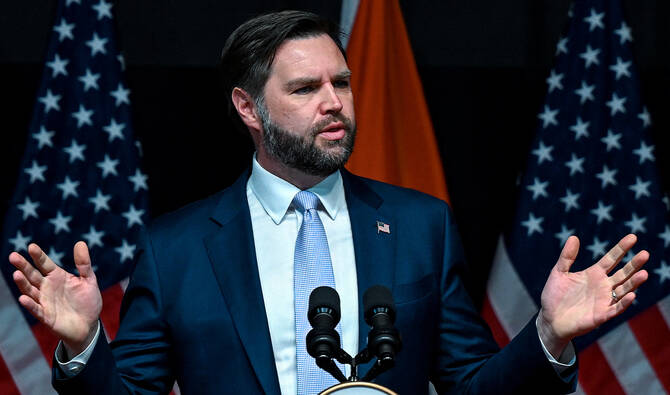
WASHINGTON: US Vice President JD Vance said on Thursday Washington hoped Pakistan would cooperate with India to hunt down Pakistan-based militants, and that India’s response to the recent Islamist militant attack in India-administered Kashmir does not lead to a broader regional conflict.
“Our hope here is that India responds to this terrorist attack in a way that doesn’t lead to a broader regional conflict,” Vance said in an interview on Fox News’ “Special Report with Bret Baier” show.
“And we hope, frankly, that Pakistan, to the extent that they’re responsible, cooperates with India to make sure that the terrorists sometimes operating in their territory are hunted down and dealt with,” Vance added.
Vance’s comments are the closest the US government has come since the April 22 attack — in which 26 people were killed — to potentially linking Pakistan to extremism in India.
Top US leaders, including President Donald Trump, have condemned the attack, calling it “terror” and “unconscionable,” while expressing support for India without directly blaming Pakistan.
India is an important US partner as Washington aims to counter China’s rising influence. Pakistan remains Washington’s ally even as its importance diminished after the 2021 US withdrawal from neighboring Afghanistan.
In recent days, Washington urged India and Pakistan to work with each other to de-escalate tensions and arrive at a “responsible solution.”
India has blamed Pakistan for the attack. Islamabad denies responsibility and is calling for a neutral probe.
The US State Department has said it was in touch with the nuclear-armed Asian neighbors at multiple levels and Secretary of State Marco Rubio held calls on Wednesday with Indian Foreign Minister Subrahmanyam Jaishankar and Pakistani Prime Minister Shehbaz Sharif.
Hindu nationalist Indian Prime Minister Narendra Modi vowed to punish those responsible and Jaishankar has told Rubio that the perpetrators should be brought to justice. Pakistan says military action by India was imminent.
Muslim-majority Kashmir is claimed in full by both Hindu-majority India and Islamic Pakistan, with each controlling only part of it and having fought wars over it.
After the attack, India suspended a treaty regulating water-sharing, and both countries closed airspace to each other’s airlines. They also exchanged fire across their border.


![]()

US vice president hopes Kashmir attack won’t spark wider conflict
Short Url
https://arab.news/cqdms
US vice president hopes Kashmir attack won’t spark wider conflict
- JD Vance says Pakistan should deal with militants that ‘sometimes operate’ in its territory
- US has expressed support for India after the April 22 attack without directly blaming Pakistan
Latest updates





© 2026 SAUDI RESEARCH & PUBLISHING COMPANY, All Rights Reserved And subject to Terms of Use Agreement.