

Pakistan saw ‘sharp’ 22 percent decline in militant attacks in April, says think tank 

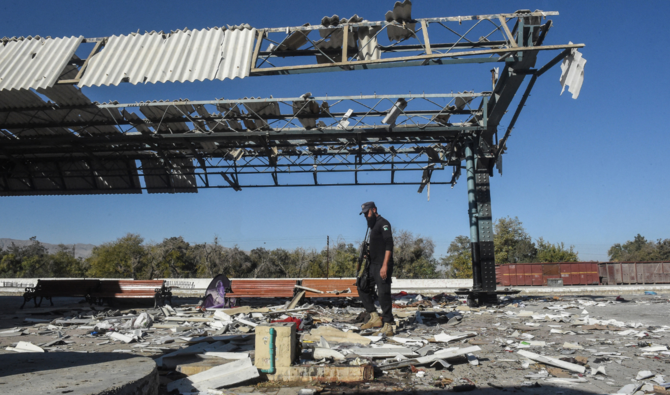
A security personnel inspects the blast site at a railway station, a day after an explosion allegedly by Pakistani separatists in Quetta, in Pakistan's Balochistan province, on November 10, 2024. (AFP/ file)
Short Url
Updated 02 May 2025
Follow

Pakistan saw ‘sharp’ 22 percent decline in militant attacks in April, says think tank 

  • Pakistan’s security forces have been battling twin insurgencies in Khyber Pakhtunkhwa, Balochistan provinces
  • April also marked the lowest monthly death toll among security forces since June 2024, says think tank’s report

KARACHI: Pakistan witnessed a sharp decline in militant attacks during April, an Islamabad-based think tank said in its report this week, saying that they dropped by a whopping 22 percent compared to the previous month, March. 

The Pakistan Institute for Conflict and Security Studies (PICSS), an Islamabad-based think tank, said in its monthly report that both militant attacks and resultant casualties dropped sharply compared to March. 

Pakistan’s security forces have been battling twin insurgencies in its northwestern Khyber Pakhtunkhwa (KP) and southwestern Balochistan provinces. In KP, the Pakistani Taliban frequently carry out some of the deadliest attacks against security forces while in Balochistan, Pakistani troops are battling ethnic Baloch separatists seeking independence from the state.

“The number of militant attacks fell by 22 percent— from 105 in March to 82 in April— while fatalities and injuries declined by 63 percent and 49 percent, respectively,” the PICSS said in its press release on Thursday. 

The report said Pakistani security forces killed 203 militants in various operations throughout the month. Militants formed an overwhelming majority (73 percent) of the total fatalities in April, while only four casualties were reported. Of these, two were civilians and two were security personnel, it added. 

“A total of 287 people were killed in April due to militant violence and security operations, down from 335 in March,” the think tank said. 

The report said April also marked the lowest monthly death toll among security forces since June 2024, noting that civilian deaths also dropped significantly last month. 

“PICSS attributed these improvements to proactive intelligence-led operations and enhanced border vigilance,” it said. 

The report said the most “consequential development” of the month was a two-phase military operation near the Pakistan-Afghanistan border that targeted a large group of infiltrating Pakistani Taliban militants. 

“At least 71 militants were killed— making it the biggest loss suffered by the group in a single operation to date,” the report said. 

The think tank also noted the resurgence of attacks on local peace committee members in tribal districts who have historically resisted militant infiltrations.

“The resurgence of attacks on these volunteers, particularly in the tribal districts, suggests that groups like the TTP [Tehreek-e-Taliban Pakistan] are attempting to reassert dominance by silencing local resistance structures,” it said. 

The report said mainland KP recorded 37 militant attacks in April, marginally down from 42 in March while tribal districts reported 17 attacks last month, slightly down from 18 in March. Balochistan witnessed 21 militant attacks in April, compared to 35 in March while Punjab reported three and Sindh four attacks in April. 

It said Pakistan’s capital Islamabad remained peaceful in April, with no militant attacks reported for the second consecutive month. 


Pakistan imposes three-day curfew in Gilgit, Skardu cities after violent Khamenei protests

Updated 5 sec ago
Follow

Pakistan imposes three-day curfew in Gilgit, Skardu cities after violent Khamenei protests

  • At least 14 people were killed in the region where protesters burned UN offices, police station, school and a local charity
  • Gilgit-Baltistan government spokesman says the situation is under control, police chief urges the residents to stay indoors

ISLAMABAD: Authorities have deployed troops and imposed a three-day curfew in the northern Pakistani cities of Gilgit and Skardu, according to a notification issued Monday, after over a dozen people were killed in clashes over the killing of Iran’s Supreme Leader Ayatollah Ali Khamenei in US-Israeli strikes.

Pakistan’s northern Gilgit-Baltistan (GB) region, where the two cities are located, saw violent clashes on Sunday as protesters set fire to and vandalized several buildings, including United Nations (UN) regional offices, army-run school, software technology park and an Aga Khan Rural Support Programme office.

Clashes with law enforcement agencies caused the deaths of at least 14 people in the region, among them a soldier, GB Caretaker Information Minister Ghulam Abbas confirmed told Arab News. He said around 50 others were injured.

“In wake of prevailing precarious law-and-order situation... it is expected that the situation may deteriorate further in Gilgit-Baltistan, particularly in District Gilgit and Skardu,” Deputy Home Secretary Ghulam Hasan said in a notification on Monday.

“It is therefore requested that Pakistan Army troops may be deployed in District Gilgit and Skardu and curfew may be imposed for an initial period of three days (2nd, 3rd and 4th March) to prevent any untoward incident and danger to human life and property.”

Separately, UN spokesman Stephane Dujarric said on Monday that protesters became violent near the UN Military Observer Group in Pakistan (UNMOGIP) Field Station, which was vandalized.

“The safety and security of UN personnel and premises throughout the region remain our top priority, and we continue to closely monitor the situation,” Dujarric said.

Shabir Mir, a Gilgit-Baltistan government spokesman, said the situation was under control and that the curfew would remain in place until Wednesday as police chief Akbar Nasir Khan urged residents to stay indoors.

Anger has been rising in Pakistan, particularly among members of the Shiite minority, following US and Israeli strikes on Iran that killed Khamenei and other senior officials. While Shiites are a minority nationwide, they form a majority in some northern districts and boast significant numbers in major urban centers.

Demonstrators in Pakistan’s southern port city of Karachi also stormed the US Consulate on Sunday, smashing windows and attempting to burn the building. Police responded with batons, tear gas, and gunfire, leaving 10 people dead and more than 50 injured.

The US embassy and its consulates in Karachi and Lahore canceled visa appointments and American Citizen Services on Monday, citing security concerns. Pakistani authorities have beefed up security at US diplomatic missions across the country, including around the US consulate building in Peshawar, to avoid any further violence.

Also Monday, the Pakistan Stock Exchange plunged, with the benchmark KSE-100 Index falling nearly 10 percent amid rising geopolitical tensions following attacks on Iran. Investors sold off shares across sectors, with analysts citing heightened uncertainty as the main driver behind the sharp decline.

Sunday’s unrest came amid ongoing cross-border fighting between Pakistan and Afghanistan, which began Thursday after Afghanistan launched attacks in retaliation for Pakistani airstrikes the previous Sunday. Pakistan has since carried out repeated operations along the border.

— With additional input from AP.