

Pakistan saw ‘sharp’ 22 percent decline in militant attacks in April, says think tank 

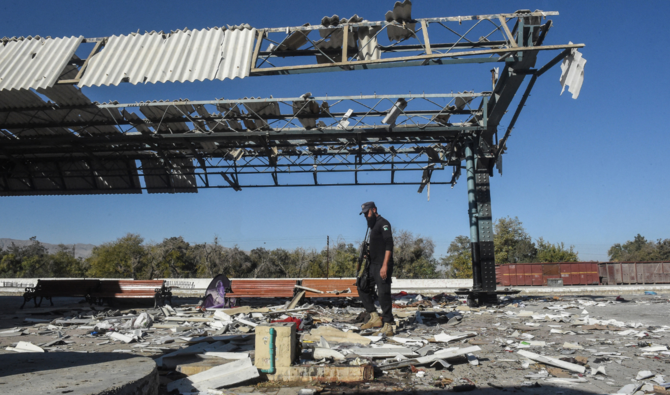
A security personnel inspects the blast site at a railway station, a day after an explosion allegedly by Pakistani separatists in Quetta, in Pakistan's Balochistan province, on November 10, 2024. (AFP/ file)
Short Url
Updated 02 May 2025
Follow

Pakistan saw ‘sharp’ 22 percent decline in militant attacks in April, says think tank 

  • Pakistan’s security forces have been battling twin insurgencies in Khyber Pakhtunkhwa, Balochistan provinces
  • April also marked the lowest monthly death toll among security forces since June 2024, says think tank’s report

KARACHI: Pakistan witnessed a sharp decline in militant attacks during April, an Islamabad-based think tank said in its report this week, saying that they dropped by a whopping 22 percent compared to the previous month, March. 

The Pakistan Institute for Conflict and Security Studies (PICSS), an Islamabad-based think tank, said in its monthly report that both militant attacks and resultant casualties dropped sharply compared to March. 

Pakistan’s security forces have been battling twin insurgencies in its northwestern Khyber Pakhtunkhwa (KP) and southwestern Balochistan provinces. In KP, the Pakistani Taliban frequently carry out some of the deadliest attacks against security forces while in Balochistan, Pakistani troops are battling ethnic Baloch separatists seeking independence from the state.

“The number of militant attacks fell by 22 percent— from 105 in March to 82 in April— while fatalities and injuries declined by 63 percent and 49 percent, respectively,” the PICSS said in its press release on Thursday. 

The report said Pakistani security forces killed 203 militants in various operations throughout the month. Militants formed an overwhelming majority (73 percent) of the total fatalities in April, while only four casualties were reported. Of these, two were civilians and two were security personnel, it added. 

“A total of 287 people were killed in April due to militant violence and security operations, down from 335 in March,” the think tank said. 

The report said April also marked the lowest monthly death toll among security forces since June 2024, noting that civilian deaths also dropped significantly last month. 

“PICSS attributed these improvements to proactive intelligence-led operations and enhanced border vigilance,” it said. 

The report said the most “consequential development” of the month was a two-phase military operation near the Pakistan-Afghanistan border that targeted a large group of infiltrating Pakistani Taliban militants. 

“At least 71 militants were killed— making it the biggest loss suffered by the group in a single operation to date,” the report said. 

The think tank also noted the resurgence of attacks on local peace committee members in tribal districts who have historically resisted militant infiltrations.

“The resurgence of attacks on these volunteers, particularly in the tribal districts, suggests that groups like the TTP [Tehreek-e-Taliban Pakistan] are attempting to reassert dominance by silencing local resistance structures,” it said. 

The report said mainland KP recorded 37 militant attacks in April, marginally down from 42 in March while tribal districts reported 17 attacks last month, slightly down from 18 in March. Balochistan witnessed 21 militant attacks in April, compared to 35 in March while Punjab reported three and Sindh four attacks in April. 

It said Pakistan’s capital Islamabad remained peaceful in April, with no militant attacks reported for the second consecutive month. 


Pakistan offers Turkmenistan its Arabian Sea ports for wider access to ‘South Asia and beyond’

Updated 4 sec ago
Follow

Pakistan offers Turkmenistan its Arabian Sea ports for wider access to ‘South Asia and beyond’

  • PM Sharif meets Turkmen president in Ashgabat, calls for deeper trade and energy cooperation
  • Islamabad cites Karachi and Gwadar as key to boosting regional connectivity, including TAPI links

ISLAMABAD: Pakistan on Thursday urged Turkmenistan to expand trade and connectivity through Karachi and Gwadar, saying its Arabian Sea ports offer Turkmen businesses and exporters a direct route to South Asian and global markets, Prime Minister Shehbaz Sharif’s office said after high-level talks in Ashgabat.

Pakistan and Turkmenistan have long discussed regional transport corridors and energy cooperation, including the Turkmenistan–Afghanistan–Pakistan–India (TAPI) gas pipeline, a proposed multibillion-dollar project that would carry Turkmen natural gas south through Afghanistan into Pakistan and India. Islamabad has also pushed to link the landlocked Central Asian states to the sea by offering transit access through its deep-water ports, which sit at the crossroads of the Middle East, Central Asia and South Asia.

On Thursday, Pakistan's Sharif met Serdar Berdimuhamedov, the president of Turkmenistan, in Ashgabat as both countries look to revive momentum in bilateral engagement after years of regional instability. Pakistan has supported Turkmen neutrality policies at the United Nations, while Ashgabat has backed Pakistan during crises, including helping evacuate Pakistani nationals caught in Iran during the Iran–Israel conflict earlier this year.

“The Prime Minister reaffirmed Pakistan’s desire to enhance connectivity with Turkmenistan through land and sea routes and said that Karachi and Gwadar ports were ideally located to be utilized by the Turkmen side to enhance their outreach to South Asia and beyond,” Sharif’s office said in a statement.

Sharif reiterated his intention to deepen trade and economic ties with Turkmenistan, saying enhanced transport links and energy cooperation could anchor long-term regional integration. He invited President Berdimuhamedow and Turkmenistan’s national leader, Gurbanguly Berdimuhamedow, on official visits to Pakistan next year.

Sharif is on a two-day visit to Turkmenistan for the International Forum on Peace and Trust, accompanied by Deputy Prime Minister and Foreign Minister Ishaq Dar, Energy Minister Awais Leghari, Information Minister Attaullah Tarar and senior officials.

Turkmenistan’s president thanked Sharif for attending the UN-backed peace forum and said Ashgabat was keen to expand cooperation across multiple sectors, according to the statement.