GENEVA: Hundreds of UN staff rallied in Geneva Thursday over deep funding cuts, especially from key donor the United States, which have led to mass-layoffs and threatened life-saving services around the world.
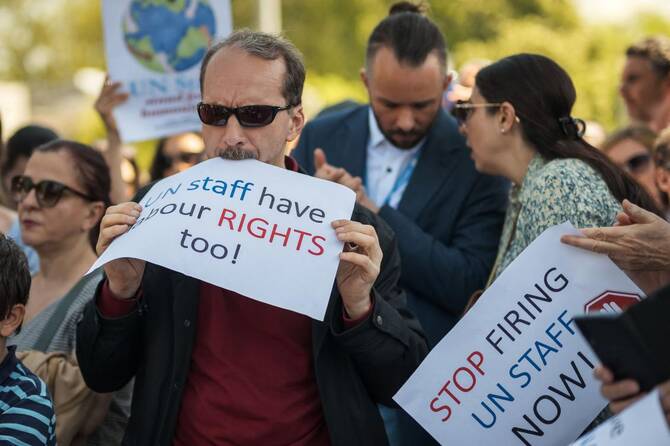
The demonstration, called by UN staff unions and associations, brought together workers from a wide range of Geneva-based agencies, along with their families and supporters under a blazing sun.
Carrying signs reading “UN staff are not a commodity,” “We stand for humanity,” “Stop firing UN staff now” and “Protect the protectors,” protesters poured into the square in front of the United Nations European headquarters.
“We’re supposed to stand for workers’ rights, so this is really tough,” Lena, a staff member at the International Labour Organization, told AFP, refusing to give her last name.
“You just feel helpless,” she said, standing next to her daughter sound asleep in a baby carriage with a sign reading “We stand for better jobs in the world” propped on top.
Humanitarian organizations worldwide have been reeling since US President Donald Trump returned to office in January, pushing an anti-refugee and anti-migrant agenda and immediately freezing most US foreign aid funding.
The United States has traditionally been by far the top donor to a number of agencies, which have been left scrambling to fill sudden and gaping budget gaps.
A number of agencies have already signalled the dire consequences as austerity measures take hold across the UN system.
According to UN staff unions, the UN refugee agency is preparing to cut up to 30 percent of its staff worldwide, while the International Organization for Migration has said it will need to lay off more than 6,000 staff members, or over a third of its workforce.
The World Food Programme is meanwhile preparing to cut between 25 and 30 percent of its global workforce.
Thousands of jobs are also being cut at the UN humanitarian agency OCHA, the World Health Organization and UNAIDS, with many more hanging in the balance, the staff unions said.
They also noted that nearly one in 10 jobs were being eliminated at the ILO, while the UN children’s agency UNICEF is facing a projected 20-percent budget cut.
“So many people are afraid of losing their jobs,” said Elodie Saban, who works at the main UN Geneva office.
“People who work for the UN are often asked to make extreme sacrifices. It is outrageous to see how they are being treated.”
Ian Richards, head of the UN office in Geneva staff union, stressed in a statement that “our colleagues have worked in some of the most dangerous, difficult and isolated locations in the world.”
“They couldn’t choose when or where they moved. They have sacrificed their personal and family lives, and in some cases paid the ultimate price, to help those in need,” he said, decrying that now “many are being let go without any social or financial support from their employers.”
Lena agreed, pointing out that some workers “are here for 20 years, and then it is basically: ‘goodbye’, you’re gone in two months.”
She highlighted that international UN staff are not granted unemployment benefits in the countries they work in, and their residence permits expire within a month of losing their employment.
Even worse, perhaps, would be the impact on operations in the field where the UN’s humanitarian agencies provide life-saving aid to millions of people, while an agency like the ILO battles against things like child labor, Lena said.
“Now, we just have to tell people we have worked with for years, ‘sorry’.”


![]()

‘Not a commodity’: UN staff rally over deep cuts
Short Url
https://arab.news/7j8gc
‘Not a commodity’: UN staff rally over deep cuts
- Carrying signs reading “We stand for humanity” and “Protect the protectors,” protesters poured into the square in front of the UN European headquarters
- “We’re supposed to stand for workers’ rights, so this is really tough,” Lena, an ILO staff member said


Latest updates


© 2026 SAUDI RESEARCH & PUBLISHING COMPANY, All Rights Reserved And subject to Terms of Use Agreement.