

UK in talks with France, Saudi Arabia over Palestinian statehood

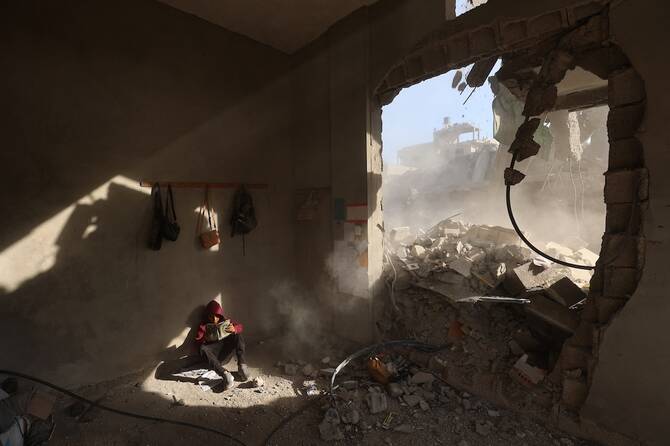
A Palestinian boy holds a book as he sits in rubble of a house, following overnight Israeli strikes. (File/AFP)
Short Url
Updated 01 May 2025
Follow

UK in talks with France, Saudi Arabia over Palestinian statehood

  • Foreign Secretary David Lammy: Discussions taking place ahead of UN conference in June
  • ‘It’s unacceptable for any group of people to have lived with no state for longer than I’ve been alive’

LONDON: The British government is in talks with its French and Saudi counterparts over official recognition of a Palestinian state, UK Foreign Secretary David Lammy has revealed.

Discussions are set to take place at a conference at the UN in June, The Guardian reported.

So far, 160 countries recognize Palestine, including most recently Spain, Norway and Ireland. If a deal can be reached, it would mean adding two permanent UN Security Council members — and key allies of Israel — to that list.

Lammy told the House of Lords International Relations Select Committee that EU countries’ recognition of Palestine had made little to no difference on progress toward statehood, and that the UK wanted something more than to make a symbolic gesture.

“It’s unacceptable for any group of people to have lived with no state for longer than I’ve been alive,” he told the committee.

“No one has a veto on when the UK recognizes that Palestinian state … We’ve always said that recognition isn’t an end in of itself, and we’ll prefer recognition as a part of a process to two states.

“(French) President (Emmanuel) Macron has had a lot to say about that, most recently, alongside the Saudis, and of course we’re in discussion with them at this time.”

Lammy said a viable state could not include Hamas remaining in power in Gaza, and a full demilitarization process of the enclave would need to be undertaken.

He added that the expansion of Israeli settlements in the West Bank is a threat to a two-state solution, and that settler violence against Palestinians is “shocking.”

He also took aim at Israel for its continuing prevention of aid entering Gaza, saying: “The blockade of necessary aid into Gaza is horrendous, the suffering is dire, the need is huge, the loss of life is extreme.”

On April 9, Macron said France would likely recognize a Palestinian state at the June conference, following an official visit to Egypt.

He later said the move, which would be the first such act of recognition by a G7 state, is intended to “trigger a series of other recognitions … including the recognition of Israel by states that do not currently do so.”

Michel Duclos, a special adviser at the Paris-based think tank Institut Montaigne, told The Guardian that the outcome of the June conference “may be nothing more than a roadmap or set of proposals.”

He added: “The dilemma for France may soon become more challenging — can it continue postponing its recognition of Palestine while waiting for a true two-state momentum? Or would further postponement undermine its credibility?”

Saudi Arabia has made clear that normalizing ties with Israel is conditional on a pathway to achieving a two-state solution.


Lebanon PM publishes long-awaited banking law draft

Updated 4 sec ago
Follow

Lebanon PM publishes long-awaited banking law draft

  • The law stipulates that each of the state, the central bank, commercial banks and depositors will share the losses accrued as a result of the financial crisis.
  • Depositors with a limit of $100,000, over the course of four years

BEIRUT: Lebanese Prime Minister Nawaf Salam published on Friday a long-awaited banking draft bill, which distributes losses from the 2019 economic crisis between banks and the state.
The draft law is a key demand from the international community, which has conditioned economic aid to Lebanon on financial reforms.
In a televised speech, Salam said “this draft law constitutes a roadmap to getting out of the crisis” that still grips Lebanon.
The draft will be discussed by the Lebanese cabinet on Monday before being sent to parliament, where it could be blocked.
The law stipulates that each of the state, the central bank, commercial banks and depositors will share the losses accrued as a result of the financial crisis.
Depositors, who lost access to their funds after the crisis, will be able to retrieve their money, with a limit of $100,000, over the course of four years.
Salam said that 85 percent of depositors had less than $100,000 in their accounts.
The wealthiest depositors will see the remainder of their money compensated by asset-backed securities.
“I know that many of you are listening today with hearts full of anger, anger at a state that abandoned you,” Salam said.
“This bill may not be perfect... but it is a realistic and fair step toward restoring rights, halting the collapse.”

- ‘Banks are angry’ -

The International Monetary Fund, which closely monitored the drafting of the bill, had previously insisted on the need to “restore the viability of the banking sector consistent with international standards” and protect small depositors.
The Associations of Banks in Lebanon criticized the draft law on Monday, saying in a statement that it contains “serious shortcomings” and harms commercial banks.
“Banks are angry because the law opens the door to them sharing any part of the losses,” said Sami Zougheib, researcher at The Policy Initiative, a Beirut-based think tank.
He told AFP that banks would have preferred that the state bear full responsibility.
The text provides for the recapitalization of failing banks, while the government’s debt to the Central Bank will be converted into bonds.
Salam said that the bill aims to “revive the banking sector” which had collapsed, giving free rein to a parallel economy based on cash transactions, which facilitate money laundering and illicit trade.
According to government estimates, the losses resulting from the financial crisis amounted to about $70 billion, a figure that is expected to have increased over the six years that the crisis was left unaddressed.
Since assuming power, Salam and President Joseph Aoun have pledged to implement the necessary reforms and legislation.
In April, Lebanon’s parliament adopted a bank restructuring law, as the previous legislation was believed to have allowed a flight of capital at the outbreak of the 2019 crisis.
The new bill stipulates that politically exposed persons and major shareholders who transferred significant capital outside the country from 2019 onwards — while ordinary depositors were deprived of their savings — must return them within three months or face fines.
The draft law could still be blocked by parliament even if the cabinet approves it.
“Many lawmakers are directly exposed as large depositors or bank shareholders, politically allied with bank owners, and unwilling to pass a law that either angers banks or angers depositors,” Zougheib said.
Politicians and banking officials have repeatedly obstructed the reforms required by the international community for Lebanon to receive financial support.