


ISLAMABAD: The first batch of Pakistani Hajj pilgrims who arrived in Madinah under the Kingdom’s Makkah Route Initiative on Wednesday praised its “remarkably smooth” immigration process, thanking the Saudi government for the facility.
The Makkah Route Initiative is designed to streamline immigration processes by enabling pilgrims to complete official travel formalities at their departure airports. Initially tested in Islamabad in 2019, the program was later expanded to Karachi, benefitting tens of thousands of Pakistani travelers. This saves pilgrims several hours upon arrival in the Kingdom, as they can simply enter the country without having to go through immigration again.
Pakistan kicked off its pre-Hajj flight operations on Tuesday, with the first batch of 900 Pakistani pilgrims arriving in Madinah from Islamabad, Karachi and other cities. Those who arrived from Karachi and Islamabad praised the Makkah Route Initiative for making their travel hassle-free.
“It was remarkably smooth as the Saudi immigration process was completed at Islamabad Airport without the need to wait in long queues,” Tariq Khan, a resident of Pakistan’s northwestern Swabi city, told Arab News over the phone from Madinah.
Around 50,500 Pakistani pilgrims in total from Islamabad and Karachi will travel to Saudi Arabia under the Makkah Route Initiative this year.
Khan, who is performing Hajj for the second time since 2016, said the pre-departure immigration process had saved pilgrims’ considerable time.
“The difference was [like] night and day,” Khan, comparing his Hajj journey in 2016 to the present one.
“This time, the process was efficient and stress-free, allowing us to focus on the spiritual aspects of our journey.”

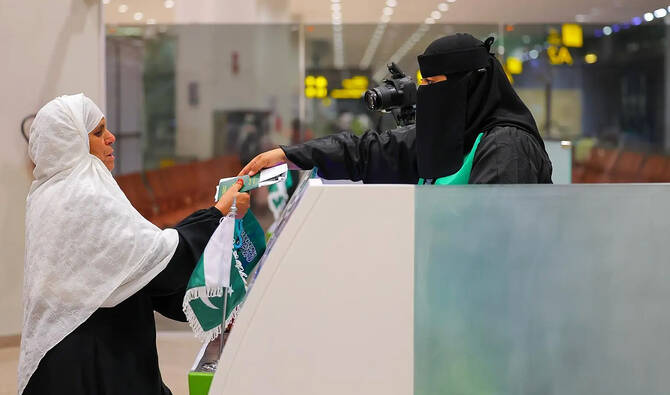
A member of the Saudi immigration team welcomes a Pakistani Hajj pilgrim in the departure lounge at Islamabad International Airport in Islamabad, Pakistan, on April 29, 2025. (SPA)
Upon landing, Khan said pilgrims bypassed the usual immigration queues while buses were waiting to transport them directly to the hotel.
“Our luggage, which had been tagged and processed in Islamabad, arrived at the hotel shortly after we did,” he noted.
Shamim Akhtar, who arrived from Karachi, described the immigration process as “exceptionally well-organized.”
“Dedicated immigration counters at Karachi Airport handled all formalities efficiently and the staff was courteous,” she told Arab News.
“And the entire process was completed swiftly, allowing us to reach the boarding lounge without hassle.”
She thanked the Saudi government for extending the service to Karachi, saying the Makkah Route Initiative significantly reduced the stress and time associated with international traveling during Hajj.
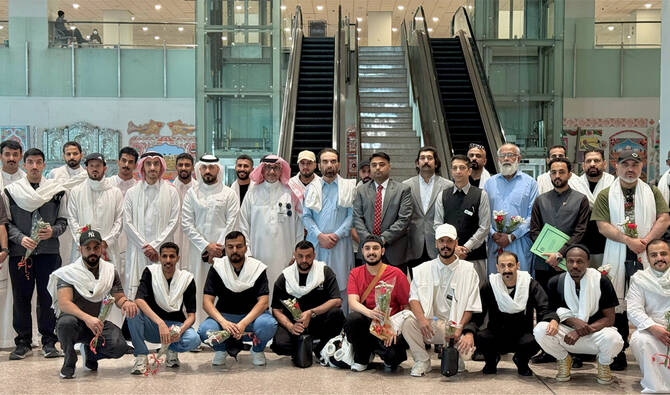
Officials from Pakistan’s Ministry of Religious Affairs pose for a group photo with the 45-member Saudi immigration team of the Makkah Route initiative in Islamabad, Pakistan, on April 27, 2025. (Photo courtesy: Handout/CAA)
“It’s a commendable effort that enhances the overall pilgrimage experience,” she said.
‘EXCELLENT ARRANGEMENTS’
Osama Anwar, an information technology professional from Pakistan’s eastern city of Rawalpindi, praised the entire Hajj process from submitting the application to the mandatory trainings organized by the government, and the “smooth” travel facilitated under the Makkah Route Initiative.
“Under the Route to Makkah, arrangements were very good and it was a very smooth process at the airport,” he said.
“It hardly took us just 20 to 25 minutes to reach the hotel from the airport in Saudi Arabia.”
He said pilgrims had been guided thoroughly about the process.
“Now that we have arrived in Madinah, we found that excellent arrangements have also been made here including good rooms and food arrangements,” Anwar said.
This year’s annual pilgrimage will take place in June, with nearly 89,000 Pakistanis expected to travel to Saudi Arabia under the government scheme and over 23,620 Pakistanis expected to perform Hajj through private tour operators.


