
LONDON: On Aug. 4, 2020, the biggest non-nuclear explosion ever recorded tore through Lebanon’s Port of Beirut, devastating entire neighborhoods and leaving hundreds dead or wounded. Almost five years on, no one has been held to account for the blast.
In a rare breakthrough in the long-stalled inquiry into the explosion, presiding judge Tarek Bitar was recently able to question two former security chiefs — including one who was appearing in court for the first time since his 2020 summons.
This development on April 11 signaled a renewed momentum after years of obstruction and political interference, brought about in part by the election of a new technocratic government and the weakening of the Iran-backed Hezbollah militia.

An aerial view shows the massive damage done to Beirut port's grain silos (C) and the area around it on August 5, 2020, one day after a mega-blast tore through the harbor in the heart of the Lebanese capital with the force of an earthquake. (AFP)
According to four judicial and two security officials who spoke to The Associated Press on condition of anonymity, Bitar questioned Maj. Gen. Abbas Ibrahim, head of the General Security Directorate from 2011 to 2023, and former State Security chief Maj. Gen. Tony Saliba.
The momentum continued the following week when Bitar summoned former Interior Minister Nohad Machnouk. Days later, he interrogated former Prime Minister Hassan Diab for more than two hours and remanded him for further questioning.
Lebanon’s judiciary has long been plagued by interference and a political culture resistant to accountability, particularly when powerful groups such as Hezbollah are involved.

Wounded men are evacuated following of an explosion at the port of the Lebanese capital Beirut, on August 4, 2020. (AFP/File)
Observers say the blast, which killed more than 218 people, remains a painful emblem of Lebanon’s systemic dysfunction.
Fadi Nicholas Nassar, senior fellow at the Middle East Institute, described the Beirut port blast as “a reflection of everything that pushed Lebanon to the brink: militia control, a political class beholden to Hezbollah, a weakened judiciary, and corruption at every level — all made worse by the obstruction of justice.”
“How Lebanon handles the investigation now will be the defining moment: a turn toward accountability, or a confirmation that impunity still rules,” he told Arab News.
The investigation into the Beirut port blast ground to a halt in late 2021 after Hezbollah’s then-leader, Hassan Nasrallah, accused Bitar of political bias and called for his replacement.

In this photo taken on October 14, 2021, a supporter of Hezbollah and the Amal movements carries a portrait of Judge Tarek Bitar, the Beirut blast lead investigator, near the Justice Palace in Beirut during a gathering to demand his dismissal. (AFP)
“The targeting is clear, you are picking certain officials and certain people,” Nasrallah said at the time. “The bias is clear,” he added, demanding that Bitar be replaced with a “transparent” judge.
This public condemnation marked a turning point in what many viewed as a calculated effort to derail the investigation and shield powerful figures from prosecution.
The list of those questioned includes former prime ministers, cabinet ministers, security chiefs, and customs and port authorities — many of whom reportedly have ties to Hezbollah and its allies, including the Amal Movement.
Diab himself was nominated to lead the government in 2019 by Hezbollah and its allies.

A demonstrator poses next to a sign of "wanted posters" showing the faces of government officials including Prime Minister Hassan Diab as protesters head towards the port of Lebanon's capital on August 4, 2021, on the first anniversary of the blast that ravaged the port and the city. (AFP/File)
Yet the specific charges against these figures remain undisclosed, underscoring the secrecy that has surrounded the investigation since it began.
Critics say the attack on Bitar was part of a broader campaign to undermine the probe.
FAST FACTS
• The Beirut port blast had a force equivalent to 1,000-1,500 tons of TNT, or 1.1 kilotons.
• It registered as a 3.3-magnitude earthquake, with shockwaves disrupting the ionosphere.
• Felt over 200 kilometers away in Cyprus, causing damage to buildings up to 10km from the port.
Makram Rabah, an assistant professor at the American University of Beirut, says Hezbollah and its allies “have tried to implode it through using red tape, through trying to rig and play the system.”
In recent months, however, shifting political dynamics may have reopened the path to justice. Hezbollah’s influence has waned since its 2023-24 conflict with Israel, while the appointment of President Joseph Aoun and Prime Minister Nawaf Salam has fueled hopes for progress.

Lebanon's President Joseph Aoun (C) attend a meeting with Prime Minister Nawaf Salam (seated 2nd L), at the Baabda presidential palace, east of Beirut, on February 11, 2025. (AFP/File)
“The new government will definitely empower Tarek Bitar to pursue justice,” Rabah told Arab News, adding that his optimism stems not from the government’s technocratic makeup, “but because it’s a normal functioning government.”
Mohammed Chebaro, a London-based political analyst and researcher, echoed Rabah’s optimism. “Since the defeat of Hezbollah in the latest war — and what I would describe as a regime change — we’ve seen a series of developments that have been broadly welcomed by most Lebanese, and by any sovereign nation,” he told Arab News.
Hezbollah suffered a major blow during its war with Israel, which resulted in the killing of Nasrallah and other top officials, the destruction of much of its military hardware, and the draining of its finances.
Forced to accept a ceasefire deal brokered by the US, the group has since ceded most of its positions south of the Litani River to the Lebanese army, leaving its future uncertain.

Lebanon’s Prime Minister Nawaf Salam, surrounded by Lebanese army soldiers, checks a map as he visits the southern village of Khiam near the border with Israel, on February 28, 2025. (AFP)
Chebaro said the election of Aoun as president in January and the appointment of Salam as prime minister signaled a shift.
“Both leaders appear to be free from foreign influence, whether Syrian or Iranian,” he said, adding that the weakening of Hezbollah’s grip on the country has “automatically paved the way for many initiatives to be relaunched.”
With political space opening, Chebaro believes Bitar now has the latitude to act. “At the moment, Judge Bitar has a free hand — and he will likely continue to have one. The real question is whether the investigation can extend to apprehending and questioning figures with political protection.”
He cited Machnouk as an example. “He’s part of the (Third) Independence Movement, and individuals from this group have generally acted within the law and have been willing to cooperate. Even if they were implicated, they wouldn’t resist presenting themselves for questioning.”
But “the real test,” Chebaro added, “lies with members of the military establishment who served under the Hezbollah-aligned governments of Diab and Najib Mikati.”
“A turning point would be seeing those military officials stand before Bitar — especially if they are backed by political patrons in what’s known as the Shiite Duo alliance of Hezbollah and Amal,” he said. “These are the same individuals who previously rejected the investigation and even accused Judge Bitar of treason for summoning them.”

Security forces push back relatives of victims of the 2020 Beirut port explosion trying to push their way into the palace of justice in Beirut on January 26, 2023, after he was charged by the country's top prosecutor in the highly political case. (AFP/File)
That puts the new government in a delicate position. “How far are they willing to go?” Chebaro asked. “This is sensitive terrain. Will they pursue full justice, even at the risk of destabilizing the political system, or move more cautiously while rebuilding rule of law?”
Chebaro believes Salam’s government has little choice but to act. “A crime as devastating as the Beirut port explosion would inevitably be a priority for a government seeking to reassert sovereignty and demonstrate to the world that Lebanon has an independent judiciary capable of uncovering the truth.”
The Beirut port blast occurred when a fire ignited 2,750 tonnes of ammonium nitrate that had been improperly stored in a warehouse since 2014.
The resulting explosion, widely blamed on years of government negligence and corruption, killed at least 218 people, injured more than 7,000, displaced some 300,000, and caused property damage estimated at over $15 billion.

In the face of a stalled investigation, the families of victims and rights groups began pushing for international intervention.
They “called for a UN-backed, independent factfinding mission that would determine the truth and clearly delineate responsibility for the disaster,” said Nassar of the Middle East Institute.
Lebanon’s new leadership now has an opportunity to reset the course “by backing the call for a UN-backed factfinding mission, ensuring the local investigation moves forward free from obstruction, and letting the truth bring justice to the victims of the Beirut blast,” he added.
In July 2024, a coalition of Lebanese and international groups, survivors, and victims’ families urged members of the UN Human Rights Council to support a resolution establishing an independent factfinding mission into rights violations tied to the explosion.
The call reflected a broader crisis of accountability in Lebanon, where major crimes have routinely gone unpunished.

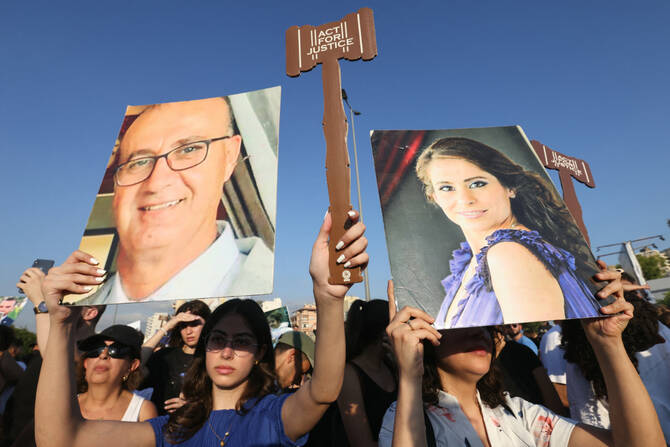
Protesters lift portraits of relatives they lost in the Beirut port blast during a march on the fourth anniversary of the devastating explosion near the capital city's harbour on August 4, 2024. (AFP/File)
Lebanon has a long history of political assassinations and violence — including the 2005 killing of former Prime Minister Rafic Hariri and the 2012 murder of intelligence chief Wissam Al-Hassan — that have largely evaded accountability.
Investigations have repeatedly been derailed by political interference and a judiciary weakened by corruption and partisan control. However, Nassar pointed to the Special Tribunal for Lebanon as a rare exception.
“The STL was the rare moment when truth broke through Lebanon’s entrenched obstruction and violence, even in the face of the assassination of Wissam Eid, a Lebanese intelligence officer who gave his life to expose the truth,” he said.
However, “since then, international diplomacy has consistently prioritized short-term stability over accountability.
“The STL’s findings, which confirm Hezbollah’s responsibility in Rafic Hariri’s assassination, remain an enduring truth. As Lebanon now faces the probe into the Beirut blast, it has a chance to break from its past.

With the Hezbollah militia's armed might reduced to ruins in its war with Israel, there may be hope that the quest for justice for victims of the Beirut port blast would finally prosper. (AFP/File)
“Only by committing to truth and accountability can Lebanon begin to undo the forces that have held it hostage for so long.”
Echoing that concern, Middle East expert Chebaro warned that while hope for justice in the Beirut port case remains, the reality is far more complicated. “Many in Lebanon already have a clear idea of who controls the state,” he said. “As much as I hope impunity won’t prevail, the outcome remains uncertain.”
Chebaro said that while those responsible for the storage of the explosive material could, in theory, be identified and prosecuted, the greater challenge lies in whether Lebanon’s political elite is willing to face the consequences.
“Balancing the pursuit of justice with the stability of the current regime — and the future of Lebanon — will ultimately determine how deep this investigation is allowed to go,” he said.

Activists and relatives of victims of the August 4, 2020 Beirut port explosion hold posters of then Hezbollah leader Hassan Nasrallah (R) and Wafiq Safa, a top Hezbollah security official, with a slogan in Arabic that reads: "He knew," during a sit-in outside the Justice Palace, a government building affiliated with the judiciary, in the Lebanese capital on January 17, 2022. (AFP)
Still, he noted that the resumption of the probe is a positive sign. “The fact that things are moving again is, at least, encouraging,” Chebaro said.
That cautious optimism is shared by Rabah of the American University of Beirut. While skeptical that Bitar can uncover the full truth on his own, Rabah said the investigation is a step in the right direction.
“I don’t believe that Tarek Bitar on his own will be able to actually know what really happened, because the way he’s going about it is only exploring the technical aspect,” he said.
“But in all cases, we do have reason to be optimistic, be it in the investigation of Tarek Bitar or any other one.”