

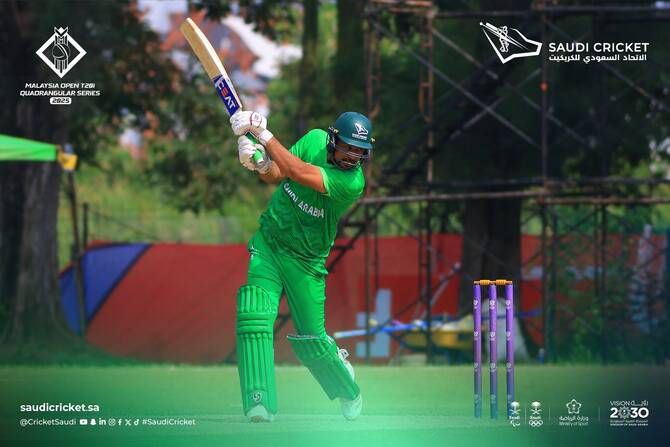
Saudi Arabia beat hosts by 7 wickets to top table at Malaysia Quadrangular

Saudi Arabia will face Malaysia in the final of the Malaysia Quadrangular in Kuala Lumpur on Friday after beating the hosts by seven wickets. (@cricketsaudi)
Short Url
Updated 30 April 2025
Follow

Saudi Arabia beat hosts by 7 wickets to top table at Malaysia Quadrangular

  • Final on Friday is against Malaysia, who finished second in the standings

KUALA LUMPUR: Saudi Arabia will face Malaysia in the final of the Malaysia Quadrangular in Kuala Lumpur on Friday, May 2, after beating the hosts by seven wickets.

Openers Faisal Khan and Abdul Waheed set up the victory in posting an opening stand of 100 in just nine overs.

Earlier in the week Saudi Arabia had repeated their victories over Thailand and Singapore in the second round of the tournament to set up a match against Malaysia that would decide first and second in the league table.

Saudi Arabia had recovered from 90 for four against Thailand thanks to a partnership of 80 in 5.2 overs from Waji Ul-Hassan and Manan Ali. Ul-Hassan then became the third Saudi Arabian to take five wickets in T20I cricket with five for nine as the Kingdom won by 39 runs.

Against Singapore, three wickets apiece for Ishtiaq Ahmed and Zain Ul-Abidin, restricted the opponents to 112 for seven. Although Khan suffered his second duck in two matches, Waheed made 42 from 28 deliveries, with Saudi Arabia winning by seven wickets inside 15 overs.

The Saudi team had won four matches out of five to stand on eight points, just one point behind Malaysia, who had a no-result against Singapore because of rain.

Hence, the winner of the second encounter between the two teams would determine the group winner. Malaysia had chased down Saudi Arabia’s score in their previous match, so the Saudis chose to bowl first.

Virandeep Singh had carried Malaysia to victory with four wickets and a brilliant unbeaten 93 in the previous match, so it was an important breakthrough when Ul-Hassan dismissed him, caught behind for 21 from 21 balls.

Syed Aziz reached his 50 from 38 balls on the way to 67 from 49 balls but Malaysia only made 160 for six, despite Sharvin Muniady hitting the last two balls of the innings for six.

Saudi Arabia’s opening partnership was likely to be key as Khan and Waheed had often provided an exciting launch pad for the innings.

Khan played out two dot balls and then was away with a six over mid-wicket, racing to 30 from 12 balls out of the 50-run partnership in 3.3 overs. He made 50 inside the first six overs, needing only 20 balls to reach the landmark, hitting six sixes and three fours.

Saudi Arabia’s score stood on 80 for no wicket after six overs. Then Singh was introduced in the attack and the field spread out, allowing singles to be easily taken as the openers changed gear. Khan did hit another six before 100 was posted in just nine overs.

He was dismissed for 66 from 32 balls and his partnership with Waheed was exactly 100 in 9.1 overs when he was caught by Singh, off the bowling of Pavandeep Singh. In the tournament he maintained a strike rate close to 200 and hit a total of 14 sixes.

Pavandeep claimed a second wicket, but the required rate was down to five runs an over. Waheed completed his 50 from 39 balls with five fours and had played a fine supporting role to the explosive Khan.

He was third out with 27 runs needed, captain Ul-Hassan guiding his side to victory with an unbeaten 22 from 18 balls, and Saudi Arabia winning by seven wickets with 2.1 overs to spare.

The two sides will meet again in the final on May 2, while Singapore will play Thailand in the third-place playoff.


From Jeddah to the world stage: Bader Idrees and Saudi Arabia’s tennis rise

Updated 25 December 2025
Follow

From Jeddah to the world stage: Bader Idrees and Saudi Arabia’s tennis rise

RIYADH: As tennis continues to gain momentum throughout Saudi Arabia, several local players are beginning to emerge on the national and international scene. One of them is Saudi national team player Bader Idrees, whose journey mirrors the Kingdom’s evolving relationship with the sport.

Idrees’ first exposure to tennis came at a time when the local game was still developing. His interest began in early 2010 after watching his older sister train regularly.

“I was five years old when I used to watch my older sister playing tennis every day,” he told Arab News. “One of her coaches recommended that I try it out, and from the first hit, I fell in love with the sport.”

Now 20 years old, Idrees finds himself progressing alongside a country that is investing heavily in tennis. Over the past three months alone, Saudi Arabia has hosted the Six Kings Slam, the WTA Finals, and the Next Gen ATP Finals, an indication of its growing ambitions on the global tennis stage.

A defining moment in Idrees’ development came at the 2025 WTA Finals, where he reached a personal milestone in his role as a hitting partner for some of the world’s best players.

“It was one of the best experiences I’ve had so far,” he said. “To actually see the players and train with them was an eye-opening experience for me.”

The exposure offered by hosting elite tournaments has had a direct impact on aspiring Saudi athletes, providing valuable insight into the professional game.

“Seeing how players prepare for matches — from how they behave off the court to actually practicing on the court — was an amazing experience,” he said.

Beyond individual growth, Idrees believes the broader sporting ecosystem benefits from welcoming international events to the Kingdom.

“Hosting these events motivates every Saudi athlete,” Idrees said. “Foreign players get to know the country and the players who represent it, and it pushes us to perform better knowing that the world is watching.”

That motivation has translated into concrete goals. Idrees is planning a busy start to the year, with four international tournaments scheduled for January.

“I feel very positive about what I’ve accomplished so far, so hopefully I can kick off with a strong start in 2026.”

Despite recent progress, Idrees credits his early development at home as the foundation of his success.

“I don’t think I would be at this level if I weren’t in Saudi Arabia, and if I didn’t meet my coach Wajih there, who played a big role in my journey,” Idrees said.

To further advance his career, he later relocated to Cairo, where increased competition and exposure helped accelerate his development.

“That experience, combined with my coach’s motivation, made me believe I could truly go pro,” he said.

The journey was not without challenges. Idrees reflected on the limitations that once existed in the local tennis landscape.

“Tennis has grown massively in Saudi Arabia over the last few years,” he said. “But before that, we didn’t always have the best facilities or infrastructure. That’s why seeing the progress now makes me happy.”

Today, that transformation is happening at a rapid pace — something Idrees notices each time he returns home from international competition.

“Month by month,” as he puts it.

Whether in Riyadh, Jeddah, or Dammam, the changes are increasingly visible. Looking ahead, Idrees is optimistic about the next generation of Saudi players.

“I wouldn’t be surprised to see the kids playing at the under-10 and under-12 level find themselves in the top 500 or 300 within the next 10 years,” he said. “I see the discipline and motivation in them, and it truly is something special.”

He is also realistic about his own development compared with today’s young talents.

“I wasn’t at this level at 10, 12 years old,” he admitted. “Training with kids at that age now, I’m genuinely impressed. It’s why I’m feeling very positive about their future.”

With growing infrastructure, elite-level exposure, and rising ambition, Idrees’ story represents more than personal achievement. It highlights how Saudi Arabia’s expanding role as a host of global sporting events is reshaping its tennis landscape — and how a new generation of players may be poised to make an impact on the world stage in the years ahead.