ATTARI, India: Dozens of Pakistani nationals living in India headed to the main land crossing between India and Pakistan on Wednesday, following New Delhi’s decision to order almost all Pakistani citizens to leave the country after last week’s deadly attack in Indian-controlled Kashmir.
The deadline for Pakistani citizens to leave the country — with exceptions for those who are on medical visas in India — passed on Sunday, but many families were still scrambling to the Indian side of the border in Attari town in northern Punjab state to cross into Pakistan.
Some were arriving on their own and others were being deported by police.
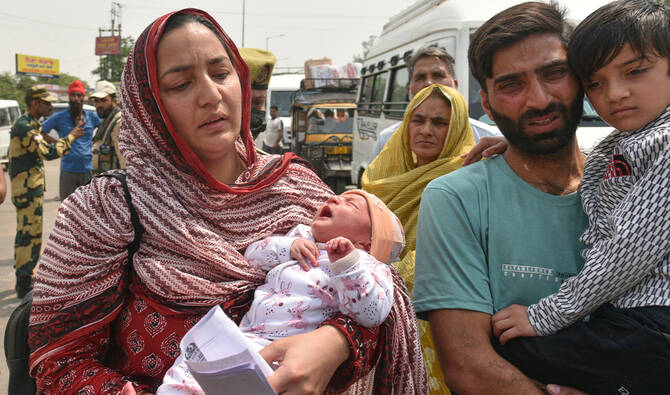
“We have settled our families here. We request the government not to uproot our families,” said Sara Khan, a Pakistani national who was ordered back to Pakistan without her husband, Aurangzeb Khan, who holds an Indian passport.
Waiting on the Indian side of the border crossing, Khan carried her 14-day-old child in her arms. She said Indian authorities did not give her any time to recuperate from a caesarean section and that her long-term visa was valid until July 2026.
“They (authorities) told me you are illegal and you should go,” said Khan, who has been living in Indian-controlled Kashmir since 2017. “They gave us no time. I could not even change my shoes.”
Tensions between rivals India and Pakistan have escalated after gunmen killed 26 people, most of them Indian tourists, near the resort town of Pahalgam in disputed Kashmir.
At least three tourists who survived the massacre told The Associated Press that the gunmen singled out Hindu men and shot them from close range. The dead included a Nepalese citizen and a local Muslim pony ride operator.
India has described the massacre as a “terror attack” and accused Pakistan of backing it. Pakistan has denied any connection to the attack, which was claimed by a previously unknown militant group calling itself the Kashmir Resistance.
The massacre set off tit-for-tat diplomatic measures between India and Pakistan that included cancelation of visas and a recall of diplomats. New Delhi also suspended a crucial water-sharing treaty with Islamabad and ordered its border shut with Pakistan. In response, Pakistan has closed its airspace to Indian airlines.
As tensions escalate, cross-border firings between Indian and Pakistani soldiers have also increased along the Line of Control, the de facto frontier that separates Kashmiri territory between the two rivals.
Kashmir is split between India and Pakistan and claimed by both in its entirety. New Delhi describes all militancy in Indian-controlled Kashmir as Pakistan-backed terrorism. Pakistan denies this, and many Muslim Kashmiris consider the militants to be part of a home-grown freedom struggle.
Meanwhile, India’s cabinet committee on security, headed by Prime Minister Narendra Modi, met on Wednesday. It was their second such meeting since the attack.
United Nations Secretary-General Antonio Guterres, in separate phone calls with India and Pakistan, stressed the need to “avoid a confrontation that could result in tragic consequences.” The US State Department also called for de-escalation and said that Secretary of State Marco Rubio would be speaking soon to the Indian and Pakistani foreign ministers.
The two nations have frequently come to blows over Kashmir in the past, but last week’s massacre has escalated tensions and Modi has repeatedly vowed to pursue and punish the attackers.
Early Wednesday, Pakistan said it had “credible intelligence” that India intends to carry out military action against it in the “next 24-36 hours on the pretext of baseless and concocted allegations of involvement in the Pahalgam incident.”
There was no immediate comment from Indian officials.


![]()
![]()

Pakistani nationals leave India as tensions between the two nations escalate over Kashmir attack

Short Url
https://arab.news/wy6dn
Pakistani nationals leave India as tensions between the two nations escalate over Kashmir attack
- New Delhi decided to order almost all Pakistani citizens to leave the country after last week’s deadly attack in Indian-administered Kashmir
- The deadline for Pakistani citizens to leave the country, with exceptions for those who are on medical visas in India, passed on Sunday


Latest updates





Recommended


© 2026 SAUDI RESEARCH & PUBLISHING COMPANY, All Rights Reserved And subject to Terms of Use Agreement.