

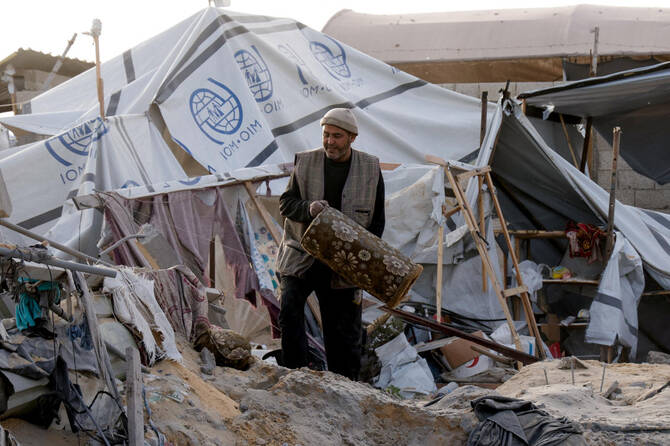
Children among at least 12 killed by Israeli strikes in Gaza

Above, a resident inspects the site of an Israeli strike on a tent camp sheltering displaced people, in Khan Younis, southern Gaza Strip on April 30, 2025. (Reuters)
Short Url
Updated 30 April 2025
Follow

Children among at least 12 killed by Israeli strikes in Gaza

  • The pre-dawn strikes hit three houses in the urban Nuseirat refugee camp
  • Israeli forces arrest renowned Palestinian journalist in occupied West Bank

JERUSALEM, NEW YORK: At least 12 people including children were killed overnight in Gaza by Israeli strikes, hospital workers said Wednesday.

The pre-dawn strikes hit three houses in the urban Nuseirat refugee camp, according to staff at the Al-Aqsa Hospital, which received the bodies. 

Among the dead were three children, including two brothers whose bodies arrived in pieces, according to the hospital’s morgue.

Israel has carried out daily strikes on Gaza since ending its ceasefire with Hamas last month. 

It has cut off the territory’s 2 million Palestinians from all imports, including food and medicine, since the beginning of March in what it says is an attempt to pressure the militant group to release hostages.

The strikes come after more than two dozen people were killed earlier this week in Gaza City and Beit Lahiya.

Israel’s war against Hamas in Gaza has killed more than 52,000 Palestinians, according to the territory’s Health Ministry.

Meanwhile, Israel’s military said it arrested Ali Samoudi, a well-known journalist, in a raid in Jenin, a Palestinian city in the north of the territory.

Samoudi previously worked for international outlets including CNN and Al Jazeera. In 2022, he was injured in the same spray of gunfire that killed prominent Palestinian journalist Shireen Abu Akleh. 

US officials say Akleh was shot dead by an Israeli sniper.

Israel’s military said Samoudi was affiliated with and transfered funds for the Islamic Jihad militant group, without providing evidence. 

They said Samoudi had been transferred to Israel’s security forces.

Samoudi’s arrest is the latest of dozens of Palestinian journalists detained by Israel since the start Israel’s war with Hamas, which began on Oct. 7, 2023.

In a related development, Lebanon’s President Joseph Aoun, who met a US military delegation on Wednesday, urged it to pressure Israel to withdraw from areas it still controls in the country and to release Lebanese prisoners. The delegation was headed by US Maj. Gen. Jasper Jeffers, the co-chairman of the Cessation of Hostilities Implementation Mechanism.

Aoun told the American delegation that the Lebanese army was carrying out its work along the border with Israel, where troops had been confiscating weapons and preventing armed presence.

A statement released by Aoun’s office said that Jeffers, who had held the post since before the Israel-Hezbollah war ended in late November, will be replaced by Maj. Gen. Michael J. Leeney. It added that Leeney also attended Wednesday’s meeting.

Separately, Iran’s official IRNA news agency reported on Wednesday that a man, identified as Mohsen Langarneshin, was hanged. It said he had played role in the 2022 killing of a Revolutionary Guard colonel in Tehran, and called him a “senior spy” for the Mossad.

The report said he had provided “technical support” in the assassination of Col. Hassan Sayyad Khodaei, shot five times by gunmen on a motorbike outside his home in Tehran.

The report said Langerneshin confessed in Iran’s Revolutionary Court. It said the Mossad recruited Langarneshin in 2020 and that he met Israeli intelligence officers in Georgia and Nepal.

Langarneshin reportedly rented safe houses for operatives in several Iranian cities, including Isfahan, when, in January 2023, bomb-carrying drones targeted what Iran described as a military workshop. Iran has accused Israel of being behind the attack.

Meanwhile, a federal judge ordered US immigration authorities to release a Palestinian student detained at a citizenship interview earlier this month over his role in Columbia University’s Gaza war protests.

Mohsen Mahdawi, who was slated for deportation, struck a defiant tone outside a courthouse in the northeastern state of Vermont.

“I am not afraid of you,” he said, “If there is no fear. What is it replaced with? Love, love is our way.”


Sudan’s war puts charity kitchen workers feeding displaced families at risk

Updated 7 sec ago
Follow

Sudan’s war puts charity kitchen workers feeding displaced families at risk

CAIRO: Enas Arbab fled Sudan’s western region of Darfur after her hometown fell to Sudanese paramilitary forces, taking only her year-old son with her and the memory of her father, who was killed, she said, simply for working at a charity kitchen serving people displaced by the fighting.
The Rapid Support Forces — or RSF, a paramilitary group that has been at war with the Sudanese army since April 2023 — had laid siege on el-Fasher in the western Darfur region, starving people out before it overran the city.
UN officials say several thousand civilians were killed in the RSF takeover of el-Fasher last October. Only 40 percent of the city’s 260,000 residents managed to flee the onslaught, thousands of whom were wounded, the officials said. The fate of the rest remains unknown.
During the fighting, Arbab says RSF fighters took her father, Mohamed ِArbab, from their home after beating him in front of the family, and demanded a ransom. When the family couldn’t pay, they told them they had killed him, she says. To this day, the family doesn’t know where his body is.
When her husband disappeared a month later, Enas Arbab decided to flee north, to Egypt. “We couldn’t stay in el-Fasher,” she said. “It was no longer safe and there was no food or water.”
Her father was one of more than 100 charity kitchen workers who have been killed since the war began, according to workers who spoke with The Associated Press and the Aid Workers Security database, a group that tracks major incidents around the world impacting aid workers.
In areas of intense fighting — especially in Darfur — famine is spreading and food and basic supplies are scarce. The community-led public kitchens have become a lifeline but many working there have been abducted, robbed, arrested, beaten or killed.
Grim numbers in a brutal war
Volunteer Salah Semsaya with the Emergency Response Rooms — a group that emerged as a local initiative and now operates in 13 provinces across Sudan, with 26,000 volunteers — acknowledges the dangers faced by workers in charity kitchens.
The real number of workers killed is likely far higher than the estimated 100, he says, but the war has prevented reliable data collection and record-keeping.
Semsaya shared records showing that 57 percent of the documented killings of charity kitchen workers occurred in Khartoum, mainly while the Sudanese capital was under RSF control, before the army retook it last March. At least 21 percent of the killings were in Darfur.
More than 50 of those killed in Khartoum worked with his group, Semsaya said.
Sudan’s war erupted after tensions between the army and the RSF escalated into fighting that began in Khartoum and spread nationwide, killing thousands and triggering mass displacement, disease outbreaks and severe food insecurity. Aid workers were frequently targeted.
Dan Teng’o, communications chief at the UN office for humanitarian affairs, says it’s unclear whether charity kitchen workers are targeted because of their work or because of their perceived affiliation with one side or other in the war.
The kitchen workers are prominent in their communities because of the work they do, making them obvious targets, activists say. Ransom demands typically range from $2,000 to $5,000, often rising once families make initial payments.
“A clear deterioration in the security context ... has significantly affected local communities, including volunteers supporting community kitchens,” Teng’o said.
Kitchen workers face risks
Farouk Abkar, a 60-year-old from el-Fasher, spent a year handing out sacks of grain at a charity kitchen in Zamzam camp, just 15 kilometers (9 miles) south of the city. He survived drone strikes and remembers the day RSF fighters attacked his kitchen. One of them punched him in the face, knocking some of his teeth out.
Abkar said he fled el-Fasher at night with his daughter, walking for 10 days. Along the way, some RSF fighters fired birdshot, which hit him in the head, leaving a chronic headache.
Now in Egypt, he shares an apartment with at least 10 other Sudanese refugees and can’t afford medical care. The harrowing images from his hometown still haunt him.
“Many things happened in el-Fasher,” he said. “There was death. There was starvation.”
Mustafa Khater, a 28-year-old charity kitchen worker, fled with his pregnant wife to Egypt a few days before el-Fasher fell to the RSF.
During the 18-month siege, some el-Fasher residents collaborated with the RSF, telling the paramilitary fighters who the kitchen workers were, Khater said. Many disappeared.
“They would take you to an area where there is a dry riverbed and kill you there,” Khater said.
A volunteer working with Semsaya’s aid group in Darfur said some of his colleagues were beaten, arrested and interrogated, with their attackers accusing them of receiving “illicit funds” for the kitchen. The volunteer spoke on condition of anonymity for fear of reprisals.
Despite the challenges, many charity kitchens remain the only reliable food source in areas gripped by conflict and a place people can come to and give each other support, Semsaya said.
Struggling to feed thousands
The town of Khazan Jedid in East Darfur province has three charity kitchens feeding about 5,000 people daily, said Haroun Abdelrahman, a spokesperson for the Emergency Response Rooms’ branch in the area.
Abdelrahman says he was once interrogated by RSF fighters, while several of his colleagues have been robbed at knifepoint. Despite the fear and harassment, many kitchen workers are still volunteering and working, he said.
In Kassala in eastern Sudan, military agents questioned a volunteer with the branch there and his colleagues in January 2024, he said, after their kitchen started serving food and providing shelter to people who escaped nearby Wad Madani when RSF seized that town. He also spoke anonymously for fear of reprisals.
Khater, the 28-year-old who fled el-Fasher, said he heard from friends back home that after the RSF takeover, all charity kitchens in the city closed and his colleagues were either “killed or fled.”
Teng’o says the closures in areas of fighting have left “vulnerable households with no viable alternatives” and forced people to shop at local “markets where food prices are unaffordable.”
Arbab, the pregnant 19-year-old who fled with her baby boy, had hoped to rebuild her life in Egypt, her friends and a humanitarian worker said, speaking on condition of anonymity to talk about the young mother.
But while on the road to the northern city of Alexandria last month, she and her son were stopped by Egyptian authorities and deported back to Sudan.