THESSALONIKI: Workers were installing benches at a park in the ancient Greek port city of Thessaloniki when their excavator pushed brown soil off a fragile white skull.
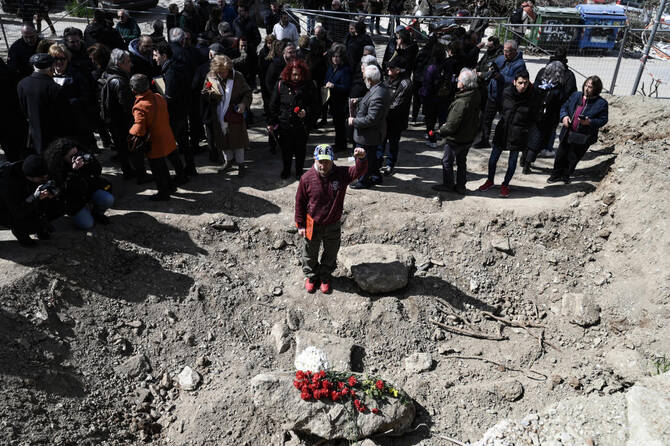
They turned off the motorized equipment and set to work with pickaxes and shovels. The crew found two skeletons, then more. By March, 33 sets of bones lay in a tight cluster of unmarked burial pits in the shadow of a Byzantine fortress.
“We found many bullets in the heads, the skulls,” supervising engineer Haris Charismiadis said, standing on earth overturned by four months of digging.
It’s common to find ancient remains or objects in Greece. But hulking Yedi Kule castle was a prison where Communist sympathizers were tortured and executed during Greece’s 1946–49 Civil War. Tens of thousands died in the early Cold War-era battles between Western-backed government forces and left-wing insurgents, a brutal conflict with assassination squads, child abductions and mass displacements.
Greece’s archaeological service cleared the site for development because the bones are less than 100 years old. But authorities in Neapolis-Sykies, a suburb of the coastal city of Thessaloniki, pressed on with excavation, saying the chance find has “great historical and national importance.”
Descendants have been coming to the site in recent weeks, leaving flowers and asking authorities to conduct DNA testing “so they can retrieve the remains of their grandfather, great-grandfather or uncle,” said Simos Daniilidis, who has served as Neapolis-Sykies’ mayor since 1994.
As many as 400 Yedi Kule prisoners were executed, according to historians and the Greek Communist Party. Items found with the bodies — a woman’s shoe, a handbag, a ring — offer glimpses into the lives cut short.
Wartime legacy
For the families of slain pro-Communist Greeks, the find in the Park of National Resistance is reviving a wartime legacy kept dormant to avoid reigniting old animosities. The small site has become Greece’s first Civil War mass grave to be exhumed.
Government forces executed 19-year-old Agapios Sachinis after he refused to sign a declaration renouncing his political beliefs.
“These are not simple matters,” his namesake nephew said during a recent visit to the site.
“It’s about carrying inside you not just courage, but values and dignity you won’t compromise — not even to save your own life,” said Agapios Sachinis, 78.
A retired Communist city council member, Sachinis was imprisoned in the 1960s for his political activity during the dictatorship. Today, Greece’s Communist Party belongs to the political mainstream, largely thanks to its role in the country’s WWII resistance.
If Sachinis’ uncle’s remains are identified, he said, he will cremate them and keep the ashes at his home.
“I want Agapios close to me, at least while I’m alive,” he said.
Cold War playbook
Greece’s Civil War began in the wake of World War II. Coming after continent-wide destruction, it quickly lost international attention but the conflict marked a turning point: US President Harry Truman’s policy of anti-communist intervention — the Truman Doctrine — was presented to Congress in 1947 as a means to direct funds and military support to Greece.
Etched on the newly excavated bones in Thessaloniki, then, is a playbook that went on to produce decades of repression, societal divisions and more unmarked graves in Asia, Africa and Latin America. Governments later addressing the Cold War-era abuses and atrocities faced a painful choice: To unearth the past — as attempted with investigative commissions in Eastern Europe and many Latin American countries — or suppress it for fear of fresh division.
Greek emergency laws were gradually lifted and only fully abolished in 1989. Records of summary trials and executions were never made public. No political force pushed for the excavation of suspected burial sites.
Politicians still use highly cautious language when addressing the past and the Thessaloniki discovery was met with a subdued public reaction. The find has not been directly addressed by the country’s center-right government – a reminder that many Greeks still find it easier to walk past the country’s ghosts than confront them.
Decades ago, the neighborhood park in Thessaloniki — a densely populated port city of a million with ruins from the ancient Greek, Roman and Ottoman eras, with historically strong Balkan and Jewish influences — was a field on the outskirts of the city. Today, it’s frequented by retirees and ringed by apartment buildings filled with middle-class families. During construction, residents whispered that bones had been discovered when foundations were laid, but no inquiry was conducted.
‘Flowers of their generation’
Executions by army firing squads extended into the 1950s and were publicly announced, but graves were unmarked and secret. Author and historian Spyros Kouzinopoulos, a Thessaloniki native, spent decades researching the executions at Yedi Kule, including the indignities endured by prisoners in their final hours.
After a military tribunal issued a death sentence, the chief guard would take the condemned prisoner to solitary confinement in tiny cells barely big enough to stand. Many would use their last hours to write letters to their families. At dawn, the chief guard and two others would retrieve the prisoner and hand them over to the firing squad. Most were loaded onto trucks to avoid attracting public attention. Sometimes they were led to their death on foot.
Most of the victims were barely adults — youth Kouzinopoulos called “flowers of their generation.”
Two 17-year-old schoolgirls, Efpraxia Nikolaidou and Eva Kourouzidou, were executed while wearing their uniforms, he said.
“It shook me to the core,” Kouzinopoulos said.
DNA testing
City officials are taking steps to conduct DNA testing on the remains, and urging families of the missing to submit genetic material. That way, the bodies can be identified and returned to relatives.
Agapios Sachinis, the septuagenarian whose uncle was executed, is among those eager to provide DNA.
Mayor Daniilidis has ordered an expansion of the dig to other parts of the park in coming weeks.
“We must send a message,” he said. “Never again.”


![]()

Greece’s dark past is uncovered after 33 bodies are found in a civil war-era mass grave
Short Url
https://arab.news/6kdq7
Greece’s dark past is uncovered after 33 bodies are found in a civil war-era mass grave
- War-era battles between Western-backed government forces and left-wing insurgents, a brutal conflict with assassination squads, child abductions and mass displacements
- Descendants have been coming to the site in recent weeks, leaving flowers and asking authorities to conduct DNA testing


Latest updates


© 2026 SAUDI RESEARCH & PUBLISHING COMPANY, All Rights Reserved And subject to Terms of Use Agreement.