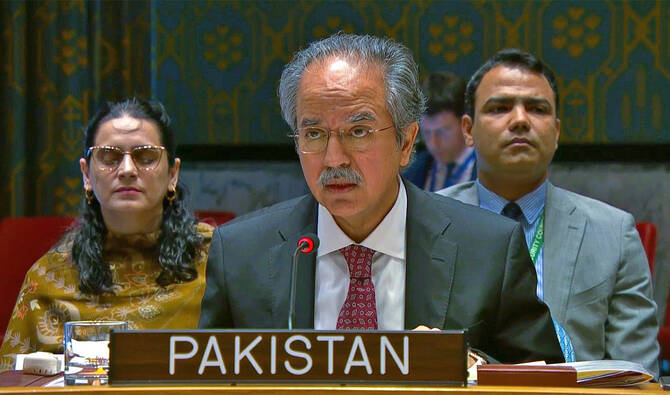
ISLAMABAD: Pakistan’s top diplomat at the United Nations said on Tuesday Israel was killing civilians in Gaza at “four times the rate of previous conflicts” as he urged the international community to move toward permanent peace in the Middle East by ending Israeli occupation of Palestinian and Arab territories.
The war in Gaza, which began in October 2023, has so far killed around 52,000 Palestinians, most of them women and children, according to Palestinian health officials.
Ambassador Asim Iftikhar Ahmed, Pakistan’s permanent representative to the UN, raised the issue during a high-level debate at the Security Council on the Middle East. He described Israel’s ongoing military campaign as “the erasure of a nation’s right to exist” and accused it of war crimes and ethnic cleansing.
“Israel’s unilateral breach of the ceasefire agreement — brokered by Egypt, Qatar and the United States [earlier this year] — was a deliberate choice of return to war over diplomacy,” Ahmed said. “This assault on Gaza is killing civilians at four times the rate of previous conflicts. Since hostilities resumed, nearly 2,000 more Palestinians have been killed, adding to the staggering death toll of over 52,000, among them more than 17,000 children.”
Ahmed condemned the attack earlier this month on Al-Ahli hospital, the last major facility providing critical health care in Gaza, calling it a “horrific massacre.”
He said Israeli forces were deliberately targeting civilians, aid convoys and critical infrastructure, while using starvation as a weapon of war.
“The deliberate targeting of civilians and essential infrastructure, the use of starvation as a weapon, and the incineration of displaced families in tents — these are not collateral damages of war; they are methods of war,” he said.
The Pakistani envoy also blamed Israel for violating ceasefire agreements and UN resolutions in Lebanon and Syria, calling the pattern “clear.”
“As long as the root cause, the illegal occupation of Palestinian and Arab lands, is ignored and not addressed, peace will remain an illusion,” he added.
Calling for immediate international action, Ahmed urged the Security Council to pursue a permanent ceasefire, full humanitarian access to Gaza and a credible path to Palestinian statehood.
He welcomed the upcoming June peace conference co-chaired by France and Saudi Arabia as a “vital opportunity” and called for concrete outcomes, including a timeline for statehood, protection of civilians and full UN membership for Palestine.
“Seventy-five years of failure have shown one immutable truth: peace cannot coexist with occupation, justice cannot thrive under apartheid and stability cannot take root where millions remain stateless,” Ahmed added.


Pakistan tells UN Israel killing Palestinians at ‘four times the rate of previous conflicts’
https://arab.news/rb44h
Pakistan tells UN Israel killing Palestinians at ‘four times the rate of previous conflicts’

- Asim Iftikhar Ahmed says peace will remain an illusion until Israel’s occupation of Arab lands continues
- He calls for a ceasefire, full humanitarian access to Gaza and a credible path to Palestinian statehood

Curfew extended in Gilgit-Baltistan, probe ordered after deadly Khamenei protests
- At least 15 people were killed in clashes with law enforcement agencies over the weekend in Gilgit-Baltistan
- Government also announces a de-weaponization campaign, crackdown on hate speech and cybercrime in region
ISLAMABAD: The government in Pakistan’s Gilgit-Baltistan (GB) region on Tuesday extended a curfew in Gilgit district and ordered a judicial probe into violent protests over the killing of Iranian Supreme Leader Ali Khamenei in US-Israeli strikes last week, an official said.
At least 15 people were killed in clashes with law enforcement agencies over the weekend in GB, where protesters torched and vandalized several buildings, including United Nations regional offices, an army-run school, software technology park and a local charity building.
The violence prompted regional authorities to impose curfew in Gilgit and Skardu districts on March 2-4 as officials urged people to stay indoors and cooperate with law enforcers, amid widespread anger in Pakistan, particularly among members of the Shiite minority, over Khamenei’s killing.
On Tuesday, the GB government convened to review the situation and announced the extension of curfew in Gilgit among a number of security measures as well as ordered the establishment of a judicial commission to investigate the weekend violence in the region.
“The government has made it clear that the law will strictly take its course against elements involved in vandalism at government institutions, private properties and incidents of vandalism in Gilgit and Skardu and no kind of mischief will be tolerated,” Shabbir Mir, a GB government spokesperson, said in a statement.
“In view of the security situation, curfew will remain in force in Gilgit, while the decision to extend the curfew in Skardu will be taken keeping the ground realities and the changing situation in view.”
The statement did not specify how long the curfew will remain in place in Gilgit.
Besides the formation of the judicial commission to investigate the violent clashes, the government also decided to launch a large-scale de-weaponization campaign in the entire Gilgit district, for which relevant institutions have been directed to immediately complete all necessary arrangements, according to Mir.
In addition, a crackdown has been ordered on hate speech, spread of fake news and cybercrime.
“The aim of these decisions is to ensure the rule of law, protect the lives and property of citizens and crack down on miscreants,” he said. “Approval has also been given to immediately survey the affected infrastructure and start their restoration work on priority basis.”
Demonstrators in Pakistan’s southern port city of Karachi also stormed the US Consulate on Sunday, smashing windows and attempting to burn the building. Police responded with batons, tear gas, and gunfire, leaving 10 people dead and more than 50 injured.
Pakistani authorities have since beefed up security at US diplomatic missions across the country, including around the US consulate building in Peshawar, to avoid any further violence.


