Pakistan tells UN it has evidence ‘external adversaries’ behind deadly train hijacking last month

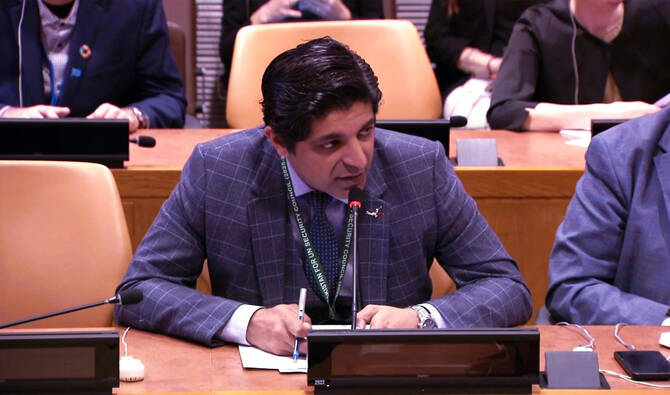
Jawad Ajmal, Counsellor at Pakistan’s UN Mission, speaks at the launch of the Victims of Terrorism Association Network at the United Nations (UN) in New York, US, on April 28, 2025. (X/@PakistanUN_NY)
Short Url
Updated 29 April 2025
Follow

Pakistan tells UN it has evidence ‘external adversaries’ behind deadly train hijacking last month

  • A Pakistani diplomat at the UN extends condolences to the families of the victims of the Pahalgam attack
  • He says the international community must support survivors of militant attacks without political selectivity

ISLAMABAD: Pakistan told the United Nations on Monday it had “credible evidence” that a deadly attack on a passenger train in its southwestern region last month was externally sponsored, as it called for stronger global efforts to hold perpetrators behind such incidents accountable.
The statement referred to the March hostage-taking on the Jaffer Express passenger train in Balochistan province, which lasted about 36 hours before security forces launched an operation that killed more than 30 militants from the separatist Baloch Liberation Army (BLA).
Pakistan’s decision to highlight the passenger train incident at the world body came at a time when tensions remain high in the region following the killing of 26 tourists in Indian-administered Kashmir last week, an attack India blamed on Pakistan, despite Islamabad’s categorical denial.
“Just last month, Pakistan suffered a heinous terrorist attack by the BLA on Jaffar Express passenger train, which included the taking of hostages in Pakistan’s Balochistan province, which resulted in the loss of at least 30 innocent Pakistani nationals,” Jawad Ajmal, Counsellor at Pakistan’s UN Mission, said at the launch of the Victims of Terrorism Association Network at the UN. “Pakistan has credible evidence that this attack had external sponsorship from our adversaries in the region.”
Ajmal stressed the international community must do more to support survivors of such militant attacks and the families of victims whose lives are permanently altered after such developments.
He urged a collective approach to prevent future attacks, emphasizing the need to hold militants and their backers accountable without political selectivity.
“If we are to chart a way forward for victims, we must look beyond narrow political interests and geopolitical agendas,” he said. “We must examine why, despite global strategies, terrorism threats continue to proliferate and give rise to an ever-increasing number of victims.”
Commenting on the recent attack in Pahalgam in Indian-administered Kashmir, Ajmal said Pakistan extended condolences to the families of the victims and wished a speedy recovery to the injured.
He noted that Pakistan joined other UN Security Council members in condemning the attack.
The Pakistani diplomat added that his country was one of the worst victims of militant violence over the past two decades and had lost more than 80,000 lives to it.
He paid tribute to the families of his country’s law enforcement and armed forces personnel who had made “countless sacrifices” to defend the nation.


Peace can only prevail if Afghanistan renounces support for ‘terrorism’— Pakistan defense chief

Updated 12 sec ago
Follow

Peace can only prevail if Afghanistan renounces support for ‘terrorism’— Pakistan defense chief

  • Pakistan’s chief of defense forces visits South Waziristan district bordering Afghanistan
  • Pakistan says has killed 481 Afghan Taliban operatives since clashes began last Thursday

ISLAMABAD: Pakistan’s Chief of Defense Forces Field Marshal Syed Asim Munir said on Wednesday that peace with Afghanistan can only prevail if Kabul renounces support for “terrorism” and “terrorist” organizations, the military’s media wing said as the two countries remain locked in conflict. 

Fighting between the two neighbors, the worst in decades, broke out last Thursday night after Afghan forces attacked Pakistan’s military installations along their shared border. Afghanistan said its attacks were in response to earlier airstrikes by Pakistan against alleged militant hideouts in its country. 

Pakistan accuses Afghanistan of sheltering militant outfits such as the Tehreek-e-Taliban Pakistan (TTP) on its soil who have launched attacks against Pakistani civilians and security forces in recent years. Kabul denies the allegations. 

Munir visited Wana town in Pakistan’s South Waziristan district to review the security situation and troops’ operational preparedness at the Afghan border, the Pakistani military’s media wing said in a statement. 

“The Field Marshal reiterated that peace could only prevail between both sides if the Afghan Taliban renounced their support for terrorism and terrorist organizations,” the Inter-Services Public Relations (ISPR) said. 

The military chief said the use of Afghan soil by militant outfits to launch attacks against Pakistan was unacceptable, vowing that “all necessary measures” would be taken to neutralize cross-border threats. 

During the visit, Munir was briefed by military commanders about ongoing intelligence-based operations and measures being taken by the military to manage the border with Afghanistan.

He was also briefed about “Operation Ghazab Lil Haq” or “Wrath for the Truth,” the name Pakistan has given to its military operation against Afghan forces, the ISPR said. 

The Pakistani military chief spoke to troops deployed in the area, praising their vigilance, professional conduct and high morale, the ISPR said. 

Pakistan’s Information Minister Attaullah Tarar said on Wednesday that the military has killed 481 Taliban operatives, injured more than 690 and destroyed 226 Afghan checkposts since clashes began. 

Arab News has been unable to verify claims by both sides about the damages they claim to have inflicted on each other.

Afghanistan has signaled it is open for dialogue but Pakistan rejected the offer, saying it would continue its military operations till its objectives were achieved. 

Since the conflict began, diplomatic efforts have intensified with several countries, including global bodies such as the European Union and United Nations, urging restraint and calling for talks.

Turkish President Recep Tayyip Erdogan told Pakistani Prime Minister Shehbaz Sharif that ⁠Ankara would help ⁠reinstate a ceasefire, the Turkish Presidency said on Tuesday, as other countries that had offered to mediate have since been hit by the conflict in the Gulf.