

Pakistan’s average inflation to remain between 5.5-7.5% during FY25— central bank

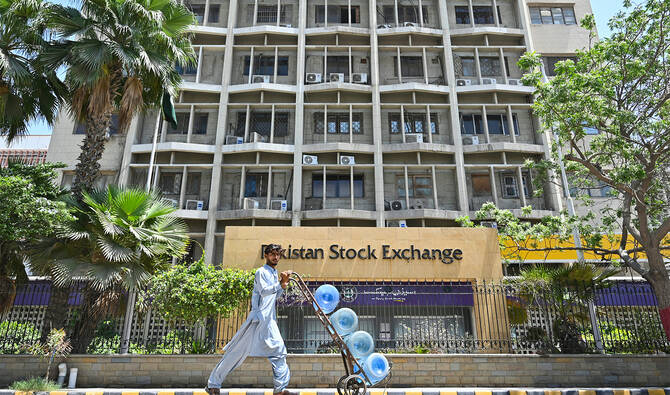
A labour carries water bottles on a hand cart past the Pakistan Stock Exchange (PSX) building as index plummeted amid a global market crash, in Karachi on April 7, 2025. (AFP)
Short Url
Updated 29 April 2025
Follow

Pakistan’s average inflation to remain between 5.5-7.5% during FY25— central bank

  • Pakistan’s real GDP growth rate expected to hover between 2.5-3.5%, says State Bank of Pakistan 
  • Central bank says “strong momentum” in remittances, exports to continue outpacing increase in imports 

ISLAMABAD: Pakistan’s average inflation is expected to remain in the 5.5-7.5% range in the fiscal year ending June 2025, the country’s central bank said in its half-yearly economic report this week, stating that its real GDP growth is expected to hover between 2.5-3.5%.

Pakistan’s economy has improved in recent months, supported by declining inflation, which caused the central bank to reduce its policy rate to 12% after a series of cuts totaling 1,000 basis points since June 2024.

In a report titled “The State of Pakistan’s Economy, Half Year Report FY25” released on Monday, the State Bank of Pakistan (SBP) noted that inflationary pressures have receded notably, with headline inflation reaching a multi-decade low of 0.7% by March 2025.

“In view of steeper-than-anticipated disinflation, combined with an adequately tight monetary policy stance, continued fiscal consolidation and an ease in global commodity prices, the SBP projects average inflation for FY25 to fall in the range of 5.5–7.5 percent,” the SBP said in a press release.

Pakistan’s inflation rate rose to a record high of 38% in May 2023 on account of surging food and fuel costs. This was caused by Islamabad’s move to withdraw energy and fuel subsidies under a deal agreed with the International Monetary Fund in exchange for a financial bailout package.

The report said Pakistan’s current account balance is projected to remain in the range of -0.5 to 0.5 percent of the GDP. The central bank said it expects a “strong momentum” in foreign remittances and exports to continue outpacing the increase in imports. 

“This is expected to cushion against lower financial inflows and help strengthen external buffers,” the report said. “The SBP’s projection for real GDP growth remains unchanged in the range of 2.5–3.5 percent.”

The report highlighted downside risks in the form of additional fiscal consolidation and less-than-expected wheat harvests. It pointed out risks to the medium-term outlook, largely stemming from global trade disruptions and related commodity price volatility in light of Washington’s tariffs, changing geo-political situations, adjustments in administered energy prices and spillover of movements in international currencies on the local currency. 


Imran Khan not a ‘national security threat,’ ex-PM’s party responds to Pakistan military

Updated 06 December 2025
Follow

Imran Khan not a ‘national security threat,’ ex-PM’s party responds to Pakistan military

  • Pakistan’s military spokesperson on Friday described Khan’s anti-army narrative as a “national security threat”
  • PTI Chairman Gohar Ali Khan says words used by military spokesperson for Khan were “not appropriate”

ISLAMABAD: Former prime minister Imran Khan’s Pakistan Tehreek-e-Insaf (PTI) party on Saturday responded to allegations by Pakistan military spokesperson Lt. Gen. Ahmed Sharif Chaudhry from a day earlier, saying that he was not a “national security threat.”

Chaudhry, who heads the military’s media wing as director general of the Inter-Services Public Relations (ISPR), spoke to journalists on Friday, in which he referred to Khan as a “mentally ill” person several times during the press interaction. Chaudhry described Khan’s anti-army narrative as a “national security threat.”

The military spokesperson was responding to Khan’s social media post this week in which he accused Chief of Defense Forces Field Marshal Asim Munir of being responsible for “the complete collapse of the constitution and rule of law in Pakistan.” 

“The people of Pakistan stand with Imran Khan, they stand with PTI,” the party’s secretary-general, Salman Akram Raja, told reporters during a news conference. 

“Imran Khan is not a national security threat. Imran Khan has kept the people of this country united.”

Raja said there were several narratives in the country, including those that created tensions along ethnic and sectarian lines, but Khan had rejected all of them and stood with one that the people of Pakistan supported. 

PTI Chairman Gohar Ali Khan, flanked by Raja, criticized the military spokesperson as well, saying his press talk on Thursday had “severely disappointed” him. 

“The words that were used [by the military spokesperson] were not appropriate,” Gohar said. “Those words were wrong.”

NATURAL OUTCOME’

Speaking to reporters earlier on Saturday, Pakistan’s Defense Minister Khawaja Asif defended the military spokesperson’s remarks against Khan.

“When this kind of language is used for individuals as well as for institutions, then a reaction is a natural outcome,” he said. 

“The same thing is happening on the Twitter accounts being run in his [Khan’s] name. If the DG ISPR has given any reaction to it, then I believe it was a very measured reaction.”

Khan, who was ousted after a parliamentary vote of confidence in April 2022, blames the country’s powerful military for removing him from power by colluding with his political opponents. Both deny the allegations. 

The former prime minister, who has been in prison since August 2023 on a slew of charges he says are politically motivated, also alleges his party was denied victory by the army and his political rivals in the 2024 general election through rigging. 

The army and the government both deny his allegations.
