BEIRUT: The leader of Lebanon’s Hezbollah group called on the government Monday to work harder to end Israel’s attacks in the country a day after an Israeli airstrike hit a suburb of Beirut.
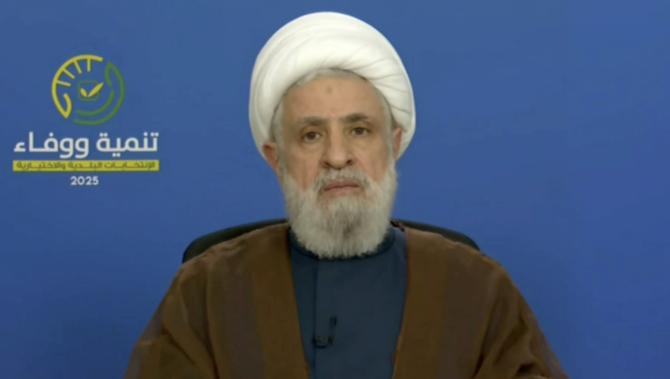
Naim Kassem said in a televised speech that Hezbollah implemented the ceasefire deal that ended the 14-month Israel-Hezbollah war in late November. But despite that, Israel is continuing with near-daily airstrikes.
Kassem’s comments came as the Israeli military said it carried out more than 50 strikes in Lebanon this month saying they came after Hezbollah violated the US-brokered ceasefire.
On Sunday, Israeli warplanes struck Beirut’s southern suburbs after issuing a warning about an hour earlier, marking the third Israeli strike on the area since a ceasefire took effect in late November. The Israeli military said it struck a precision-guided missiles facility.
“The resistance complied 100 percent with the (ceasefire) deal and I tell state officials that it’s your duty to guarantee protection,” Kassem said, adding that Lebanese officials should contact sponsors of the ceasefire so that they pressure Israel to cease its attacks.
“Put pressure on America and make it understand that Lebanon cannot rise if the aggression doesn’t stop,” Kassem said, pointing to Lebanese officials. He added that the US has interests in Lebanon and “stability achieves these interests.”
Kassem said the priority should be for an Israeli withdrawal from Lebanon, an end to Israeli strikes in the country and the release of Lebanese held in Israel since the war that ended on Nov. 27.
Hezbollah began launching rockets, drones and missiles into Israel the day after the Oct. 7, 2023, attack on southern Israel by its Hamas allies ignited the Israel-Hamas war. Palestinian militants killed about 1,200 people in Israel and abducted 251 others during the 2023 attack.
The Israel-Hezbollah conflict exploded into all-out war last September when Israel carried out waves of airstrikes and killed most of the militant group’s senior leaders. The fighting killed over 4,000 people.
The Lebanese government said earlier this month that 190 people have been killed and 485 injured in Lebanon by Israeli strikes since the ceasefire took effect.

Hezbollah leader calls on government to work harder to end Israel’s attacks on Lebanon
https://arab.news/rvz66
Hezbollah leader calls on government to work harder to end Israel’s attacks on Lebanon
- Naim Kassem's comments came as the Israeli military said it carried out more than 50 strikes in Lebanon this month
- He said the priority should be for an Israeli withdrawal from Lebanon, an end to Israeli strikes in the country and the release of Lebanese held in Israel
Syria welcomes US House vote to end ‘Caesar Act’ sanctions
- Representatives back defense bill that includes provisions to scrap wide-ranging sanctions imposed on former leader Bashar Assad
- Syria’s new government says vote is ‘pivotal moment’ for country as it attempts to rebuild its economy
LONDON: A vote by the US House of Representatives in favor of ending tough sanctions on Syria was welcomed by Damascus on Thursday as a “pivotal moment.”
The “Caesar Act” sanctions regime was imposed in 2020 against former President Bashar Assad’s government over the human-rights abuses carried out during the civil war.
The move to repeal the sanctions, seen as a crucial step for the Syrian Arab Republic’s economic recovery, is contained in a wide-ranging defense bill that the lower house of Congress backed on Thursday.
The Syrian Foreign Ministry said the vote “paves the way for a broader economic recovery and the return of opportunities long denied to Syrians.”
The ministry described it as a first step toward improving trade flows, and increasing the availability of essential goods, and medical supplies.
The National Defense Authorization Act, or NDAA, will now pass to the US Senate where a vote is expected to be held by the end of the year.
Assad was forced from power a year ago after a rapid military campaign by opposition forces brought the 13-year conflict to an end.
The new president, Ahmad Al-Sharaa, who led the offensive, has made ending Syria’s isolation a priority as he attempts to rebuild the country’s shattered economy.
President Donald Trump said in May that he planned to lift all sanctions on Syria and many have already been removed or suspended.
The Caesar Act, which imposed the toughest restrictions on trade and investment in Syria, requires Congressional approval to be overturned.
Along with repealing the act, the bill requires the White House to provide regular reports confirming that Syria’s government is fighting Daesh militants and upholding religious and ethnic minority rights, Reuters reported.
Syria’s foreign minister, Asaad Al-Shaibani, said the step toward repealing the Caesar Act was a “triumph for justice but also a recognition of the strength and resilience of the Syrian people.”
He said it reflected the success of Syrian diplomacy with the US.
Al-Sharaa has held talks with Trump three times, including an initial meeting in Riyadh in May on the sidelines of a US-GCC summit.
The Syrian president traveled to Washington in September where he was hosted at the White House. Speaking after the meeting, Trump said the US would do “everything we can to make Syria successful.”
During the visit, Syria confirmed that it would join the global coalition against Daesh.
Removing international sanctions on Syria would allow foreign investment to flow into the country, where the cost of rebuilding is estimated to be more than $200 billion.
Syrian Central Bank Gov. Abdulkader Husrieh told Reuters recently that the repeal of US sanctions was “a miracle” and that the economy was growing faster than expected.
The Caesar Act targeted individuals, companies and institutions linked to Assad, and sanctioned foreign entities from funding them.
The legislation was named after a code name given to a Syrian military photographer who smuggled thousands of photos documenting torture and war crimes by the Syrian regime out of the country.


