

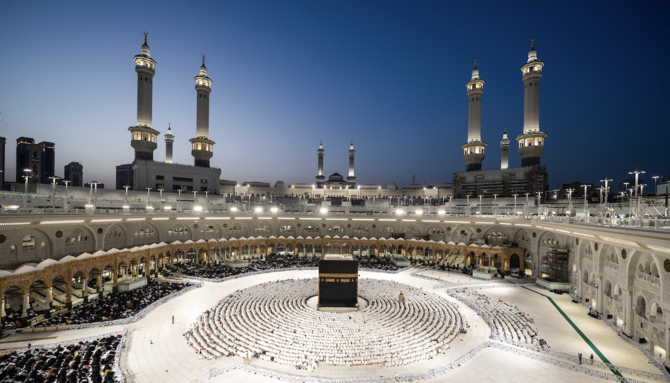
Unauthorized Hajj Pilgrims, facilitators face penalties in Saudi interior ministry clampdown

Saudi Arabia’s Ministry of Interior has announced penalties for individuals who violate Hajj permit regulations and those who facilitate such violations. (@AlharamainSA)
Short Url
Updated 29 April 2025
Follow

Unauthorized Hajj Pilgrims, facilitators face penalties in Saudi interior ministry clampdown

  • Penalties will apply from Tuesday until approximately June 10

RIYADH: People caught violating Hajj permit regulations, and those helping them, in Saudi Arabia’s Makkah face stiff penalties in a Ministry of Interior clampdown.

The ministry said the penalties would apply from Tuesday until approximately June 10.

A fine of up to SR20,000 ($5,331.43) will be imposed on people caught performing or attempting to perform Hajj without a permit, and on holders of all types of visit visas who attempt to enter or stay in Makkah and the holy sites during the specified period.

A fine of up to SR100,000 will also be imposed on anyone who applies for a visit visa for an individual who has performed or attempted to perform Hajj without a permit, or who has entered or stayed in Makkah city and the holy sites during the specified period. The fine will multiply for each individual involved.

The same fine will apply to anyone who transports or attempts to transport visit visa holders to Makkah and the holy sites during the specified period, as well as to those who shelter or attempt to shelter visit visa holders in any accommodation, including hotels, apartments, private housing, shelters, or housing sites for Hajj pilgrims.

This includes concealing their presence or providing assistance that enables their stay. The fine will multiply for each individual sheltered, concealed, or assisted.

A separate penalty would also apply to illegal infiltrators attempting to perform Hajj, whether residents or overstayers, and the guilty parties would be deported to their countries and banned from entering the Kingdom for ten years.

The ministry also said the relevant court would be ordered to confiscate land vehicles used to transport visit visa holders to Makkah and the holy sites during the specified period, if owned by the transporter, facilitator, or any accomplices.


Saudi defense minister calls on Southern Transitional Council to de-escalate in Yemen

Updated 21 sec ago
Follow

Saudi defense minister calls on Southern Transitional Council to de-escalate in Yemen

  • In a statement addressed “to our people in Yemen” and published on X, Prince Khalid said Saudi Arabia’s intervention came at the request of Yemen’s internationally recognized government

DUBAI: Saudi Defense Minister Prince Khalid bin Salman called on the Southern Transitional Council (STC) to respond to Saudi-Emirati mediation efforts and de-escalate tensions in eastern Yemen, urging the group to withdraw its forces from camps in Hadramout and Al-Mahra and hand them over peacefully to local authorities.
In a statement addressed “to our people in Yemen” and published on X, Prince Khalid said Saudi Arabia’s intervention came at the request of Yemen’s internationally recognized government and aimed to restore state authority across the country through the Decisive Storm and Restoring Hope operations.
He said the Kingdom has consistently treated the southern issue as a “just political cause” that must be resolved through dialogue and consensus, citing the Riyadh Conference and Riyadh Agreement as frameworks that ensured southern participation in governance and rejected the use of force.
The minister warned that recent events in Hadramout and Al-Mahra since early December had caused divisions that undermine the fight against Yemen’s common enemy and harm the southern cause. He praised southern leaders and groups who, he said, have acted responsibly to support de-escalation and preserve social stability.
Prince Khalid reaffirmed that the southern issue would remain part of any comprehensive political settlement in Yemen and stressed that it must be resolved through trust-building and national consensus, not actions that could fuel further conflict.