WASHINGTON: US Treasury Secretary Scott Bessent on Sunday did not back President Donald Trump’s assertion that tariff talks with China were under way and said he did not know if the US president had talked to Chinese President Xi Jinping.
The Trump administration signaled openness last week to de-escalating a trade war between the world’s two largest economies that has raised fears of recession. Trump himself has said talks on tariffs were taking place with China and that he and Xi have spoken.
Yet Beijing has denied that any trade talks are occurring.
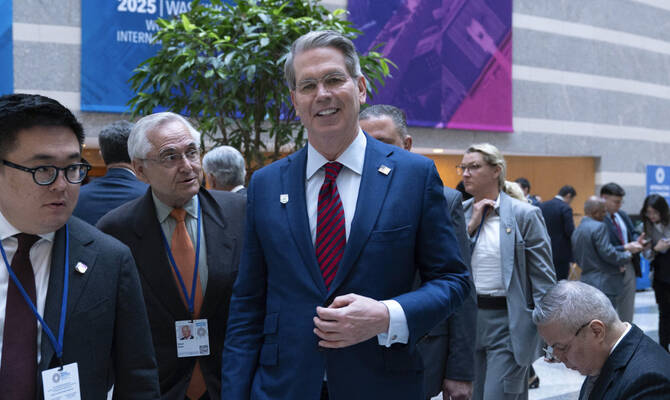
Bessent, a key player in US trade talks with multiple countries, said that he had interactions with his Chinese counterparts last week during International Monetary Fund meetings in Washington, but did not mention tariffs.
“I had interaction with my Chinese counterpart, but it was more on the traditional things like financial stability, global economic early warnings,” he said on ABC’s “This Week.”
“I don’t know if President Trump has spoken with President Xi,” Bessent added. “I know they have a very good relationship and a lot of respect for each other.”
Asked why the Chinese were denying talks, Bessent said. “I think they’re playing to a different audience.”
Bessent, who said last week that tariff negotiations with Beijing would be a “slog,” did not give a timetable for any potential agreement with China.
He said a trade deal can take months, but a de-escalation and an agreement in principle can be achieved sooner and would keep tariffs from ratcheting back to the maximum level.
Trump’s erratic, and often confusing, rollout of tariffs has hit many countries including the largest US trading partners, like Canada, Mexico and China. The result has been almost unprecedented market volatility and serious damage to investor trust in US assets.
In a separate television interview on Sunday, Agriculture Secretary Brooke Rollins said the United States was holding daily conversations with China over tariffs, but did not elaborate.
“Every day we are in conversation with China, along with those other 99, 100 countries that have come to the table,” Rollins said on CNN’s “State of the Union.”

Bessent does not back up Trump on China tariff discussions
https://arab.news/rpupc
Bessent does not back up Trump on China tariff discussions
- Trump’s erratic, and often confusing, rollout of tariffs has hit many countries including the largest US trading partners, like Canada, Mexico and China
Lufthansa adds more flights to Asia, Africa as Middle East war reshapes air travel
- Airlines across Europe have been redirecting capacity after suspending services in the Middle East
- Lufthansa said the move also helps meet demand on long-haul routes that Middle Eastern carriers cannot currently serve
LONDON: Lufthansa said on Friday it was shifting capacity from 10 canceled Middle Eastern destinations to routes such as Singapore and Bangkok as it contends with disruption from the US-Israeli war on Iran.
Airlines across Europe, including budget carrier Wizz Air , have been redirecting capacity after suspending services in the Middle East.
Lufthansa said the move also helps meet demand on long-haul routes that Middle Eastern carriers cannot currently serve.
Airline stocks have slumped this week as US and Israeli airstrikes on Iran — and retaliatory strikes by Iran across the Middle East — have disrupted long-haul flights and sent oil prices soaring.
“The war in the Middle East proves once again how exposed air traffic is and how vulnerable it remains,” Lufthansa CEO Carsten Spohr said in a statement. He added the outlook was uncertain, particularly for jet fuel costs.
The schedule changes came as the German group reported better-than-expected 2025 results, saying stricter financial management and fleet renewal had helped contain costs and lift profits. Its shares rose as much as 4 percent, before reversing to trade down 1.2 percent at 1246 GMT.
The company said demand on routes to and from Asia and Africa had risen strongly since the conflict began on Saturday, and it would stick with its focus on expanding long-haul services. Spohr said new flights to Asia would launch in days.
Lufthansa did say how many services it had canceled because of the conflict.
While carriers face costs for rescheduling and rerouting, the biggest impact for those outside the Middle East is expected from surging fuel prices. Brent crude futures have jumped more than 20 percent this week.
Spohr said Lufthansa was well hedged in the short term. The group hedges fuel up to 24 months ahead and was 85 percent hedged as of December 31, according to its annual report.
RESILIENCE
European carriers, including Lufthansa, benefited from slightly lower fuel bills in 2025. Lufthansa’s fuel bill fell 7 percent, helping support earnings as passenger demand stayed firm.
“Last year we were able to significantly increase the Group’s operating profit and achieved the highest revenue in our history. Our results demonstrate the resilience and stability of the Group,” Spohr said.
Lufthansa reported an adjusted operating profit of 2 billion euros ($2.3 billion), compared with 1.9 billion euros forecast in a company-compiled analyst poll and up from 1.6 billion euros in 2024. The group also posted an operating margin of 4.9 percent, up from 4.4 percent a year earlier.
Lufthansa aims to lift operating margins to 8 percent-10 percent between 2028 and 2030 from 4.4 percent in 2024, but strikes by workers, including the most recent on February 12, have made it harder to boost profitability.
Bernstein analyst Alex Irving said ongoing weakness in the passenger airline segment persisted, but that strong performances in Cargo and Lufthansa Technik helped lift profits.
The carrier said the outlook for 2026 was unclear due to geopolitical uncertainty. It projected capacity growth of 4 percent, alongside increased revenue and profit margin.


