- Foreign Minister Ishaq Dar speaks to counterparts in China, Saudi Arabia, Egypt, PM contacts Iranian President
- Ties have plunged since New Delhi accused Islamabad of being behind latest attack in Indian-administered Kashmir
ISLAMABAD: Pakistani top leaders have reached out to senior government officials in China, Saudi Arabia, Iran and Egypt this week as tensions with New Delhi have sharply escalated over a deadly militant attack in Indian-administered Kashmir.
Relations between the neighbors have plunged to their lowest level for years, at least since 2019, as Delhi accused Islamabad of involvement in the latest attack in a scenic tourist area of Indian-administered Kashmir on Tuesday in which 26 tourists were killed. Pakistan has denied involvement and says it is ready to take part in a credible and transparent investigation.
Both sides have announced a flurry of punitive measures to downgrade ties, with India suspending a key water-sharing treaty and Pakistan closing its airspace to Indian planes. There are also mounting fears of India carrying out limited airstrikes or special forces raids close to the border with Pakistan, which would push the nuclear-armed rivals closer toward an all-out war.
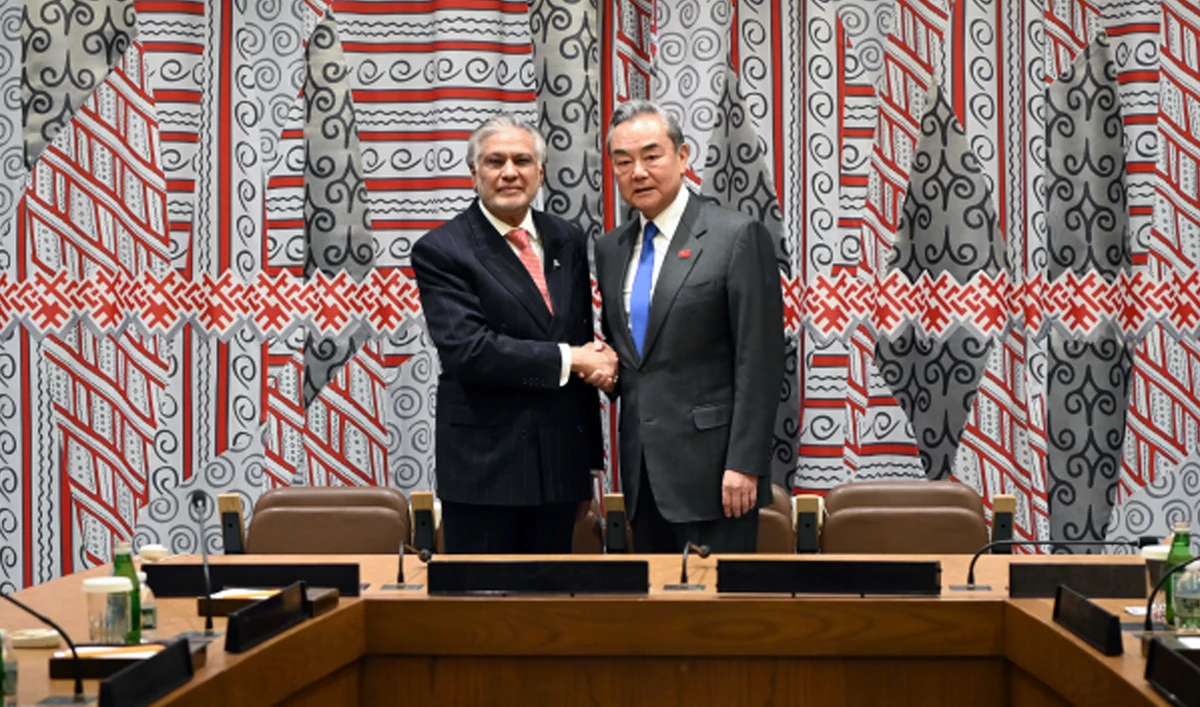
Against this background, Pakistan’s Deputy Prime Minister (DPM) and Foreign Minister (FM) Ishaq Dar on Saturday engaged with his counterparts from Egypt, Turkiye and Saudi Arabia to rally diplomatic support.
“DPM/FM briefed FM Wang Yi on the current regional situation,” a statement from Pakistan’s foreign ministry said after Dar spoke to his Chinese counterpart. “He categorically rejected India’s unilateral and illegal actions, as well as its baseless propaganda against Pakistan.”
The statement said both diplomats reiterated their resolve to uphold regional peace and stability, promote mutual respect, and jointly oppose “unilateralism and hegemonic policies.”
“They agreed to maintain close communication and coordination at all levels to advance their shared objectives of peace, security, and sustainable development in the region and beyond,” the foreign office said.
Dar had similar conversations with his counterparts from Saudi Arabia, Egypt and Turkiye on Saturday.
Prime Minister Shehbaz Sharif also spoke to Iranian President Masoud Pezeshkian on Saturday, saying he would welcome any efforts by Tehran to promote peace between Islamabad and New Delhi.
According to the latest report in The New York Times, Indian Prime Minister Narendra Modi has reached out to over a dozen world leaders while diplomats from 100 missions in New Delhi have been called for briefings.
However, the report said India is not rallying the international community for help to de-escalate tensions with Pakistan.
“Instead, according to four diplomatic officials aware of the discussions, New Delhi appears to be building a case for military action against its neighbor and archenemy,” the report said.
After the Pahalgam attack, New Delhi suspended the 1960 Indus Waters Treaty with Pakistan unilaterally, recalled defense staff, announced the closure of the main land Attari-Wagah border crossing with Pakistan, downgraded diplomatic ties and withdrew special visas for Pakistani nationals.
In response, Islamabad ordered the expulsion of Indian diplomats and military advisers, canceled visas for Indian nationals, with the exception of Sikh pilgrims, and also announced it was closing the main border crossing from its side.
Pakistan has said any attempt by India to stop the supply of water from the Indus River would be seen as an “act of war” and replied with the “full force of national power.”
According to international news agency AFP, troops from Pakistan and India exchanged fire in disputed Kashmir for a third night in a row on Saturday.
Kashmir has been disputed between India and Pakistan since independence from British rule in 1947. Both rule it in part but claim it in full and have fought two wars over the Himalayan territory.