ISLAMABAD: Pakistan’s Deputy Prime Minister (DPM) and Foreign Minister (FM) Ishaq Dar on Saturday engaged with his counterparts from Egypt and Turkiye and held a meeting with China’s envoy as Islamabad seeks to rally diplomatic support after rejecting India’s accusations over a deadly militant attack on tourists in Kashmir.
At least 26 people were killed earlier this week when gunmen opened fire at a popular tourist site in Indian-administered Kashmir, in one of the deadliest attacks on civilians in the disputed region in decades.
India blamed Pakistan for orchestrating the attack amid calls for retaliatory strikes from its media. Islamabad denied any involvement, warning of a “befitting response” to any escalation and offering a neutral investigation into the incident.
India has already unilaterally suspended the Indus Waters Treaty (IWT), a landmark river water distribution mechanism signed in 1960, expelled Pakistani diplomats and shut down a major land border crossing.
Dar discussed recent regional developments over the phone with Egypt’s Foreign Minister Badr Abdelatty during the day.
“DPM/FM Dar firmly rejected India’s baseless allegations, condemned its unilateral actions, and false propaganda against Pakistan,” Pakistan’s foreign ministry said in a statement after the two officials held the conversation.
“He reaffirmed Pakistan’s commitment to safeguarding its national interests while promoting regional peace and stability,” it added.
In a separate call with Turkish Foreign Minister Hakan Fidan, Dar briefed him on decisions taken by Pakistan’s National Security Committee in response to India’s accusations.
He thanked Turkiye for its consistent support to Pakistan at international forums, and the two sides agreed to maintain close coordination as tensions rise in the region.
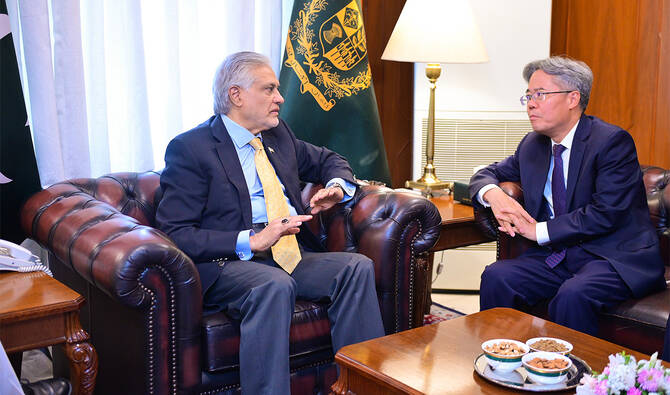
Earlier in the day, the deputy prime minister met Chinese Ambassador Jiang Zaidong in Islamabad.
Reaffirming their “all-weather strategic partnership,” both Pakistan and China agreed to maintain close communication and coordination, said another statement.
Dar’s conversation with Jiang comes at a time when Pakistan has rejected India’s move to suspend the IWT, warning that any attempt to block waters from flowing into Pakistan would constitute an act of war and set a dangerous precedent for New Delhi, given India’s own reliance on rivers originating from China.


Pakistan engages Egypt, Turkiye, China after rejecting India’s accusations over Kashmir attack
https://arab.news/bwgsk
Pakistan engages Egypt, Turkiye, China after rejecting India’s accusations over Kashmir attack

- Ishaq Dar reaffirms Pakistan’s commitment to safeguarding its national interests in his conversations
- China and Pakistan agree to have close communication, coordination over the regional developments

Magnitude 5.6 earthquake jolts parts of Pakistan, no losses reported
- Tremors were felt in Swat, Peshawar and Chitral in Khyber Pakhtunkhwa, as well as in the federal capital Islamabad
- Pakistan Meteorological Department measures quake’s depth at 114 km, identifies Hindu Kush region in Afghanistan as epicenter
ISLAMABAD: A 5.6-magnitude earthquake jolted parts of Pakistan on Wednesday evening, the Pakistan Meteorological Department (PMD) said with no loss of lives or massive damage to property reported.
The tremors were felt in the federal capital, Islamabad, as well as the northwestern cities of Swat, Peshawar and Chitral in Pakistan’s Khyber Pakhtunkhwa province, the PMD said.
“An earthquake recorded on 25-02-2026 at 16:12 PST with a 5.6-magnitude and a depth of 114km,” the PMD said in a statement. “Its epicenter was the Hindu Kush Region Afghanistan.”
Earthquakes are common in Afghanistan, particularly along the Hindu Kush mountain range, where the Eurasian and Indian tectonic plates meet.
In August last year, a shallow 6-magnitude earthquake in eastern Afghanistan flattened mountainside villages and killed more than 2,200 people. Weeks later, a 6.3-magnitude quake in northern Afghanistan killed at least 27.
Powerful tremors struck western Herat in Afghanistan, near the Iranian border, in 2023, and the Nangarhar province in 2022, killing hundreds and destroying thousands of homes.


