ATHENS: Authorities in Greece have arrested six people on the island of Crete in connection with an alleged antiquities smuggling ring that was attempting to sell dozens of ancient artifacts, police said Thursday.
The arrests came after a sting operation on Wednesday, during which the suspects were reportedly trying to sell a collection of antiquities. Investigators say the group operated as a coordinated criminal network, with clearly defined roles, including a leader, go-betweens, and a designated transporter.
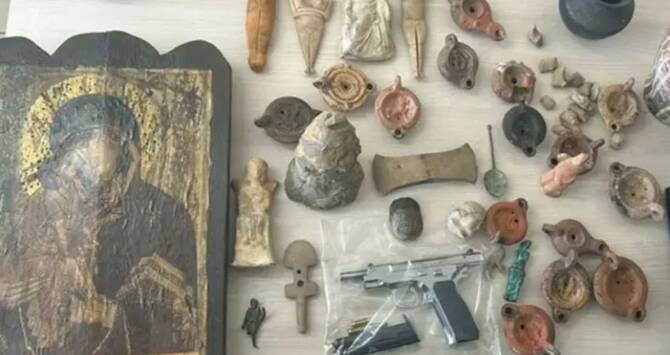
Among the recovered items were 15 ancient oil lamps, 17 figurines or fragments, several ceramic vessels, and a marble sculpture believed to depict a child’s head. All are thought to date from various periods of ancient Greek history and will be assessed by a state archaeological service.
Police also confiscated metal detectors and scanning equipment believed to have been used to locate buried relics, as well as firearms, ammunition, quantities of cannabis, and more than 3,000 euros ($3,200) in cash.
Greece, known for its rich archaeological heritage, has long battled the illicit trade in antiquities. Despite strict national laws, such artifacts remain highly sought-after on the international black market.
All six suspects are facing multiple charges, including membership in a criminal organization and breaches of cultural heritage protection legislation.

Dozens of ancient artifacts seized in Greek island smuggling raid
https://arab.news/b89rr
Dozens of ancient artifacts seized in Greek island smuggling raid
- Among the recovered items were 15 ancient oil lamps, 17 figurines or fragments
- Police also confiscated metal detectors and scanning equipment believed to have been used to locate buried relics
French musician joins Saudi talents for creative residency in historic Al-Balad
- Collaboration ‘fosters dialogue through music’ ahead of Jeddah concert
- Stracho Temelkovski: ‘Maybe it’s humility, maybe it’s the respect I feel in this area. I know it’s a very important place, and I feel good energy’
JEDDAH: A creative residency encouraging musical collaboration between Saudi and French artists was held in Jeddah’s Al-Balad this week.
The French Consulate General in Jeddah, in partnership with the Tariq Abdulhakim Museum, the French Embassy, and Alliance Francaise, brought together French musician Stracho Temelkovski and five Saudi artists for the residency.
Held from Nov. 27 to Dec. 5, the program featured multi-instrumentalist Temelkovski along with Saudi talents Sultan Al-Qurashi on oud, Ziyad Ayman Saeed on violin, Amin Mohammed Abu Harb on semsemiya, Abadi Abdulrahim Al-Qurashi on drums, and singer Mada Ali Al-Ghamdi.
Over several afternoons of musical exchange, they worked on a collaborative repertoire that will culminate in a public performance on Friday night, Dec. 5, at Festival Garden in Al-Balad’s Cultural Square.
Temelkovski described the residency as a natural extension of his lifelong artistic mission. “I really like to make bridges in my music,” he said. “That’s one of the aims. Music has to be something deep, and I try every time to make a real meeting with another culture.”
He added that the chance to collaborate with Saudi musicians resonated with his own background. “I have oriental roots from Macedonia. Even though I’m French, this inspired me to make this bridge happen with Saudi culture because it’s something different from what I’m used to, and it was really exciting.”
During his time in Jeddah’s Old Town, Temelkovski said Al-Balad became a source of quiet creative energy.
“I feel really welcomed at Al-Balad. It’s something you cannot explain. Maybe it’s humility, maybe it’s the respect I feel in this area. I know it’s a very important place, and I feel good energy. I feel I’m welcome. Every person, every musician I met and all the staff have been so kind to me.
“That’s not a small detail because I feel everyone is really involved, and it helps me be in a creative process.
“Being in this museum feels like meeting between my music and Saudi Arabia. Tariq Abdulhakim was one of the greatest musicians in this land, and I have the impression that I’m meeting his sons. It’s something very deep for me.”
Studying the late maestro’s compositions further shaped Temelkovski’s experience.
“I have listened to his music, and it really inspires me because I like this music. It’s so rich in the melodic interpretation and in the rhythm. I even feel a link with my Macedonian roots in the rhythmic way,” he said.
Mohammed Nehad, consul general of France in Jeddah, highlighted the significance of the collaboration, saying: “This artistic residency illustrates the ambition shared by France and Saudi Arabia to foster dialogue between traditions, open up new spaces for creativity, and support today’s talents.
Nehad said that meeting between Temelkovski and the Saudi musicians, made possible thanks to the commitment of the Tariq Abdulhakim Museum, “demonstrates the strength of Saudi Arabia’s musical heritage and the creativity that arises from the intersection of cultures.”
Larry Lamartiniere, managing director of Alliance Française, added: “This event perfectly embodies the mission of the Alliance Française Saudi Arabia which is building cultural bridges through dialogue, creativity and shared experiences.”
Saudi drummer Al-Qurashi said that the residency expanded his creative perspective.
“Working with Stracho mixed Arabic, French and Saudi styles, and it really changed how I listen, perform and connect with musicians. It was a big step for me personally, and it helps show the world the beauty of Saudi music when it blends with new cultures.”
Referring to the upcoming concert, he said: “I’m excited for the audience to feel the unique mix of Saudi and French styles and the new energy we created together.”
Singer Al-Ghamdi described the residency as an artistic turning point. “Working with him made everything feel easier, and he always made sure the work came from passion and authenticity, not from pressure or abdication.
“That really aligns with who I am as an artist,” she said. “I often struggle with rigidity and lack of creativity when collaborating with some musicians.
“In the past, I worked with artists who made me feel like art was exhausting and heavy. But Mr. Stracho brought me back to my core. He reminded me that art has no limits, no fixed rules, no single language or style. It’s a space full of freedom and humanity.”
Al-Ghamdi, whose style is a blend of Oriental, Arabic, English, and predominantly Western influences, said that the residency supported her global artistic ambitions.
“My goal is for my art to reach global audiences, not just the Gulf or Middle East. As a Saudi woman, I have a vision, feelings, and ideas I want to share proudly.
“I want to show the world the real Saudi culture — its beauty, strength, wisdom and pride.”
Preparing for the concert on Friday, Al-Ghamdi said she looked forward to bringing her authentic self to the stage. “I want the audience to feel the message that being true to yourself is powerful. There is no need to complicate things or fear judgment.
“The more authentic and open-minded we are, the faster we connect. Difference is the essence of beauty, and love is the foundation that brings us together. Clean, honest music is the best way to elevate the soul.”
Temelkovski expressed similar hopes for the final performance. “It’s the bridge. I want to share not just entertainment but a ritual together, a meeting between my identity and Saudi music and all these wonderful musicians.
“When music has no lyrics, sometimes it’s easier to be universal. I want to give something unique, something new. I want the experience to be a kind of meditation, but also to dance and express happiness.”


