Pakistan pauses controversial canals project amid protests in Sindh

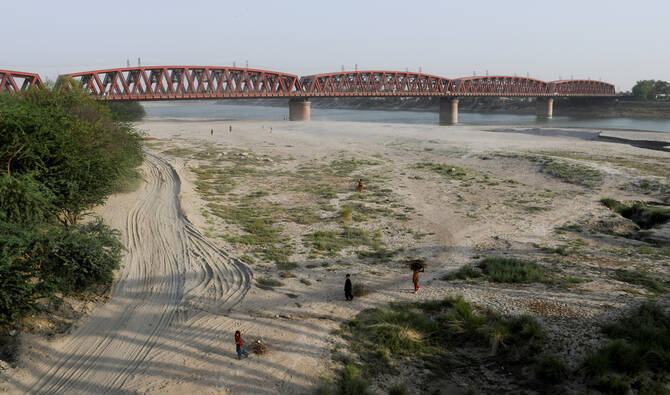
People walk on the dry riverbed of the Indus River in Hyderabad, Pakistan on April 24, 2025. (REUTERS)
Short Url
Updated 24 April 2025
Follow

Pakistan pauses controversial canals project amid protests in Sindh

  • Nationalist parties, civil society members in fear project to build canals on River Indus will trigger water shortages
  • Shehbaz Sharif says there will be no further progress on canals until all provinces reach a consensus over the matter

ISLAMABAD: Prime Minister Shehbaz Sharif announced on Thursday that the federal government will pause constructing new canals on River Indus until a consensus develops between Pakistan’s provinces on the matter, following outrage and sit-in protests in Sindh.
Pakistan’s government launched an ambitious agricultural project in February to build a network of six canals on River Indus. The government says it aims to irrigate millions of acres of barren lands and ensure food security for the 240-million strong country.
However, critics say the project would trigger water shortages in the southern parts of the country, especially Sindh. Lawyers, members of the civil society and supporters of nationalist parties in Sindh have disrupted trade and traffic on the province’s National Highway since last Friday, staging sit-in protests over the issue.
Pakistan Peoples Party (PPP), a key ally of the ruling coalition led by Sharif and the largest party in Sindh, has led protests against the project. PPP Chairman Bilawal Bhutto Zardari met Sharif on Thursday to discuss the canals issue and Pakistan’s prevailing tensions with India.
“We must resolve this issue through mutual consent and dialogue,” Sharif said with Bhutto Zardari by his side. “And today, in the meeting held between the Pakistan Peoples Party and the Pakistan Muslim League (Nawaz), we have mutually agreed that no new canals will be constructed until a decision is reached via consensus in the Council of Common Interests (CCI).”
The CCI is a constitutional body whose members are appointed by the president on the advice of the prime minister. The council resolves power-sharing and other disputes between the federation and the provinces.
Sharif said the center had decided that there will be “no further progress” on canal-related matters unless a consensus is developed among provinces. 
“Therefore, we have decided today that a meeting of the Council of Common Interests will be convened on Friday, May 2, in which the Pakistan Peoples Party and the Pakistan Muslim League-Nawaz, and the federal government’s decisions will be endorsed,” he added.
Bhutto Zardari thanked the prime minister for listening to his concerns regarding the issue, saying that the CCI meeting will endorse the decision that no new canals would be constructed without consensus on the matter. 
“Today, we are not taking a decision together but are merely agreeing that without consensus on water-related matters, no new canals are being made,” he said. 
The PPP last week threatened to withdraw its support for Sharif’s ruling coalition government if it decided to go ahead with building the new canals. Bhutto Zardari’s party, which emerged as the second-largest political party after the controversial 2024 general election in Pakistan, Sharif get elected prime minister last year.
The PPP settled for the presidency and governorships in Punjab and Khyber Pakhtunkhwa (KP) provinces, areas where it performed poorly in the national polls.


Pakistan rules out talks with Afghanistan, says over 330 Afghan fighters killed in clashes

Updated 10 sec ago
Follow

Pakistan rules out talks with Afghanistan, says over 330 Afghan fighters killed in clashes

  • Clashes between the neighbors erupted after Pakistan’s airstrikes on Afghan territory last weekend
  • US voices support for Pakistan, Information Minister Attaullah Tarar says they aim to make Pakistan safe

ISLAMABAD: Pakistan has ruled out any talks with Afghanistan until an end to “terrorism” emanating from the Afghan soil, officials said on Friday, following the killing of more than 330 Afghan fighters in cross-border clashes this week.

The latest clashes between the neighbors erupted after Pakistan’s airstrikes on Afghan territory last weekend triggered Afghan retaliatory attacks along the border on Thursday, escalating long‑simmering tensions over Pakistan’s claim that Afghanistan shelters Pakistani Taliban militants. Afghanistan denies this and argues Pakistan is deflecting blame for its own security failures.

Pakistani Information Minister Attaullah Tarar said they had killed 331 Afghan fighters, destroyed over 100 posts and targeted 37 military locations across Afghanistan. Afghan officials have said that more than 50 Pakistani soldiers have been killed and several Pakistan posts have been captured by their forces. None of the casualty figures or battlefield claims from either side could be independently verified.

Meanwhile, Mosharraf Zaidi, Prime Minister Shehbaz Sharif’s spokesperson for foreign media, ruled out any talks with Afghanistan until Kabul addresses the issue as the United States (US) expressed his support for what it called Pakistan’s “right to defend itself” against attacks from Afghanistan’s Taliban rulers.

“There won’t be any talks, there is nothing to talk about... Terrorism from Afghanistan has to end,” Zaidi told Pakistani state media, saying Islamabad would continue to target militant havens inside Afghanistan.

“Pakistan’s responsibility is to protect its citizens. If we know that there is a terrorist in point A and we know that there is a terrorist enabler at point A, we will find a weapon to land at point A and eliminate the threat.”

Zaidi said he didn’t expect Pakistan to deviate from this position and that the government had clearly conveyed what it was doing.

“We have clearly articulated what we are doing and what we plan on continuing to do and what it will take for us to stop doing what we are doing,” Zaidi said.

“And we will expect that both the international community and the regime in question, the Afghan Taliban, will come to their senses and will help reduce instability and disorder in this region.”

Pakistan is a major non-NATO ally of Washington, while the US considers the Afghan Taliban to be a “terrorist” group.

“The United States supports Pakistan’s right to defend itself against attacks from the Taliban, a Specially Designated Global Terrorist group,” Reuters quoted a State Department spokesperson as saying. US diplomat Allison Hooker said on X she spoke on Friday with Pakistan Foreign Secretary Amna Baloch.

The State Department spokesperson said Washington was aware of the escalation in tensions and “outbreak of fighting between Pakistan and the Afghan Taliban,” adding the US was “saddened by the loss of life.”

“The Taliban have consistently failed to uphold their counterterrorism commitments,” the State Department said, adding that “terrorist groups use Afghanistan as a launching pad for their heinous attacks.”

Meanwhile, Afghan Taliban spokesperson Zabihullah Mujahid called for talks to resolve the crisis.

“We have always emphasized peaceful resolution, and now too we want the issue to be resolved through dialogue,” he said on Friday afternoon.

Asked what Pakistan desired, Information Minister Tarar said: “Neutralizing the threat and ensuring that Pakistan is safe.”

“Because for us, we’ve been good neighbors, we’ve been very friendly neighbors, we’ve been very, very generous neighbors. Our generosity, unfortunately, has often been seen as our weakness,” he told state media.

“So the objective, aim is to neutralize the threat and make Pakistan safe.”

To a question about a ceasefire, Tarar said it was “too early” to comment on that as it was an evolving situation.