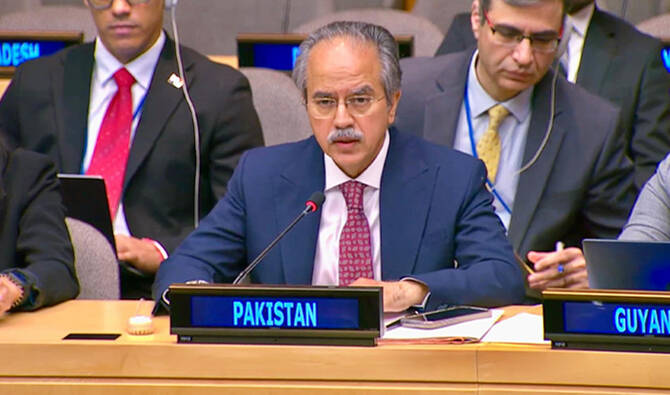
ISLAMABAD: Pakistan’s top diplomat to the United Nations, Ambassador Asim Iftikhar Ahmad, urged the international community to reaffirm it commitment to multilateralism and collective action during a Security Council meeting convened by China on Wednesday.
An informal session, the meeting provided a platform to the member states to discuss the challenges posed by unilateral actions in the current global context.
Ambassador Ahmad highlighted the unraveling of longstanding norms that underpin global peace and cooperation, emphasizing the need to revive faith in multilateralism.
“History reminds us that enduring peace and sustainable solutions have never come from unilateral actions or coercive practices,” he said. “They emanate from inclusion, respect, shared purpose and unified responses.”
The Pakistani diplomat also called for reforms in the international trading system to better reflect the aspirations and needs of developing countries.
“Trade should be a bridge, not a barrier — a vehicle for peace and shared prosperity, not domination or isolation,” he added.
Ahmad underscored the importance of empowering the UN to lead global development cooperation and champion equitable systems of trade, finance and climate governance.
He reaffirmed Pakistan’s unwavering belief in multilateralism and the central role of the world body in fostering a fairer, more peaceful and compassionate international order.
The UN meeting was held at a time when the international community faces increasing polarization, with wars, inequality, economic instability and climate change threatening global peace and security.

Pakistan calls for revival of multilateralism at UN amid rising global tensions
https://arab.news/jxwu7
Pakistan calls for revival of multilateralism at UN amid rising global tensions
- Ambassador Ahmad highlights the unraveling of longstanding norms supporting global peace
- He says international trade should reflect the aspirations and needs of developing countries
UK announces ‘major reset’ of Pakistan development partnership with new trade, climate, education initiatives
- UK commits to increased investment-led cooperation in climate, business regulation and higher education
- London shifts from aid donor to investment-focused partner as bilateral trade crosses $7.3 billion
ISLAMABAD: The United Kingdom on Wednesday unveiled what it called a “major reset” in its development partnership with Pakistan, announcing new investment-focused cooperation, education programs and a bilateral climate compact during a visit by UK Minister for Development Jennifer Chapman.
The trip marks the first federal-level development dialogue between the two governments in eight years and reflects London’s shift from a traditional aid-donor role toward investment-based partnerships. The British government said the new approach aims to use UK expertise to help partner economies build capacity and unlock domestic growth.
Pakistan-UK trade has also reached a record high, crossing £5.5 billion ($7.3 billion) for the first time, with more than 200 British firms now active in Pakistan, an increase London says signals growing two-way commercial confidence.
“Pakistan is a crucial partner for the UK. We work together to tackle the drivers behind organized crime and illegal migration, keeping both our countries safer,” Chapman was quoted as saying in a statement by the British High Commission in Islamabad.
“Our strong bilateral trading relationship brings jobs and growth to us both. And we’re working together to tackle climate change, a global threat.”
The minister and Prime Minister Shehbaz Sharif on Tuesday jointly launched a package of business regulatory reforms aimed at improving Pakistan’s investment climate and making it easier for UK firms to operate. Officials said the initiative supports Pakistan’s economic recovery agenda and creates new commercial avenues for British companies.
A second key announcement was the next phase of the Pak-UK Education Gateway, developed with the British Council and Pakistan’s Higher Education Commission. The expanded program will enable joint research between universities in both countries, support climate- and technology-focused academic collaboration, and introduce a startup fund to help commercialize research. The Gateway will also promote UK university courses delivered inside Pakistan, giving students access to British degrees without traveling abroad.
Accompanied by Pakistan’s Minister for Climate Change Dr. Musadik Malik, Chapman also launched a Green Compact, a framework for climate cooperation, green investment, environmental protection and joint work at global climate forums.
The UK emphasized it remains one of Pakistan’s largest development partners, citing ongoing work in education, health, climate resilience and anti-trafficking capacity building.
During the visit to Pakistan, Chapman will meet communities benefiting from UK-supported climate programs, which London says helped 2.5 million Pakistanis adapt to climate impacts in the past year, and observe training of airport officers working to prevent human trafficking.
“We remain firm friends of Pakistan, including in times of crisis, as shown through our floods response,” Chapman said. “And we know to accelerate growth in both our countries, we must work together in partnership to tackle the problems we face.”