


ISLAMABAD: Pakistani foreign affairs and defense analysts on Wednesday condemned Indian media’s “warmongering” over the recent attack in Indian-administered Kashmir, warning that any military action by New Delhi would compel Pakistan to respond and hence, endanger regional peace.
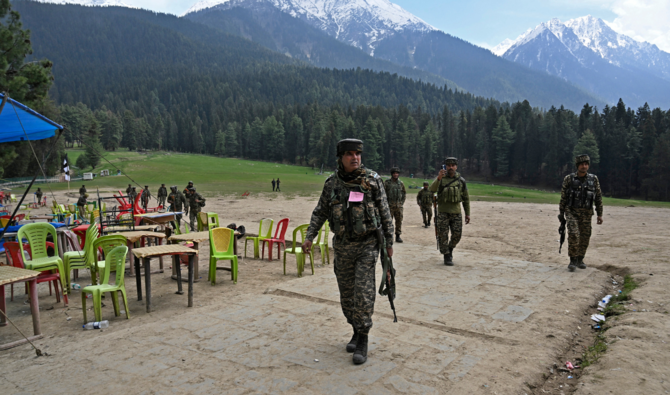
Twenty-six people were gunned down at a tourist site in Indian-administered Kashmir on Tuesday afternoon. The attack took place in Pahalgam, a popular resort town in the Anantnag district, where armed men emerged from forest cover and opened fire on crowds of mostly domestic tourists.
India’s defense minister reacted to the region’s deadliest attack on non-combatants in decades, vowing a “loud and clear” response will be given to those who carried out the attacks as well as those who planned it, while Pakistan expressed concern at the attack. A little-known militant group, the “Kashmir Resistance,” claimed responsibility for the attack in a social media message, saying more than 85,000 “outsiders” had been settled in the region after arriving as tourists, vowing violence against such settlers.
Kashmir is divided between India and Pakistan since 1947, which they both claim fully but rule in part, and has been plagued by years of insurgent violence that New Delhi says is supported by Islamabad. Pakistan denies the accusations, saying it only provides diplomatic support to Kashmiris in their struggle for self-determination.
Such attacks have historically strained ties between India and Pakistan. In 2019, a suicide bombing in Pulwama killed 40 Indian paramilitary personnel and triggered cross-border air strikes, pushing the neighbors to the brink of war.
“Placing blame on Pakistan in a knee-jerk reaction, without investigation or evidence, and even engaging in warmongering is truly unfortunate,” Aizaz Ahmed Chaudhary, a former Pakistani foreign secretary, told Arab News.
He said the best course of action for India would be to probe the incident dispassionately, adding that Pakistan may even cooperate with the investigation.
“But they don’t talk to Pakistan at all, I think that would help us all reach the actual perpetrators who must be punished,” Chaudhary said.
Pakistan’s foreign office, government officials and the defense ministry did not respond to Arab News’ requests for comment.
Meanwhile, geopolitical and defense analyst Lt. Gen. (retired) Ghulam Mustafa described the attack as a “false flag operation,” alleging it was deliberately planned at a time when US Vice President JD Vance was in India.
He criticized the Indian media’s coverage of the incident.
“India has to do something because they have created significant hype around this issue,” Mustafa said. “And now they must address it, likely through some form of action against Pakistan along the Line of Control.”
Former diplomat Masood Khalid said it was a pity that the Indian media was in a state of frenzy and was accusing Pakistan without evidence.
“With over 700,000 Indian troops present in IoK [Indian occupied Kashmir], one wonders how the militants could make an ingress deep inside the occupied territory,” he questioned.
Khalid hoped India would address the grievances of the people of Kashmir, saying that they were waging a struggle for their right to self-determination.
Dr. Qamar Cheema, executive director of the Sanober Institute, a think tank that focuses on issues in Pakistan and South Asia, said there is a possibility that India may further downgrade relations with Pakistan given the sensitivity of the situation.
“Indian media, often echoing government views, can shape public sentiment that justifies military action against Pakistan,” Cheema explained. “Especially as the Indian defense minister has already met with service chiefs.”
’WILL NOT TAKE IT LYING LOW’
Chaudhary said that if India launched an attack anywhere in Pakistan, it would be “most irresponsible.”
“I mean Pakistan has the capacity to defend itself and would not really take it lying low; therefore, they [India] must not get into this otherwise it can be very costly for this whole region,” he said.
Khalid agreed.
“On its part, Pakistan will be fully prepared to respond to any aggressive move by India,” he said.
A security official who spoke on condition of anonymity said India was diverting attention from the episode when the TRF had already claimed responsibility for the attack.
“Have the consequences of this hysteria been weighed? Pakistan, will not remain passive in the face of any action across its borders and the consequences will disturb regional peace,” he said.


