Pakistan central bank expected to cut key interest rate— survey

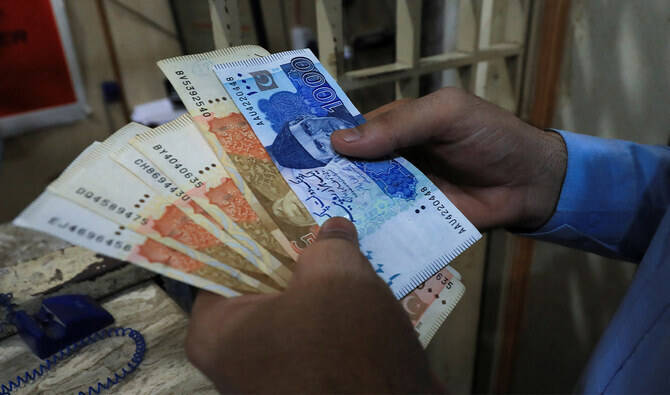
A man counts Pakistani rupee notes at a currency exchange shop in Peshawar, Pakistan, on September 12, 2023. (REUTERS/File)
Short Url
Updated 23 April 2025
Follow

Pakistan central bank expected to cut key interest rate— survey

  • Topline Securities' poll says 69% expect rate cut of at least 50bps while 31% believe central bank will observe status quo
  • Falling oil prices, falling dollar index and higher remittances also make a strong case for a rate cut, says Topline Securities 

ISLAMABAD: Pakistan’s central bank is expected to slash the policy rate in its upcoming Monetary Policy Meeting (MPC), a leading brokerage firm said on Wednesday, saying decreasing global oil prices and higher remittances make a strong case for a cut. 

The State Bank of Pakistan (SBP) kept the interest rate unchanged at 12 percent in its last MPC meeting in March. The central bank put a hold on slashing the interest rate after it made a series of cuts totaling 1,000 basis points to revive the economy from a record high of 22 percent in June 2024.

The SBP is scheduled to hold its MPC committee meeting on May 5, Topline Securities said. 

“In a Poll conducted by Topline Securities, 69 percent of the market participants expect a rate cut of at least 50bps, while 31 percent believe that the central bank will observe the status quo,” Topline Securities said in a report.

“The ratio of participants observing status quo has come down from 38 percent in previous poll to current 31 percent.”

The report said out of this 69 percent, 37 percent expect a rate cut of 50bps while 30 percent expect a rate cut of 100bps. Only 2 percent expect a rate cut of 150bps.

Topline Securities said that the SBP has further room to cut around 200bps till December as the FY26 inflation can average between 6-7 percent, translating into a real rate of 500-600bps. 

“Furthermore, falling oil prices, falling dollar index and higher remittances also make a strong case for a rate cut,” it added. “However, the sustainability in prices/index of the former two (oil and dollar) is yet to be seen.”

Topline Securities said that despite its view, it believes the central bank will observe the status quo in the upcoming MPC meeting due to various reasons. 

It said the expected foreign inflows for the second half of FY25 have not materialized yet and are expected to be received once the first review of the International Monetary Fund is approved by the Board. 

Furthermore, the IMF has also mentioned in its press release that Pakistan remains committed to maintaining a sufficiently tight monetary policy to keep inflation low.

It said another reason why the central bank will maintain the same rate is because the US tariff risks still loom and “we expect the central bank to maintain status quo till any clarity on this global development.”

Inflation in Pakistan soared to around 40 percent in May 2023, driven by currency devaluation and subsidy removals for IMF approvals. But inflation dropped to a near-decade low of 1.5 percent in February, providing room for the central bank to boost growth.

Economists also warn of the risk of the government taking advantage of lower interest rates to increase borrowing for an expansionary budget. That would potentially destabilize the progress made under the IMF program and crowd out the private sector.

With additional input from Reuters


Pakistan engages Saudi Arabia, China in bid to ease surging Middle East tensions 

Updated 10 March 2026
Follow

Pakistan engages Saudi Arabia, China in bid to ease surging Middle East tensions 

  • Pakistan’s foreign minister stresses need for de-escalation in conversations with Chinese, Saudi counterparts
  • Tensions in the Middle East continue to remain high as conflict between US, Israel and Iran intensifies

ISLAMABAD: Pakistan’s Deputy Prime Minister Ishaq Dar spoke to the foreign ministers of Saudi Arabia and China on Tuesday, stressing the importance of diplomatic engagement to de-escalate tensions in the Middle East as the Iran war intensifies. 

Pakistan has constantly engaged regional countries in efforts to broker a ceasefire in the Middle East, after the US and Isreal launched coordinated strikes against Iran on Feb. 28. 

Iran launched fresh attacks on Gulf countries on Tuesday morning, where it has targeted US military bases in recent weeks. In addition to firing missiles and drones at Israel and American bases in the region, Iran has also been targeting energy infrastructure which, combined with its stranglehold on the Strait of Hormuz, has sent oil prices soaring worldwide. 

Dar spoke to Saudi Foreign Minister Prince Faisal bin Farhan to discuss developments in the Middle East and ongoing deliberations at the UN Security Council, Pakistan’s foreign office said in a statement. 

“DPM/FM shared Pakistan’s perspective, underscoring the importance of continued coordination and diplomatic engagement to support de-escalation and promote peace and stability across the region and beyond,” the statement said. 

Dar, who also serves as Pakistan’s foreign minister, spoke to Chinese foreign minister Wang Yi over the telephone separately. The two discussed the evolving regional situation and broader global developments.

Dar underscored the need to ease tensions in the Middle East and the wider region during the conversation, the foreign office said. 

Yi appreciated Pakistan’s constructive efforts aimed at promoting de-escalation and stability in the region, it added. 

“The two leaders stressed the importance of de-escalation and emphasized the need to pursue dialogue and diplomacy in accordance with the principles of the UN Charter,” the foreign office’s statement said. 

The conflict in the Middle East has hit Pakistan hard as well, forcing Islamabad to hike petrol and diesel prices by Rs55 per liter last Friday. 

Pakistan’s government has also announced a set of austerity measures, which include closing schools and cutting down on government expenditures, as it evaluates petrol stocks and looks for alternative supply routes.