GAVI, Unicef supply refrigerated trucks to strengthen Pakistani children’s access to vaccines 

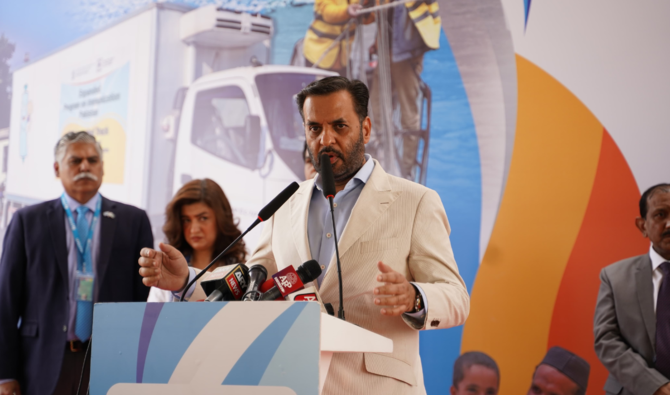
Federal Health Minister Syed Mustafa Kamal speaks at the handover ceremony of 31 refrigerated trucks by UNICEF and Gavi in Karachi, Pakistan on April 23, 2025. (GOP)
Short Url
Updated 23 April 2025
Follow

GAVI, Unicef supply refrigerated trucks to strengthen Pakistani children’s access to vaccines 

  • Five trucks to be allocated to each Pakistani province, says Health Minister Syed Mustafa Kamal
  • Harsh weather, difficult terrains and limited health care facilities complicate delivery of vaccines

ISLAMABAD: The United Nations International Children’s Emergency Fund (UNICEF) and global vaccine alliance Gavi have donated 31 refrigerated trucks to Pakistan, the country’s health ministry confirmed on Wednesday, in their bid to improve vaccine access for children in remote areas.

Children in Pakistan’s remote areas face considerable challenges in accessing vaccines. Many parts of the country, such as mountainous terrains in the north, desert areas in the south and conflict-affected zones lack proper road infrastructure and reliable transportation for vaccines. 

Refrigerated trucks, also known as cold chain vehicles, store vaccines in specific cold temperatures to ensure they do not lose their effectiveness. These trucks were provided through a collaborative effort between the Pakistani government, UNICEF and Gavi, the health ministry said. 

“UNICEF officially handed over 31 refrigerated trucks to the Federal Directorate of Immunization (FDI) in Islamabad today,” the Ministry of National Health Services Regulations and Coordination said. 

Health Minister Syed Mustafa Kamal and UNICEF’s representative in Pakistan, Abdullah Fadil, took part in a ceremony during which the trucks were handed over to Pakistan. 

The ministry quoted Kamal as saying that five refrigerated trucks would be allocated to each province of the country.

“These new refrigerated vehicles will significantly strengthen access to life-saving vaccines for children across Pakistan, including the remote regions of Gilgit-Baltistan and other hard-to-reach areas,” he said. 

Kamal also spoke about Pakistan’s ongoing national anti-polio drive, which began on Apr. 21 and will run for seven days. Over 450,000 frontline workers are taking part in the drive. 

The health minister expressed concern over parents’ growing refusals for polio drops and directed authorities to file a police report against vaccine refusers.

“Every child has the right to be protected from preventable diseases,” UNICEF’s Fadil was quoted as saying. “By safeguarding vaccine potency through a strengthened cold chain, we are making strides toward a healthier Pakistan where every child is fully immunized.”

The health ministry said UNICEF, with support from Gavi, was also providing technical assistance to improve vaccine micro plans, cold chain system strengthening and real-time monitoring.

This latest initiative builds upon ongoing support for vaccine access in Pakistan, which included the delivery of 23 refrigerated vehicles in 2021 and seven pick-up trucks earlier this year. 


Pakistan’s Mahnoor Omer named among TIME’s ‘Women of the Year’ for 2026

Updated 56 min 18 sec ago
Follow

Pakistan’s Mahnoor Omer named among TIME’s ‘Women of the Year’ for 2026

  • Omer moved a Pakistani court against the so-called ‘period tax’ in Sept. 2025 which has since sparked a national debate
  • Taxes on sanitary pads in Pakistan can add up to 40 percent to retail price, UNICEF says only around 12 percent women use such products

ISLAMABAD: Pakistani women’s rights activist Mahnoor Omer, who fought against taxes on menstrual products, has been named among the TIME magazine’s ‘Women of the Year’ for 2026.

Omer’s efforts have been recognized alongside 16 activists, artists, athletes and businesswomen in the TIME’s Women of the Year 2026 list, including Olympic gold medalist Sydney McLaughlin-Levrone and Oscar-nominated filmmaker Chloe Zhao.

Dissatisfied with the efforts to educate Pakistani girls about sexual violence, Omer founded the Noor Foundation at the age of 14 and held her own workshops with village girls about everything from climate change to menstruation, according to the TIME magazine.

Two years later, a conversation with a domestic worker about the price of pads made her realize that not everyone could afford these essentials. She moved a court against the so-called “period tax” in Sept. 2025 and the case has sparked a national debate on the subject, considered a taboo by many in Pakistan, since its first hearing late last year.

“A decade and one law degree after her interest in activism was sparked, Omer, now 25, is putting her passion and expertise to work in the name of gender equity,” TIME wrote about Omer on its website.

Taxes imposed on sanitary products in Pakistan can add up to 40 percent to the retail price. UNICEF estimates just 12 percent of women in the country use commercially produced pads or tampons. The alternative, using cloth, risks health impacts including rashes and infections, and can make it impossible for girls to attend school while menstruating.

Omer’s suit, which awaits the government response, has sparked a national discussion. She says she spoke about menstruation to her father and male cousins, who thanked her for standing up for their daughters.
The 25-year-old, who is currently enrolled in a master’s degree in gender, peace, and security at the London School of Economics, sees this case as just the first of many.

“I’m not free until every woman is free,” she was quoted as saying by TIME. “I want to leave no stones unturned in terms of what I can do with the next few decades, as a lawyer for the women in my country and gender minorities in general.”