

Private sector integration advancing to meet Saudi Vision 2030 goals: finance minister

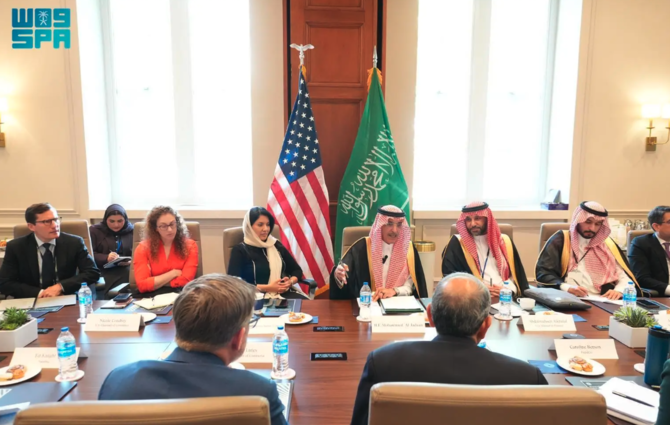
Mohammed Al-Jadaan speaking in a roundtable meeting at the US Chamber of Commerce. SPA
Short Url
Updated 23 April 2025
Follow

Private sector integration advancing to meet Saudi Vision 2030 goals: finance minister

JEDDAH: Saudi Arabia is stepping up efforts to strengthen its economy by deepening private sector partnerships and improving regulatory practices, the Kingdom’s finance minister has said.

Speaking during a roundtable at the US Chamber of Commerce, held on April 23 in Washington alongside the 2025 Spring Meetings of the World Bank Group and the International Monetary Fund,  Mohammed Al-Jadaan said Saudi Arabia’s Vision 2030 seeks to reshape and diversify the country’s economy.

This year’s Spring Meetings of the World Bank Group and the IMF take place against the backdrop of rising trade tensions sparked by US President Donald Trump’s tariff announcement, raising concerns regarding global economic forecasts and the impact on various economies.

According to the Saudi Press Agency, Al-Jadaan “emphasized that one of the Kingdom’s key priorities is establishing clear frameworks and effective governance to enhance integration with the private sector, support economic growth, and achieve the objectives of the Vision.”

The drive to diversify the Saudi economy saw the Kingdom’s gross fixed capital formation reach SR1.18 trillion ($313.68 billion) in 2024, reflecting a 5.3 percent annual increase. This growth was driven by a 7.6 percent rise in private sector investments, according to the Ministry of Investment.

The roundtable was attended by Saudi Arabia’s Ambassador to the US Reema bint Bandar and following his participation in the meeting, Al-Jadaan said in a post on his X account: “We discussed ways to enhance the economic partnership between Saudi Arabia and the US, as well as the valuable investment opportunities under Saudi Vision 2030.”

He added that he held talks with US Treasury Secretary Scott Bessent on strengthening bilateral and multilateral cooperation, focusing on supporting the efforts of the IMF and the World Bank.

In a separate post, the minister said: “I also met with Tobias Adrian, the IMF’s financial counsellor and director of the monetary and capital markets department, as well as Pierre-Olivier Gourinchas, the IMF’s economic counsellor and director of research. We discussed recent developments in global macroeconomic and financial policies.”

In an additional post on X, Al-Jadaan said he held talks with Indermit Gill, the World Bank’s senior vice president for development economics and chief economist, and Ousmane Dione, the bank’s vice president for the Middle East and Africa region. Al-Jadaan added: “We discussed economic developments globally and regionally.”

Al-Jadaan also met with the Syrian Minister of Finance Mohammed Barnieh and the Central Bank of Syria Governor Abdulkader Husrieh to discuss the latest economic developments in Syria and explore ways to strengthen bilateral cooperation.

A further meeting was held with Sweden’s Minister of Finance Elisabeth Svantesson to discuss global economic developments and ways to enhance bilateral collaboration.


PIF-backed AviLease achieves revenue of $664m and 19% growth in 2025

Updated 27 February 2026
Follow

PIF-backed AviLease achieves revenue of $664m and 19% growth in 2025

RIYADH: Saudi Arabia’s Public Investment Fund-backed AviLease achieved exceptional performance and sustainable business growth during 2025, supported by the strategic expansion of its global platform.

According to its financial results for 2025, AviLease recorded total revenues of $664 million, an annual increase of 19 percent, driven by disciplined growth in its asset portfolio and strong performance in aircraft remarketing amid sustained global demand for modern, fuel-efficient aircraft, the Saudi Press Agency reported.

Profit before tax doubled compared to the previous year, reaching $122 million. The year witnessed an expansion in AviLease’s portfolio, reaching 202 owned and managed aircraft, leased to over 50 airline companies in more than 30 countries. 

The total value of the company’s assets stabilized at $9.3 billion. AviLease maintained a 100 percent fleet utilization rate, reflecting the resilience of its business model, the efficiency of its asset management, and the strength of its strategic relationships with airlines around the world.

AviLease concluded purchase agreements for aircraft from Airbus, including the A320neo family and A350F, and Boeing 737 aircraft, aiming to enhance its future asset portfolio with modern, fuel-efficient aircraft. This step will contribute to supporting future growth and meeting increasing customer demand for the latest aircraft, aligning with the Kingdom’s ambitions to become a leading global aviation hub.

AviLease strengthened its prestigious credit standing by obtaining a strong Baa2 credit ratings from Moody’s and BBB from Fitch, reflecting its financial solidity, managerial discipline, and efficiency in managing leverage. The company also successfully issued senior unsecured bonds worth $850 million last November under Regulation 144A/RegS. This issuance contributed to diversifying its funding sources and enhancing its financial flexibility.

Commenting on the results, AviLease CEO Edward O’Byrne said: “This exceptional performance reflects the quality of the company’s investment portfolio, the strength of its partnerships with airlines, and its strategic focus on responsibly deploying capital into highly sought-after, efficient, modern aircraft assets.”

He added: “As aviation markets continue to grow, AviLease is strategically positioned to continue its expansion plans and deliver sustainable long-term value for shareholders, contributing to the Kingdom’s ambitions.”

Throughout 2025, AviLease continued to play a pivotal role in the Kingdom’s growing aviation sector and contributed directly to the launch and scaling of the new national carrier, Riyadh Air, by completing a sale and leaseback transaction for a Boeing 787-9 aircraft, which thereby became the first aircraft to join the airline’s fleet.

AviLease also established a strategic partnership with Hassana Investment Co. This partnership aims to provide an opportunity for local and international investors to enter the aircraft financing asset class and benefit from AviLease’s technical expertise and operational capabilities to support partnership growth and enhance performance. 

Hassana Investment Co. has agreed to acquire an initial portfolio of 10 modern aircraft from AviLease.