First Indonesian Hajj pilgrims to reach Saudi Arabia next week

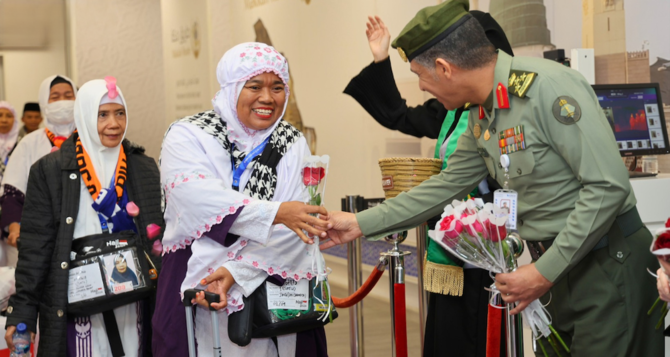
Indonesian pilgrims arrive in Madinah for the annual Hajj pilgrimage on May 12, 2024 in this file photo. (Indonesian Consulate General in Jeddah)
Short Url
Updated 23 April 2025
Follow

First Indonesian Hajj pilgrims to reach Saudi Arabia next week

  • Kingdom’s Makkah Route initiative will facilitate pilgrims in Jakarta, Surabaya and Solo
  • Thousands of Indonesian Hajj officers will be stationed in Makkah, Madinah and Jeddah

JAKARTA: The first group of more than 1,500 Indonesian pilgrims will depart for Saudi Arabia under the Makkah Route initiative next week, as 221,000 are expected to take part in this year’s Hajj.

In 2025, the Hajj is expected to take place on June 4 and end on June 9.

Though the pilgrimage itself can be performed over five or six days, many pilgrims arrive early to make the most of the once-in-a-lifetime opportunity to fulfill their religious duty.

“Indonesian pilgrims will start departing on May 2, and this will be our first batch,” Hilman Latief, director general of Hajj and Umrah management at the Ministry of Religious Affairs, told Arab News.

“Some of them are still in the visa processing stage, but we are optimistic that their visas will be issued before their departure … we hope that the Hajj journey this year can go smoothly, and that our pilgrims will have a comfortable and safe trip.”

Indonesia, the world’s biggest Muslim-majority nation, sends the largest Hajj contingent of pilgrims every year to perform the spiritual journey that is one of the five pillars of Islam.

Its first Hajj flights are scheduled to depart from the cities of Jakarta, Surabaya and Solo, where Indonesian pilgrims will be facilitated under Saudi Arabia’s Makkah Route initiative.

Launched in Muslim-majority countries in 2019, the program allows Hajj pilgrims to fulfill all visa, customs and health requirements in one place, at the airport of origin, and save long hours of waiting before and upon reaching the Kingdom.

When they arrive in Saudi Arabia, Indonesians will be assisted by more than 4,000 Hajj officers who are stationed in Jeddah, Madinah and Makkah.

Each batch will have four officers, including medics, helping them at all times, said Nasrullah Jasam, who heads the Indonesian Hajj Organization Committee in Saudi Arabia.

“On the ground, the officers are also divided into various sectors. They are tasked to serve the pilgrims with things related to accommodation, transportation and food,” Jasam told Arab News.

“Our Hajj officers have undergone the technical guidance in Jakarta and are now preparing for the same in Saudi Arabia … we are ready.”


Venezuela says oil exports continue normally despite Trump blockade

Updated 9 sec ago
Follow

Venezuela says oil exports continue normally despite Trump blockade

  • Trump warned “Venezuela is completely surrounded by the largest Armada ever assembled in the History of South America”
  • Oil prices surged in early trading Wednesday in London on news of the blockade, which comes a week after US troops seized a sanctioned oil tanker

CARACAS: Venezuela struck a defiant note Wednesday, insisting that its crude oil exports were not impacted by US President Donald Trump’s announcement of a potentially crippling blockade.
Trump’s declaration on Tuesday marked a new escalation in his months-long campaign of military and economic pressure on Venezuela’s leftist authoritarian President Nicolas Maduro.
Venezuela, which has the world’s largest proven oil reserves, shrugged off the threat of more pain, insisting that it was proceeding with business as usual.
“Export operations for crude and byproducts continue normally. Oil tankers linked to PDVSA operations continue to sail with full security,” state oil company Petroleos de Venezuela (PDVSA) said.
Trump said Tuesday he was imposing “A TOTAL AND COMPLETE BLOCKADE OF ALL SANCTIONED OIL TANKERS going into, and out of, Venezuela.”
Referring to the heavy US military presence in the Caribbean — including the world’s largest aircraft carrier — he warned “Venezuela is completely surrounded by the largest Armada ever assembled in the History of South America.”
Oil prices surged in early trading Wednesday in London on news of the blockade, which comes a week after US troops seized a sanctioned oil tanker that had just left Venezuela with over 1 million barrels of crude.
Maduro held telephone talks with UN Secretary-General Antonio Guterres to discuss what he called the “escalation of threats” from Washington and their “implications for regional peace.”
Guterres’s spokesman said the UN chief was working to avoid “further escalation.”

- ‘We are not intimidated’ -

Venezuela’s economy, which has been in freefall over the last decade of increasingly hard-line rule by Maduro, relies heavily on petroleum exports.
Trump’s campaign appears aimed at undermining domestic support for Maduro but the Venezuelan military said Wednesday it was “not intimidated” by the threats.
The foreign minister of China, the main market for Venezuelan oil, defended Caracas in a phone call with his Venezuelan counterpart Yvan Gi against the US “bullying.”
“China opposes all unilateral bullying and supports all countries in defending their sovereignty and national dignity,” he said.
Last week’s seizure of the M/T Skipper, in a dramatic raid involving US forces rappelling from a helicopter, marked a shift in Trump’s offensive against Maduro.
In August, the US leader ordered the biggest military deployment in the Caribbean Sea since the 1989 US invasion of Panama — purportedly to combat drug trafficking, but taking particular aim at Venezuela, a minnow in the global drug trade.
US strikes on alleged drug-smuggling boats in the Caribbean and eastern Pacific have left at least 95 people dead since.
Caracas believes that the anti-narcotics operations are a cover for a bid to topple Maduro and steal Venezuelan oil.
The escalating tensions have raised fears of a potential US intervention to dislodge Maduro.
Mexican President Claudia Sheinbaum waded into the dispute on Wednesday, declaring that the United Nations was “nowhere to be seen” and asked that it step up to “prevent any bloodshed.”

- Oil lifeline -

The US blockade threatens major pain for Venezuela’s crumbling economy.
Venezuela has been under a US oil embargo since 2019, forcing it to sell its production on the black market at significantly lower prices, primarily to Asian countries.
The country produces one million barrels of oil per day, down from more than three million in the early 2000s.
Capital Economics analysts predicted that the blockade “would cut off a key lifeline for Venezuela’s economy” in the short term.
“The medium-term impact will hinge largely on how tensions with the US evolve — and what the US administration’s goals are in Venezuela.”