



SKARDU, Pakistan: In the mountainous region of Gilgit-Baltistan (GB) in northern Pakistan, valleys like Choundha transform into picturesque landscapes each spring, as cherry and apricot blossoms emerge amid lingering snow.
The fleeting natural spectacle draws tourists eager to witness the vibrant contrast of pink and white flowers against snow-covered fields.
Located at an altitude of approximately 2,500 meters, Choundha Valley is surrounded by towering peaks and verdant forests. The region is renowned for its breathtaking scenery and is considered one of the most spectacular areas in Pakistan.
“This is the first time I have seen this valley and also the first time I have fully explored Gilgit-Baltistan,” a female tourist from Lahore, who only identified herself as Sarah, said.
“Seeing the valley was really amazing,” she added. “It was such a beautiful experience. After seeing it, I really felt like I had finally seen real nature. Honestly, I don’t even have the words to fully explain what it was like and how incredible everything we saw was.”
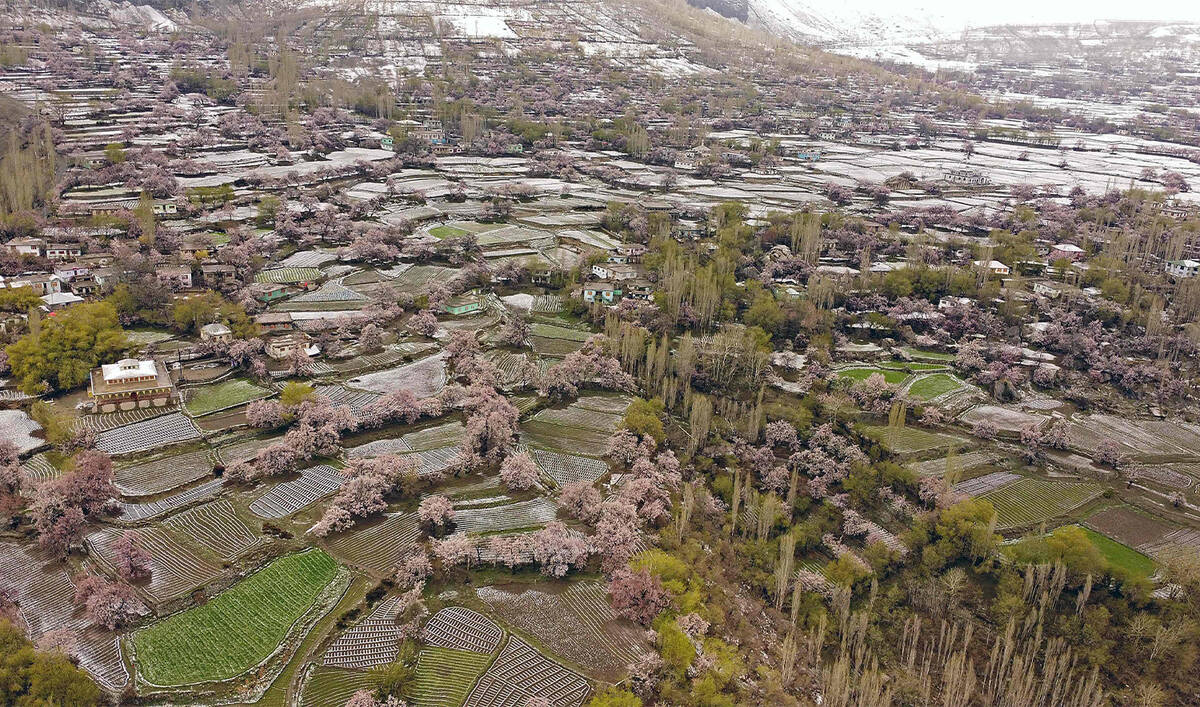
This aerial photograph taken on April 20, 2025 shows a general view of Apricot Blossom trees along the snow covered field at Choundha Valley of Skardu district in Gilgit-Baltistan region. (AFP)
GB, an administrative territory in northern Pakistan, is known for its mountain ranges, including the Karakoram and the western Himalayas. The region is home to five of the world’s 14 peaks exceeding 8,000 meters, including K2, the second-highest mountain globally.
The region’s diverse climate and fertile valleys support a variety of fruit orchards, making it a significant contributor to Pakistan’s fruit production.
The region’s harsh winters and short spring season make the rare overlap of snowfall and blossoms a visual treat.
“By sheer luck, we were able to see both cherry blossoms and snow-covered mountains today,” Muhammad Farqan, 36, said. “This particular spot only happens once in a while — when both snow and cherry blossoms appear together — and we were lucky enough to experience it. Being here lifted my spirits, everything felt vibrant and alive.”
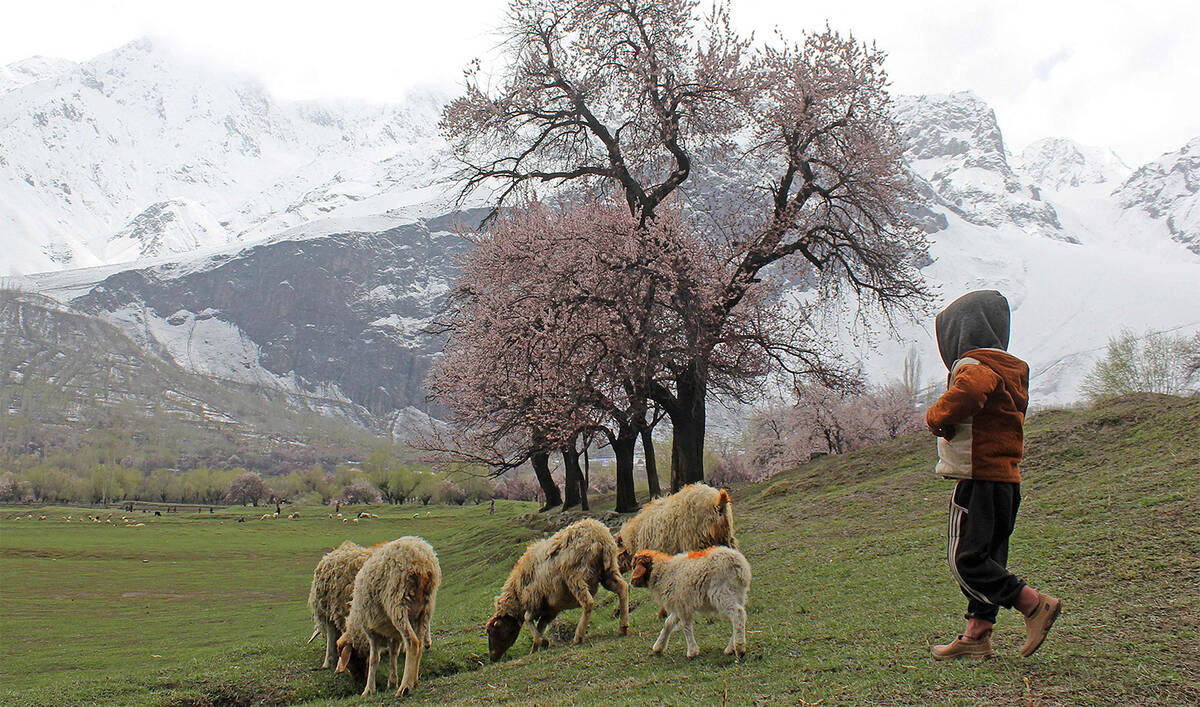
This aerial photograph taken on April 20, 2025 shows a general view of Apricot Blossom trees along the snow covered field at Choundha Valley of Skardu district in Gilgit-Baltistan region. (AFP)
Apricots hold particular importance in the region’s agricultural landscape. Traditional sun-drying methods are employed to produce dried apricots, a staple in local diets and a source of income for many families.
Additionally, apricot kernels are used to extract oil and the fruit is made into jams and juices.
Cherries, too, are harvested in abundance and are sold fresh during the summer or preserved for local consumption.
In recent years, cherry-based products such as jams and syrups have also gained popularity, contributing to household incomes, particularly among women engaged in small-scale food processing.
“Last night it was very cold in the Choundha Valley and there was snowfall, which made the view even more magical today,” said tourist Yogi Samyia. “I feel that this moment fulfilled the whole purpose of our trip and every penny we spent was absolutely worth it.”
For many, the surreal setting leaves a lasting impression.
“It’s truly breathtaking to see God’s creation and the beauty of nature in such a pure form,” said Fahad Ali, 28. “I just can’t stop looking. It has become one of the most memorable experiences of my life. I have traveled to many countries, but I have never seen anything like this.”


