GAZA CITY, Palestinian Territories: Palestinian president Mahmud Abbas on Wednesday urged Hamas to free all hostages, saying their captivity provided Israel with “excuses” to attack Gaza, as rescuers recovered charred bodies from an Israeli strike.
Israeli strikes killed at least 25 people across the besieged territory, while Germany, France and Britain urged Israel to end its blockade on aid entering.
Israel resumed its military campaign in Gaza on March 18, ending the ceasefire that had largely paused hostilities and resulted in the release of 33 hostages from Gaza and approximately 1,800 Palestinian prisoners from Israeli jails.
Talks on a new ceasefire have so far failed to produce any breakthroughs, and a Hamas delegation is currently in Cairo for renewed negotiations with Egyptian and Qatari mediators.
“Hamas has given the criminal occupation excuses to commit its crimes in the Gaza Strip, the most prominent being the holding of hostages,” Abbas said in Ramallah, seat of the Palestinian Authority (PA) in the Israeli-occupied West Bank.
“I’m the one paying the price, our people are paying the price, not Israel. My brother, just hand them over.”
“Every day there are deaths. Why? Because they (Hamas) refuse to hand over the American hostage,” Abbas said of Edan Alexander, who was reportedly on a list of hostages Israel had asked to be freed in a proposal that was recently rejected by Hamas.
“You sons of dogs, hand over what you have and get us out of this” ordeal, he added, levelling a harsh Arabic epithet at Hamas.
Senior Hamas official Bassem Naim called Abbas’s remarks “insulting.”
“Abbas repeatedly and suspiciously lays the blame for the crimes of the occupation and its ongoing aggression on our people,” he said.
Hamas’s armed wing the Ezzedine Al-Qassam Brigades later issued footage it said was of an Israeli hostage alive in a Gaza tunnel. He identified himself as 48-year-old Omri Miran.
Ties between Abbas’ Fatah party and Hamas have been tense, with deep political and ideological divisions for nearly two decades.
Abbas and the PA have often accused Hamas of undermining Palestinian unity, while Hamas has criticized the former for collaborating with Israel and cracking down on dissent in the West Bank.
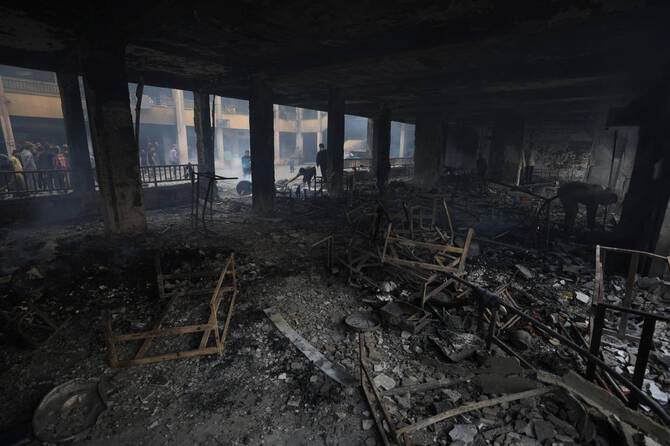
Israel continued to pound Gaza on Wednesday, with rescuers saying at least 25 people had been killed since dawn, including 11 in a strike on a school-turned-shelter.
“The school was housing displaced people. The bombing sparked a massive blaze, and several charred bodies have since been recovered,” civil defense spokesman Mahmud Bassal said, describing the attack on Yaffa school in Gaza City’s Al-Tuffa neighborhood.
An AFP journalist reported seeing several bodies in white shrouds at Al-Shifa hospital’s morgue, where women wept over the body of a child.
“We want nothing more than for the war to end, so we can live like people in the rest of the world,” said Khan Yunis resident Walid Al-Najjar.
“We are a people who are poor, devastated — our lives are lost.”
Since the war began following Hamas’s October 7, 2023 attack on Israel, tens of thousands of displaced Gazans have sought refuge in schools.
Aid agencies estimate that the vast majority of Gaza’s 2.4 million residents have been displaced at least once.
“We lack the necessary tools and equipment to carry out effective rescue operations or recover the bodies of martyrs,” Bassal said.
On Tuesday, Israel’s military said it had targeted approximately 40 “engineering vehicles,” alleging they were used for “terror purposes.”
Elsewhere in Gaza, further fatalities were reported Wednesday, including four killed in Israeli shelling of homes in eastern Gaza City, Bassal said.
The military did not immediately comment on the latest strikes.
Since Israel’s campaign resumed, at least 1,928 people have been killed in Gaza, bringing the total death toll since the war erupted to at least 51,305, according to the health ministry in Hamas-run Gaza.
Hamas’s attack on Israel that ignited the war resulted in the deaths of 1,218 people on the Israeli side, mostly civilians, according to an AFP tally based on official Israeli figures.
Germany, France, and Britain on Wednesday called on Israel to stop blocking humanitarian aid into Gaza, warning of “an acute risk of starvation, epidemic disease and death.”
“We urge Israel to immediately restart a rapid and unimpeded flow of humanitarian aid to Gaza in order to meet the needs of all civilians,” their foreign ministers said in a joint statement.


![]()

Abbas urges Hamas to free Gaza hostages as Israeli strikes kill 25
Short Url
https://arab.news/p5c67
Abbas urges Hamas to free Gaza hostages as Israeli strikes kill 25
- “Hamas has given the criminal occupation excuses to commit its crimes in the Gaza Strip, the most prominent being the holding of hostages,” Abbas said
- “Every day there are deaths. Why? Because they (Hamas) refuse to hand over the American hostage,” Abbas said of Edan Alexander


Latest updates


© 2026 SAUDI RESEARCH & PUBLISHING COMPANY, All Rights Reserved And subject to Terms of Use Agreement.