

L’Atelier Nawbar gains fans in Hollywood

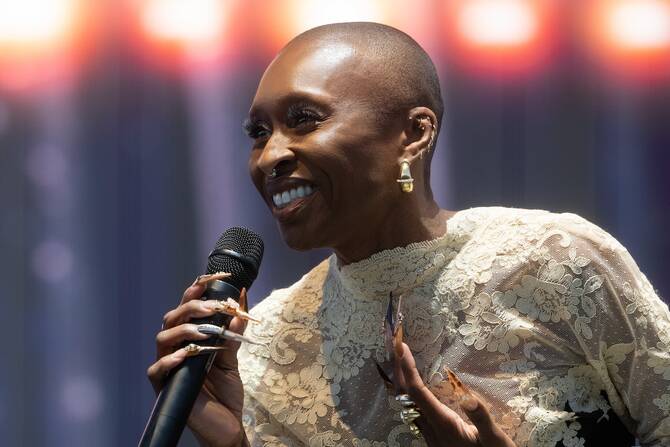
Cynthia Erivo was spotted wearing The Buoy Hoops from L’Atelier Nawbar’s latest collection. (Getty Images)
Short Url
Updated 23 April 2025
Follow

L’Atelier Nawbar gains fans in Hollywood

  • British star Cynthia Erivo wears label’s jewelry at Coachella
  • Dima and Tania Nawbar head family business set up in 1881

DUBAI: Dima and Tania Nawbar, the sisters behind Lebanese jewelry label L’Atelier Nawbar, have added a new Hollywood name to their list of fans: Cynthia Erivo.

The British singer and actress was spotted this week wearing The Buoy Hoops from L’Atelier Nawbar’s latest Lot No. 91 collection during her Coachella debut.

Crafted from 18-karat yellow gold, the statement earrings were paired with a cream lace gown featuring wide bell sleeves layered over a black satin base. The look combined varied textures and was styled with over-the-knee black boots.

The sisters took to Instagram to share a picture of the star wearing the earrings and wrote: “In love!!!”

L’Atelier Nawbar was established in 2011. Dima and Tania are fourth generation jewelers. They are the first women to take over the family’s Beirut-based business which was founded by their great-great-grandfather in a gold souk in 1881.

Since establishing their own modern take on the brand, the sisters have gone on to see their designs worn by international celebrities including Queen Rania of Jordan and Joey King.

And they have their collection of rings, pendants, necklaces and bracelets stocked at major retailers including Harrods, Bloomingdales and Moda Operandi.

The designers previously told Arab News that they wanted trendy, multipurpose jewelry for every day and night. Their designs can be worn in various ways, with pendants serving also as rings, which reduces investment costs.

The sisters also decided to move away from the traditional business model and offer something new. “We didn’t want to traditionally follow the family business as it was,” Dima said.

So the sisters decided to embrace individuality by remodeling pieces and creating new bespoke jewelry for clients.

Clients are able to bring their own jewelry into the atelier, and the designers will upcycle and redesign the pieces into something fresh and modern.


Cairo book fair breaks visitor records

Updated 03 February 2026
Follow

Cairo book fair breaks visitor records

  • Strong Saudi participation underscores KSA’s prominent role in Arab cultural landscape
  • Egyptian writer Naguib Mahfouz, who was awarded the Nobel Prize in Literature in 1988, was selected as the fair’s featured personality

CAIRO: The 57th edition of the Cairo International Book Fair has attracted record public attendance, with the number of visits reaching nearly 6 million, up from a reported 5.5 million previously.

Egypt’s Minister of Culture Ahmed Fouad Hanou said: “This strong turnout reflects the public’s eagerness across all age groups to engage with the exhibition’s diverse cultural and intellectual offerings.”

Hanou said the event included “literary and intellectual activities, meetings with thinkers and creative figures, and thousands of titles spanning various fields of knowledge.”

The Egyptian writer Naguib Mahfouz, who was awarded the Nobel Prize in Literature in 1988, was selected as the fair’s featured personality, coinciding with the 20th anniversary of his death.

The exhibition’s official poster features a famous quote by Mahfouz: “Who stops reading for an hour falls centuries behind.”

A total of 1,457 publishing houses from 83 countries participated in the fair. Mahfouz’s novels occupied a special place, as Egypt’s Diwan Library showcased the author’s complete works, about 54 books.

“The pavilion of the Egyptian National Library and Archives witnessed exceptionally high attendance throughout the fair, showcasing a collection of rare and significant books.

Among the highlights was the book “Mosques of Egypt” in Arabic and English, Dr. Sherif Saleh, head of financial and administrative affairs at the Egyptian National Library and Archives, told Arab News.

The fair ended on Tuesday with a closing ceremony that featured a cultural performance titled “Here is Cairo.”

The event included the announcement of the winners of the fair’s awards, as well as the recipient of the Naguib Mahfouz Award for Arabic Fiction.

Organizers described this year’s edition as having a celebratory and cultural character, bringing together literature, art, and cinema.

Romania was the guest of honor this year, coinciding with the 120th anniversary of Egyptian-Romanian relations.

At the Saudi pavilion, visitors were welcomed with traditional coffee. It showcased diverse aspects of Saudi culture, offering a rich experience of the Kingdom’s heritage and creativity.

There was significant participation from Saudi Arabia at the event, highlighting the Kingdom’s prominent role in the Arab cultural arena.

Saudi Arabia’s participation aimed to showcase its literary and intellectual output, in alignment with the objectives of Vision 2030.

The Kingdom’s delegation was led by Saudi Arabia’s Ambassador to Egypt Saleh bin Eid Al-Hussaini. Also in attendance were Dr. Abdul Latif Abdulaziz Al-Wasel, CEO of the Literature, Publishing and Translation Commission, and Dr. Hilah Al-Khalaf, the commission’s director-general.

The King Abdulaziz Public Library placed the Encyclopedia of Saudi Arabia in a prominent position at the pavilion. The encyclopedia, consisting of 20 volumes, is organized according to the Kingdom’s culturally diverse regions.

Founded in 1980 by King Abdullah, the library was established to facilitate access to knowledge and preserve heritage collections. Over the years, it has grown into one of the Kingdom’s most important cultural institutions.

Internationally, the library has strengthened ties between Saudi Arabia and China, including the opening of a branch at Peking University and receiving the Crown Prince Mohammed bin Salman Award for Cultural Cooperation between the two nations.

Regionally, the library has played a pivotal role in the Arab world through the creation of the Unified Arabic Cataloging Project, one of the most important initiatives contributing to knowledge accessibility and alignment with global standards.