Malnutrition treatments halted in Ethiopia due to underfunding

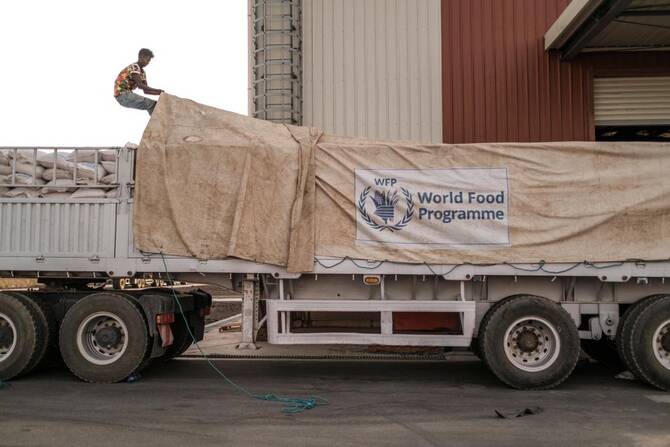
A worker covers a truck full of sacks of grain in a warehouse of the World Food Programme (WFP) in the city of Abala, Ethiopia, on June 09, 2022. (AFP)
Short Url
Updated 22 April 2025
Follow

Malnutrition treatments halted in Ethiopia due to underfunding

  • WFP says it had reduced rations in recent months and that its operations were now at breaking point

ADDIS ABABA: The World Food Programme suspended malnutrition treatment for 650,000 malnourished women and children in Ethiopia this week due to severe funding shortages, the UN agency said, with millions more at risk of losing access to aid.

WFP gets financing from 15-20 donors including the US but many of them have cut funding this year, said Zlatan Milisic, WFP Country Director in Ethiopia. The agency has received exemptions from US President Donald Trump’s aid freeze that has disrupted humanitarian work around the world, he added, but little for 2025 so far.

More than 10 million people in Ethiopia are gravely short of food, including 3 million displaced by conflict and extreme weather conditions as well as refugees from war-torn neighboring Sudan, according to WFP.

Milisic said WFP had already reduced rations in recent months but that its operations were now at “breaking point” due to severe underfunding, forcing more drastic measures.

“We’ve been left no choice but to this week suspend treatment for 650,000 malnourished women and children — simply because we’ve run out of commodities and funding,” he told a Geneva press briefing by video from Addis Ababa.

A WFP spokesperson later added that those cut off were in various locations including the northern regions of Tigray and Afar, and that the UN agency is actively seeking funding to purchase more supplies to resume treatments.

Around 3.6 million people could lose access to assistance, including some being treated for malnutrition, if more funding is not received by June, Milisic added.

“I would hope that we will get the resources and put in place measures to really do our best to assist them. But if they don’t receive assistance, we will have serious consequences.”

Ethiopia’s food crisis has worsened in recent years as a result of a 2020-22 civil war in Tigray. The country also faced the Horn of Africa’s worst drought in decades in 2022.


US bars five Europeans it says pressured tech firms to censor American viewpoints online

Updated 10 min 19 sec ago
Follow

US bars five Europeans it says pressured tech firms to censor American viewpoints online

WASHINGTON: The State Department announced Tuesday it was barring five Europeans it accused of leading efforts to pressure US tech firms to censor or suppress American viewpoints.
The Europeans, characterized by Secretary of State Marco Rubio as “radical” activists and “weaponized” nongovernmental organizations, fell afoul of a new visa policy announced in May to restrict the entry of foreigners deemed responsible for censorship of protected speech in the United States.
“For far too long, ideologues in Europe have led organized efforts to coerce American platforms to punish American viewpoints they oppose,” Rubio posted on X. “The Trump Administration will no longer tolerate these egregious acts of extraterritorial censorship.”
The five Europeans were identified by Sarah Rogers, the under secretary of state for public diplomacy, in a series of posts on social media. They include the leaders of organizations that address digital hate and a former European Union commissioner who clashed with tech billionaire Elon Musk over broadcasting an online interview with Donald Trump.
Rubio’s statement said they advanced foreign government censorship campaigns against Americans and US companies, which he said created “potentially serious adverse foreign policy consequences” for the US.
The action to bar them from the US is part of a Trump administration campaign against foreign influence over online speech, using immigration law rather than platform regulations or sanctions.
The five Europeans named by Rogers are: Imran Ahmed, chief executive of the Center for Countering Digital Hate; Josephine Ballon and Anna-Lena von Hodenberg, leaders of HateAid, a German organization; Clare Melford, who runs the Global Disinformation Index; and former EU Commissioner Thierry Breton, who was responsible for digital affairs.
Rogers in her post on X called Breton, a French business executive and former finance minister, the “mastermind” behind the EU’s Digital Services Act, which imposes a set of strict requirements designed to keep Internet users safe online. This includes flagging harmful or illegal content like hate speech.
She referred to Breton warning Musk of a possible “amplification of harmful content” by broadcasting his livestream interview with Trump in August 2024 when he was running for president.
Breton responded Tuesday on X by noting that all 27 EU members voted for the Digital Services Act in 2022. “To our American friends: ‘Censorship isn’t where you think it is,’” he wrote.
French Foreign Minister Jean-Noël Barrot said France condemns the visa restrictions on Breton and the four others. Also posting on X, he said the DSA was adopted to ensure that “what is illegal offline is also illegal online.” He said it “has absolutely no extraterritorial reach and in no way concerns the United States.”
Most Europeans are covered by the Visa Waiver Program, which means they don’t necessarily need visas to come into the country. They do, however, need to complete an online application prior to arrival under a system run by the Department of Homeland Security, so it is possible that at least some of these five people have been flagged to DHS, a US official said, speaking on condition of anonymity to discuss details not publicly released.
Other visa restriction policies were announced this year, along with bans targeting foreign visitors from certain African and Middle Eastern countries and the Palestinian Authority. Visitors from some countries could be required to post a financial bond when applying for a visa.