

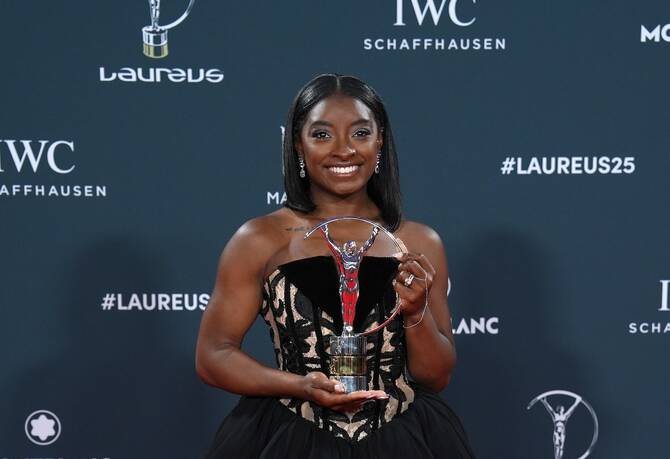
Simone Biles wins Laureus award in Saudi design

The athlete wore a black gown by Saudi Arabia designer Eman Al-Ajlan. (Supplied)
Short Url
Updated 22 April 2025
Follow

Simone Biles wins Laureus award in Saudi design

  • Saudi Arabia’s Eman Al-Ajlan designed Biles’ dress
  • US gymnast won 3 gold, 1 silver at Paris Olympics

DUBAI: US gymnast Simone Biles took home the Sportswoman of the Year award at the 2025 Laureus World Sports Awards this week, wearing a black gown by Saudi Arabia designer Eman Al-Ajlan.

The athlete opted for a strapless dress with a structured corset bodice featuring nude and black embroidered detailing. It included a voluminous peplum-style layer at the waist and a floor-length, sheer black skirt.


Simone Biles opted for a strapless dress with a structured corset bodice. (Getty Images)

She paired the look with simple diamond accessories and a black Tyler Ellis bag.

The American gymnast won three gold and a silver at the Paris Olympics.

Swedish pole vaulter Mondo Duplantis was named Sportsman of the Year. He had won a second Olympic gold medal and twice raised his own world record.

Al-Ajlan shared a photo on Instagram of Biles wearing her design, writing: “Congratulations @simonebiles on winning the Laureus World Sportswoman of the Year Award.”

This is not the first time Al-Ajlan’s designs have appeared on major red carpets.

Earlier this year, at the 96th Academy Awards, US social media personality Kristy Sarah wore a gown by Al-Ajlan.

The dress was a strapless, form-fitting gown in a soft nude tone. It featured a structured, ruched bodice that extended into a mermaid-style silhouette.

The skirt and train were embellished with three-dimensional floral appliques in shades of lavender and lilac.

In 2023, she dressed US actress, dancer, and social media star Tessa Brooks in an all-black ensemble for the MusiCares Persons of the Year event in Los Angeles.

The following year, British model and TV presenter Leomie Anderson wore a structured look by Al-Ajlan at the 2024 amfAR Gala in Cannes, featuring a mini dress layered with a net-like skirt.

Al-Ajlan, who launched her label in 2007, is based in Riyadh and specializes in couture, bridal and pret-a-porter designs.

She has dressed several regional celebrities for international events, including Saudi Arabia actresses Mila Alzahrani and Dae Al-Hilali at the 2019 Venice Film Festival.

In 2024, Riyadh-based TV host Ajwa Aljoudi wore a mustard gown by the designer to the 76th Primetime Emmy Awards in Hollywood.


Riyadh exhibition to trace the origins of Saudi modern art

Updated 07 January 2026
Follow

Riyadh exhibition to trace the origins of Saudi modern art

  • Features painting, sculpture and archival documents
  • Open from Jan. 27-April 11 at Saudi national museum

DUBAI: A new exhibition in Riyadh is focusing on the origins of Saudi Arabia’s modern art scene, examining how a generation of artists helped shape the Kingdom’s visual culture during a period of rapid change.

The “Bedayat: Beginnings of Saudi Art Movement” show reportedly traces the emergence of creative practices in Saudi Arabia from the 1960s to the 1980s, an era that laid the groundwork for today’s art ecosystem.

On view from Jan. 27 until April 11 at the National Museum of Saudi Arabia, it includes works and archival material that document the early years of modern and abstract art in the Kingdom, according to the organizers.

It will examine how artists responded to shifting social, cultural and economic realities, often working with limited infrastructure but a strong sense of purpose and experimentation.

The exhibition is the result of extensive research led by the Visual Arts Commission, which included dozens of site visits and interviews with artists and figures active during the period.

These firsthand accounts have helped to reconstruct a time when formal exhibition spaces were scarce, art education was still developing, and artists relied heavily on personal initiative to build communities and platforms for their work.

Curated by Qaswra Hafez, “Bedayat” will feature painting, sculpture, works on paper and archival documents, many of which will be shown publicly for the first time.

The works will reveal how Saudi artists engaged with international modernist movements while grounding their practice in local heritage, developing visual languages that spoke to both global influences and lived experience.

The exhibition will have three sections, beginning with the foundations of the modern art movement, and followed by a broader look at the artistic concerns of the time.

It will conclude with a focus on four key figures: Mohammed Al-Saleem, Safeya Binzagr, Mounirah Mosly and Abdulhalim Radwi.

A publication, documentary film and public program of talks and workshops will accompany the exhibition, offering further insight into a pivotal chapter of Saudi art history and the artists who helped define it.