KARACHI: US tech firm Spectreco LLC and AlBaraka Forum, a Saudi think-tank, would launch an Environmental, Social and Governance (ESG) Index in June to develop a robust benchmark for sustainable investments that align with the Islamic law and global regulations, the Spectreco chief executive officer told Arab News.
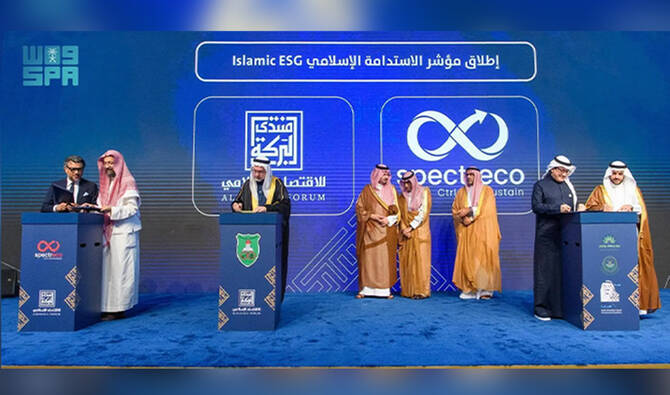
The two partners announced the launch of the Artificial Intelligence-led Shariah-compliant ESG index at the 45th AlBaraka Islamic Economics Symposium which was held last week in the Saudi city of Madinah.
“The actual launch of this index will happen in Istanbul in June,” said Faraz Khan, the winner of UK’s prestigious Order of the British Empire who was born in Pakistan’s southwestern city of Quetta.
“In the next three to five years, we hope to make this index [will be] the most widely used index in the MENA [Middle East and North Africa] region, starting with Saudi Arabia and led by it.”
The index is designed to be a “game changer” and a smart, technology-driven solution that will integrate the faith-based financial system with global ESG regulations. It will have the fundamentals of both the global ESG regulations and Shariah-compliant financial systems, and will be binding them through technology, according to Khan.
Spectreco and AlBaraka are currently looking for users, asset managers, banks and funds for the index that would help the Islamic economy and the wider world to integrate in a more value proposition-oriented way. The initiative would serve stakeholders, including investors, regulators and Islamic finance institutions seeking to align faith-based investment practices with modern sustainability goals, as the reporting of their compliance with ESG regulations is becoming mandatory for companies from Europe, the United Kingdom, Asia Pacific, and parts of North America.
“Now your trade and FDI both have embedded the sustainability and ESG and carbon footprint mechanisms across their space,” Khan told Arab News in an interview.
He said Islamic economies from the Middle East and North Africa region, including Qatar, the United Arab Emirates (UAE) and Saudi Arabia, were moving toward mandatory ESG compliance reporting, while Oman had already made it mandatory.
“A huge Islamic economy is moving toward mandatory reporting,” said Khan, whose firm aims to simplify sustainability reporting, compliance and performance tracking across multiple jurisdictions.
Speaking of the leverage his company has over others in terms of entering Saudi Arabia and other gulf markets, Khan said they have a technology that has an end-to-end mechanism and is driven by data, evidence and AI in the space of ESG and sustainability.
“We have on-ground expertise of the built environment and financial services and investor paradigm,” he said.
Yousef Hassan Khalawi, secretary-general at the Albaraka Forum that aims to advance Islamic economy, said the global Islamic economy was attracting more and more people and its size was expected to increase to $7 trillion by 2028.
“This is yet not that number which can represent the capacity of Muslims which are as a population now almost around 25 percent” of the world population, Khalawi told Arab News in a separate interview from Bahrain.
At $2 trillion, he said, the Islamic finance industry is still less than five percent of the global finance industry. He said the Shariah-compliant index would encourage bankers and business developers to develop more products that would meet global sustainability standards.
“It is, it should be a global index which means it should cover banks from Indonesia till Nigeria till even South Africa,” Khalawi said.
Around 65 percent of Islamic banking assets were concentrated in the Gulf Cooperation Council (GCC) region as well as Malaysia, according to the Albaraka official. In Saudi Arabia, the size of retail Islamic banking stood more than 95 percent while the corporate size was over 70 percent.
“Here, you are focusing on the major markets and then the rest of the world will come easier,” he added.
Khalawi called Pakistan a “very important nation,” with one of the “fiercest creators” of the Shariah-compliant economy.
Pakistan’s Islamic banking is growing at more than 20 percent every year and its government is trying to fully make its interest-based financial system Shariah-compliant by Dec. 2027, a deadline set by Pakistan’s Shariah court in April 2022.
“Many initiatives also will come in Pakistan,” Khalawi said. “For sure, we are considering Pakistan, as I said, in every single initiative we have.”


![]()

US tech giant joins hands with Saudi think-tank to launch AI-led, Shariah-compliant global ESG Index
Short Url
https://arab.news/gu494
US tech giant joins hands with Saudi think-tank to launch AI-led, Shariah-compliant global ESG Index
- The new index aims to bridge $2 trillion Islamic economy with global ESG standards, says CEO of US tech firm
- Saudi think-tank Albaraka Forum says the index will help grow the Islamic economy to $7 trillion in three years
Latest updates


© 2026 SAUDI RESEARCH & PUBLISHING COMPANY, All Rights Reserved And subject to Terms of Use Agreement.