Pakistan finmin seeks investments in Washington meetings with Deloitte, IFC executives

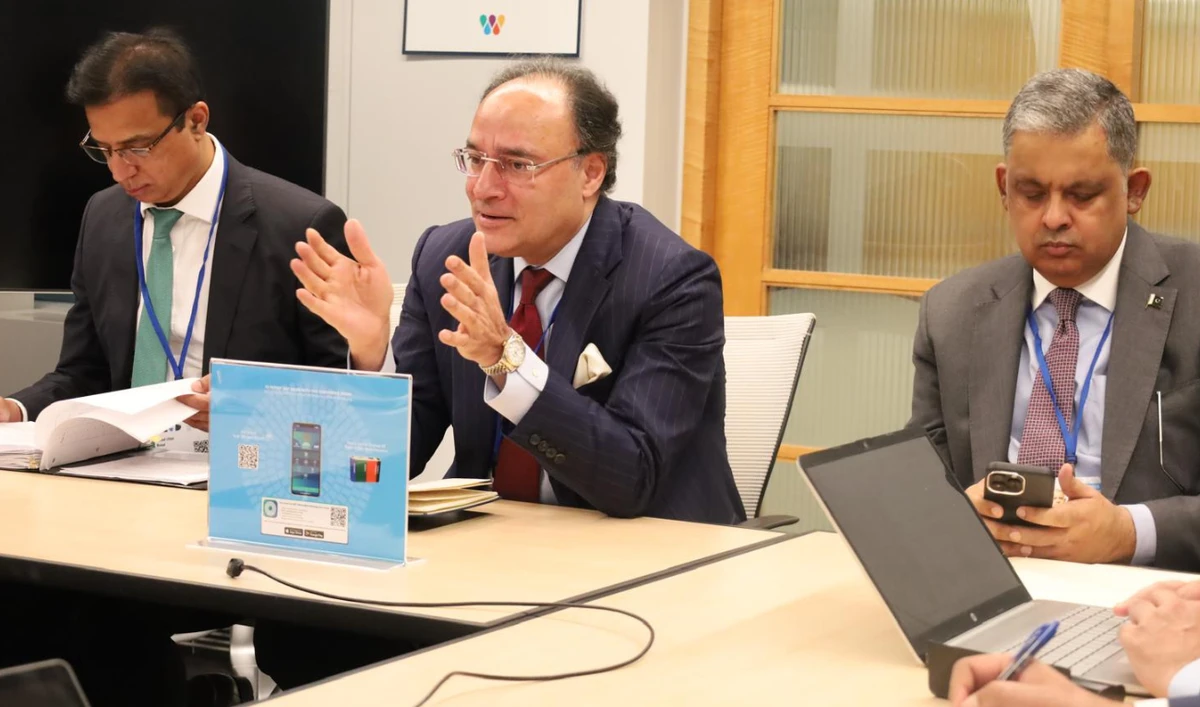
Federal Minister for Finance and Revenue Muhammad Aurangzeb meeting with the Deloitte team on the sidelines of the WB/IMF Spring Meetings 2025, in Washington D.C., on April 21, 2025. (GOP)
Short Url
Updated 21 April 2025
Follow

Pakistan finmin seeks investments in Washington meetings with Deloitte, IFC executives

  • Aurangzeb discusses cooperation in private sector reforms, energy transition, sound municipal finance, employment with IFC team
  • Pakistan finmin seeks investments in Washington meetings with Deloitte, IFC executivesDiscusses energy reforms, extraction, marketing of critical minerals, privatization, technology, crypto policy with Deloitte executives

KARACHI: Pakistani Minister for Finance and Revenue, Muhammad Aurangzeb, held separate meetings on Monday with executives from Deloitte and the International Finance Corporation and discussed cooperation in multiple areas like energy and private sector reforms and critical minerals.

Aurangzeb left for the US last week to attend the World Bank Group/IMF Spring 2025 Meetings from Apr. 21-26. A statement from his office said on Saturday besides meeting with top officials of the World Bank and the IMF, the finance minister would also meet with finance ministers and counterpart leaders of China, the United States, United Kingdom, Saudi Arabia and Turkiye and officials of global credit rating agencies, commercial and investment banks.

On Monday, Aurangzeb met Hela Cheikhrouhou, Regional Vice President of the International Finance Corporation, and her team.

“Both sides explored cooperation in the areas of private sector reforms, energy transition, sound municipal finance and full employment,” a statement from the finance ministry said. “The Minister appreciated the lead role of IFC in raising $2.5 billion in debt financing for Reko Diq Copper & Gold Mine Project in Balochistan. 

Aurangzeb also separately met with a team from Deloitte and briefed them on Pakistan’s macroeconomic outlook, the government’s sectoral development agenda and export-led growth priorities, the finance ministry said. 

“Explored cooperation in the areas of energy sector reforms, extraction and marketing of critical minerals, privatization, technology, crypto policy and operationalization of Country Partnership Framework (CPF),” the statement added. 

Pakistan remittances seen surpassing $40 billion in FY26 as Saudi Arabia leads November inflows

Updated 4 sec ago
Follow

Pakistan remittances seen surpassing $40 billion in FY26 as Saudi Arabia leads November inflows

  • The country’s November remittances rose 9.4 percent year-on-year to $3.2 billion, official data show
  • Economic experts say rupee stability and higher use of formal channels are driving the upward trend

ISLAMABAD: Pakistan’s workers’ remittances are expected to exceed the $40 billion mark in the current fiscal year, economic experts said Tuesday, after the country recorded an inflow of $3.2 billion in November, with Saudi Arabia once again emerging as the biggest contributor.

Remittances are a key pillar of Pakistan’s external finances, providing hard currency that supports household consumption, helps narrow the current-account gap and bolsters foreign-exchange reserves. The steady pipeline from Gulf economies, led by Saudi Arabia and the United Arab Emirates, has remained crucial for Pakistan’s balance of payments.

A government statement said monthly remittances in November stood at $3.2 billion, reflecting a 9.4 percent year-on-year increase.

“The growth in remittances means the full-year figure is expected to cross the $40 billion target in fiscal year 2026,” Sana Tawfik, head of research at Arif Habib Limited, told Arab News over the phone.

“There are a couple of factors behind the rise in remittances,” she said. “One of them is the stability of the rupee. In addition, the country is receiving more inflows through formal channels.”

Tawfik said the trend was positive for the current account and expected inflows to remain strong in the second half of the fiscal year, noting that both Muslim festivals of Eid fall in that period, when overseas Pakistanis traditionally send additional money home for family expenses and celebrations.

The official statement said cumulative remittances reached $16.1 billion during July–November, up 9.3 percent from $14.8 billion in the same period last year.

It added that November inflows were mainly sourced from Saudi Arabia ($753 million), the United Arab Emirates ($675 million), the United Kingdom ($481.1 million) and the United States ($277.1 million).

“UAE remittances have regained momentum in recent months, with their share at 21 percent in November 2025 from a low of 18 percent in FY24,” said Muhammad Waqas Ghani, head of research at JS Global Capital Limited. “Dubai in particular has seen a steady pick-up, reflecting improved inflows from Pakistani expatriates owing to some relaxation in emigration policies.”