Militant ‘ringleader’ among six insurgents killed in northwest Pakistan — army

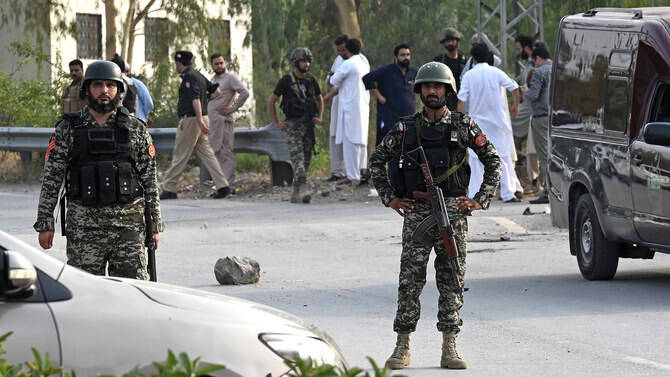
In this file photo, taken on July 18, 2023, Pakistani security personnel stand guard at the Hayatabad area of Peshawar. (AFP/File)
Short Url
Updated 21 April 2025
Follow

Militant ‘ringleader’ among six insurgents killed in northwest Pakistan — army

  • Military conducts frequent operations against militants it claims launch attacks from safe havens in Afghanistan
  • Militants have intensified attacks on army and its bases since revoking ceasefire with government in late 2022

ISLAMABAD: The Pakistan Army said on Monday a militant “ringleader” was among six insurgents killed in two intelligence-based operations in the northwestern Khyber Pakhtunkhwa province.

In recent months, the military has launched frequent operations in the restive Khyber Pakhtunkhwa province bordering Afghanistan. The army’s target in the area is militants it says launch attacks inside Pakistan and against the army using safe havens in Afghanistan, a charge Kabul denies. 

Groups like the Pakistani Taliban, commonly known as the Tehreek-e-Taliban Pakistan (TTP), have been waging a war against the Pakistani state for nearly two decades in a bid to overthrow the government and replace it with what they consider an Islamic system of governance.

“On 20-21 April 2025, six Khwarij [militants] were sent to hell in two separate engagements in Khyber Pakhtunkhwa Province,” the army said in a statement.

One operation was in the South Waziristan district, where the army said militant “ringleader” Zabi Ullah was killed. The statement said he had “remained actively involved in numerous terrorist activities against security forces as well as in target killing of innocent civilians and was highly wanted by the Law Enforcement Agencies.”

Another intelligence-based operation was conducted in Razmak, North Waziristan District, in which five militants were killed. 

Militants have intensified their attacks since revoking a ceasefire with the government in late 2022, with recent months witnessing significant strikes targeting the military and its bases.


Pakistan PM leaves for Saudi Arabia on brief visit as Middle East crisis rages on

Updated 10 sec ago
Follow

Pakistan PM leaves for Saudi Arabia on brief visit as Middle East crisis rages on

  • The visit comes at a time of increased volatility in the region, following US-Israeli strikes on Iran and Tehran’s counterattacks
  • Sharif and Crown Prince Mohammed will discuss the ongoing tensions, regional security and bilateral relations, Sharif’s office says

ISLAMABAD: Pakistan’s Prime Minister Shehbaz Sharif on Thursday departed for Saudi Arabia on a brief, hours-long visit, his office said, amid an ongoing conflict in the Middle East.

The visit comes at a time of increased volatility in the region, following Unites States-Israeli strikes on Iran and Tehran’s counterattacks on US bases in several Gulf countries as well as commercial and oil infrastructure, raising the spectre of a wider war.

Sharif, expected to discuss regional security and diplomatic coordination with Saudi leaders, is visiting the Kingdom on the invitation of Crown Prince Mohammed bin Salman, according to the prime minister’s office.

“Sharif will meet His Highness Prince Mohammed bin Salman,” the former’s office said.

“The meeting between the two leaders will discuss the ongoing tensions in the region, the regional security situation and the bilateral relations between the two countries.”

The development came a day after Bloomberg, citing comments from Sharif’s spokesperson, reported that Pakistan is ready to support Saudi Arabia “no matter what” as tensions escalate across the Middle East following Iranian strikes on Gulf states.

Mosharraf Zaidi told Bloomberg TV Islamabad would come to Riyadh’s aid whenever required, emphasizing the longstanding security partnership between the two countries, which was further strengthened by a mutual defense pact signed in September last year.

There was “no question we might, we will” come to Saudi Arabia’s aid “no matter what and no matter when,” Zaidi said.

“Both countries, even before the defense agreement, have always operated on the principle of being there for the other,” he added.

Pakistan and Saudi Arabia have historically maintained close military and strategic ties, and the new agreement elevated their security cooperation at a time of heightened regional instability.

Zaidi said Pakistan was also working diplomatically to prevent the conflict from expanding further across the region.