

Bangladeshi police seek Interpol red notice for ex-PM Hasina

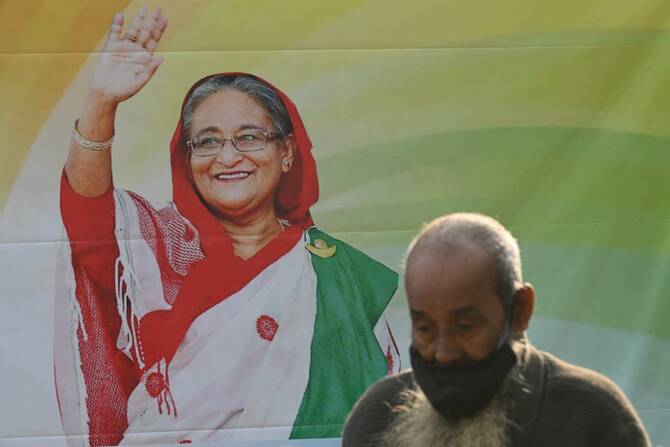
A man walks past a poster of the Awami League party featuring its leader Sheikh Hasina in Dhaka, Bangladesh, on Jan. 5, 2024. (AFP)
Short Url
Updated 20 April 2025
Follow

Bangladeshi police seek Interpol red notice for ex-PM Hasina

  • Authorities are also requesting Interpol red notice for Hasina’s ministers
  • Police move is part of trial process over student protest killings last year

DHAKA: Bangladeshi police have requested an Interpol red notice against ousted Prime Minister Sheikh Hasina, who is wanted for alleged involvement in the killings of hundreds of people during student protests that forced her to step down and flee last year.

In early July, a student-led movement began with peaceful demonstrations initially sparked by opposition to public-sector job quotas.

But they were met with a violent crackdown by security forces after two weeks, which according to UN estimates left more than 600 people dead. The deaths led to a nationwide uprising that forced Hasina to resign and leave for neighboring India in early August, ending her 15 years in power.

By October, Bangladesh’s International Crimes Tribunal had issued arrest warrants for Hasina and more than 40 other people who are linked to the protest killings.

“The assistance from Interpol is being sought to repatriate the accused persons,” Enamul Haque Sagor, assistant inspector general at the Bangladesh Police Headquarters, told Arab News on Sunday.

“Our all-out efforts are there to make (the red notice issuance happen) as soon as possible.”

Red notices are published by Interpol, an intergovernmental organization of 196 member countries. They serve as requests for law enforcement around the world to detain individuals for whom member states have issued arrest warrants.

Bangladeshi police are also seeking red notices for 11 other people linked to the protest killings, including Hasina’s Awami League general secretary, Obaidul Quader, and former home minister, Asaduzzaman Khan Kamal.

The red notice application was submitted at the request of the International Crimes Tribunal, which had sought police assistance after issuing the arrest warrant last year.

The special court will hear at least 70 cases related to the July-August violence.

Established in 2010 during Hasina’s rule, the International Crimes Tribunal is a domestic court responsible for investigating and prosecuting suspects of the 1971 genocide committed by the Pakistan Army and its local collaborators during the Bangladesh Liberation War. It also has jurisdiction over other war crimes and crimes against humanity.


Bangladesh’s leading contender for PM returns after 17 years in exile 

Updated 18 min 1 sec ago
Follow

Bangladesh’s leading contender for PM returns after 17 years in exile 

DHAKA: Millions of supporters crowded the streets of Dhaka on Thursday to welcome Tarique Rahman, acting chairman of the Bangladesh Nationalist Party, who has returned to his country after more than 17 years in exile. 

Rahman, the son of ailing former Prime Minister Khaleda Zia, waved to the large crowds from the front of a BNP bus escorted by security, as people lined the route from the capital’s airport to a reception venue, waving national and party flags, chanting slogans and carrying banners and flowers. 

His return comes in the wake of former Prime Minister Sheikh Hasina’s ouster last year and as Bangladesh gears up to hold general elections in February, for which he is emerging as a leading contender to become prime minister. 

“As a member of the BNP, I want to say in front of you that I have a plan for the people of my country, for my country,” Rahman said as he addressed a throng of supporters in Dhaka. 

“This plan is for the interest of the people of the country, for the development of the country and for changing the fate of the people. For this, I need support from each and every one of this country.  If you people stand beside us, God willing, we would be able to implement those plans.” 

The 60-year-old lived in London after he fled Bangladesh in 2008 over what he called a politically motivated persecution. 

After facing multiple criminal convictions in Bangladesh, including money laundering and charges linked to an alleged plot to assassinate Hasina, courts acquitted him following Hasina’s removal from office, clearing the legal obstacles that delayed his return. 

Rahman’s homecoming is “significant” as it comes as Bangladesh is going through a “very critical political crisis,” said analyst Prof. Dilara Choudhury. 

“People of Bangladesh, they are expecting that there will be free and fair elections, and whoever wins will form the government and forward to the transition. In that sense, his return is significant.” 

Bangladesh will hold parliamentary elections on Feb. 12, its first vote since a student-led uprising removed Hasina and her Awami League-led government from power in August 2024. 

The South Asian nation of nearly 175 million people has since been led by interim leader Muhammad Yunus, a Nobel Prize-winning economist, who took over governance after Hasina fled to India, where she is now in self-exile. 

As the Yunus-led administration has banned Awami League from all activities, meaning the former ruling party would not be able to join the upcoming race, the BNP is on course to win the largest number of parliamentary seats, according to a survey published in December by the US-based International Republican Institute. 

“I believe a new era in our politics will start with the arrival of Tarique Rahman in the country,” political analyst Mahbub Ullah told Arab News. 

“He will take the realms of his party with his own hand and he will do all kinds of things to organize the party and lead the party to victory in the next election.”