Pakistani forces kill four militants in Swat operation — military

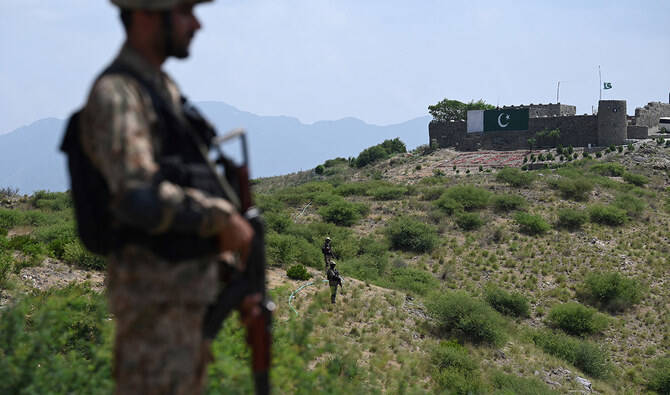
Pakistani troops patrol along Pakistan-Afghanistan border at Big Ben post in the Khyber district of the Khyber Pakhtunkhwa province on August 3, 2021. (AFP/FILE)
Short Url
Updated 18 April 2025
Follow

Pakistani forces kill four militants in Swat operation — military

  • ISPR says weapons and ammunition were recovered from the site where the militants were killed
  • Prime Minister Shehbaz Sharif praises the operation, calls it reflective of military’s professionalism

ISLAMABAD: Pakistani security forces killed four militants in an intelligence-based operation in the country’s northwestern Swat district on Friday, informed the military, as Islamabad intensifies its crackdown on insurgents staging violent attacks on civilians and uniformed personnel.
Pakistan refers to fighters of the Tehreek-e-Taliban Pakistan (TTP), an umbrella group of various armed groups, as khawarij, a term rooted in Islamic history that is used for an extremist sect that rebelled against authority and declared other Muslims to be apostates.
“On 18 April 2025, Security Forces and Law Enforcement Agencies conducted a joint intelligence based operation in Swat District on reported presence of Khawarij,” the military’s media wing, Inter-Services Public Relations (ISPR), said in a statement.
“During the conduct of operation, own troops effectively engaged khawarij location, resultantly four khawarij were sent to hell,” it added.
The ISPR said weapons and ammunition were recovered from the site and described the slain militants as being involved in a number of militant activities in the area.
It added a “sanitization operation” was underway to clear the area of any remaining fighters.
Prime Minister Shehbaz Sharif praised the operation, calling the forces’ efforts reflective of their professionalism and vowing to continue the fight against militancy.
“We will continue this war until terrorism is completely eradicated from the country,” Sharif said in a statement released by his office, adding that the entire nation stood firmly behind the armed forces.
Swat, once a Taliban stronghold, has witnessed a renewed presence of militants in some of its areas.
The TTP, which is separate from the Afghan Taliban but shares ideological roots, has stepped up attacks since the collapse of a ceasefire agreement with the Pakistani government in late 2022.


Pakistan flags funding strain, host state cooperation gaps in UN peacekeeping

Updated 07 February 2026
Follow

Pakistan flags funding strain, host state cooperation gaps in UN peacekeeping

  • Pakistan says blue helmets remain the most visible symbol of UN commitment to peace
  • The country urges member states to pay contributions on time to sustain UN missions

ISLAMABAD: Pakistan on Friday raised concerns over mounting financial pressures on United Nations peacekeeping operations along with a lack of cooperation from some host countries, warning that the challenges risk undermining the effectiveness and safety of missions worldwide.

Pakistan’s top diplomat at the UN flagged the issues while speaking at a UN Security Council briefing on peacekeeping police components.

Pakistan is one of the world’s top troop-contributing countries and has deployed more than 235,000 peacekeepers to 48 UN missions across four continents over the past eight decades.

A total of 182 of its peacekeepers have also lost their lives while serving under the UN flag.

“We are concerned at the current challenges faced by the United Nations peacekeeping, both financial as well as those arising from lack of host state cooperation,” Ambassador Asim Iftikhar Ahmad told the council. “Pakistan underscores the importance of full cooperation by host States to enable timely deployment of peacekeepers including police components where authorized by the Security Council.”

He noted that UN missions were operating under acute financial stress, leading to capacity reductions that directly affected mandate delivery and the safety of peacekeepers, while UN police units continued to face gaps between authorized strength and actual deployments.

Ahmad urged UN member states to pay their assessed contributions in full and on time to ensure peacekeeping missions remain operationally capable.

“Blue helmets are the most visible symbol of the United Nations commitment to peace and stability,” he said. “Peacekeeping brings relevance and legitimacy to this organization by making a tangible difference in people’s lives.”

Pakistan has contributed both military and police personnel to UN operations, deploying more than 50 formed police units to missions including Haiti, Darfur, Timor-Leste and Côte d’Ivoire, according to Pakistan’s UN mission.