Pakistan to seek bids to sell national airline next week

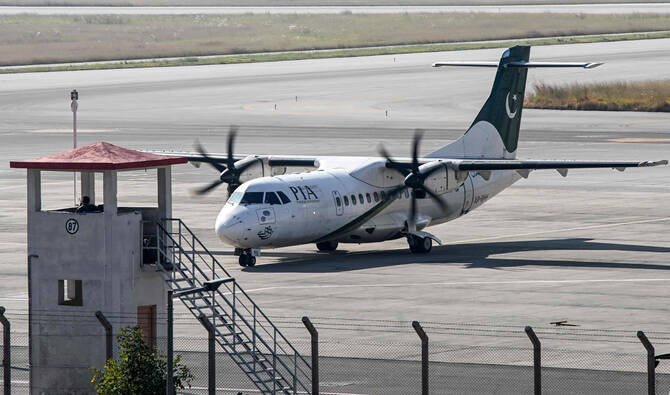
Pakistan International Airlines (PIA) ATR aircraft arrives at the Islamabad International Airport in Islamabad on October 31, 2024. (AFP/File)
Short Url
Updated 17 April 2025
Follow

Pakistan to seek bids to sell national airline next week

  • Privatization board approves pre-qualification criteria for selection of prospective bidders
  • New expressions of interest in buying between 51-100 percent of airline would be sought next week

ISLAMABAD: The Pakistani government will seek expressions of interest next week for the sale of Pakistan International Airlines, the privatization ministry said on Thursday, days after it reported its first annual profit in over two decades.
Pakistan has been seeking to sell a 51-100 percent stake in the debt-ridden carrier, to raise funds and reform cash-draining, state-owned enterprises as envisaged under a $7 billion International Monetary Fund program.
Its failed attempt to privatise Pakistan International Airlines last year received a single offer, well below the asking price of more than $300 million.
The privatization commission board has approved seeking new bids, the ministry said in a statement.
“The board approved the pre-qualification criteria for selection of prospective bidders,” it said. It added new expressions of interest in buying between 51 and 100 percent of the airline would be sought next week.
Pakistan has shifted almost all of the national carrier’s legacy debt to government books after issues raised by bidders led to the failure of the last privatization attempt.
Muhammad Ali, government adviser on privatization, said last week all the issues raised at the time of last year’s failed attempt had been dealt with.


Pakistan regulator says over 21,600 new companies registered in first half of FY26

Updated 11 January 2026
Follow

Pakistan regulator says over 21,600 new companies registered in first half of FY26

  • This reflects a 29 percent increase compared to the 16,839 companies that were registered during same period last year, says regulator
  • These incorporations contributed $109.5 billion in paid-up capital, says Securities and Exchange Commission of Pakistan report

ISLAMABAD: The Securities and Exchange Commission of Pakistan (SECP) said this week it registered over 21,600 new companies in the first half of the current fiscal year, reflecting rising investor confidence and positive economic outlook in the country. 

In a report issued on Jan. 6, the SECP said it registered 21,668 companies in the first six months of the current fiscal year, adding that these incorporations contributed Rs30.7 billion [$109.5 million] in paid-up capital. 

The report said this represented a 29 percent increase compared to the 16,839 companies registered during the same period last year.

“Pakistan’s business landscape continues to demonstrate strong momentum, reflecting rising investor confidence and a positive economic outlook,” the SECP report said. 

The SECP said the latest increase has brought the total number of registered companies in Pakistan to 279,724. It said the top ten sectors by incorporations were led by the IT & e-commerce, with 4,277 companies, followed by trading (2,997 companies), services (2,686 companies) and real estate (2,031 companies). 

“This sectoral diversity highlights expanding entrepreneurial activity, particularly in technology-driven and service-oriented industries,” the report said. 

The SECP said foreign investment also remained “robust” during the period, adding that 524 newly incorporated companies received foreign investment amounting to Rs1.26 billion [$4.5 million] with the participation from 731 foreign investors. 

“China emerged as the leading source, accounting for 71 percent of total inflows,” the SECP said. “It was followed by Afghanistan (8 percent), the United States (2 percent), and the United Kingdom, Germany, South
Africa, South Korea, Norway, Vietnam, Nigeria, and Bangladesh, each contributing 1 percent,” it added. 

The SECP said an additional 11 percent of the investment originated from other countries.