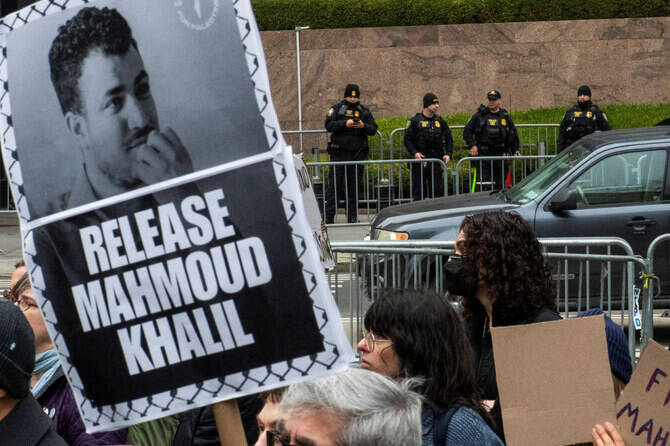
More than 130 students in US join federal lawsuit over revoked visas

More than 130 international students across the United States have joined a federal lawsuit accusing the Trump administration of unlawfully canceling their visas, jeopardizing their legal status in the country, court documents show. (Reuters/File)
Short Url
Updated 17 April 2025
Follow

More than 130 students in US join federal lawsuit over revoked visas

  • The students allege the Immigration and Customs Enforcement agency abruptly and illegally terminated their status
  • The initial complaint was filed by 17 students on April 11 in the state of Georgia

WASHINGTON: More than 130 international students across the United States have joined a federal lawsuit accusing the Trump administration of unlawfully canceling their visas, jeopardizing their legal status in the country, court documents show.
The students allege the Immigration and Customs Enforcement agency abruptly and illegally terminated their status in the government’s Student and Exchange Visitor Information System (SEVIS) database, putting them at risk of arrest, detention and deportation.
The initial complaint was filed by 17 students on April 11 in the state of Georgia.
Since then, 116 more have joined them as the administration of US President Donald Trump pursues a wide-ranging immigration crackdown that has targeted foreign students, among many others.
Across campuses in the United States, international students have been scrambling as they have discovered their visas have been revoked, often for little or no reason, according to court documents and media reports.
The Georgia lawsuit names US Attorney General Pam Bondi, Homeland Security Secretary Kristi Noem and Acting ICE Director Todd Lyons as defendants and seeks to reinstate the revoked visas.
In the complaint, which does not identify the students by name “due to fear of retaliation,” the summaries offered for each of the 17 original cases reveal seemingly arbitrary cancelations, with each plaintiff giving their best guess as to what may have prompted them to be targeted.
Some pointed to minor traffic infringements, such as John Doe 2, a Chinese citizen pursuing an engineering doctorate at the Georgia Institute of Technology.
He was notified by his school that his visa was revoked after a criminal records check, but the violation was not specified. The student believes it may have been related to a traffic offense that was closed and, according to the filing, he has no other criminal history.
Another of the students, an Indian national at New York Institute of Technology, said he had been found not guilty of shoplifting, and the case was dismissed.
“Over the past week, visa revocations and SEVIS terminations have shaken campuses across the country,” the complaint says.
“The SEVIS terminations have taken place against the backdrop of numerous demands being made of universities by the federal government and threats of cutting off billions of dollars in federal funding.”
The suit also noted that students’ removal from the government database could jeopardize the individuals’ ability to reenter the United States in the future.


Two high-speed trains derail in Spain, broadcaster reports seven people killed

Updated 40 min 50 sec ago
Follow

Two high-speed trains derail in Spain, broadcaster reports seven people killed

  • The accident happened near Adamuz, which is near Cordoba

MADRID: Two high-speed trains derailed on Sunday in southern Spain, the rail network operator said, and state-run television channel RTVE said seven people had died, citing police sources.
The accident ​happened near Adamuz, in Cordoba province. Seven people have been confirmed dead by police, RTVE said, adding that 100 people have been injured, 25 seriously.
Spanish police did not immediately respond to request for comment from Reuters.
“The Iryo 6189 Malaga — (to Madrid) train has derailed from the track at Adamuz, crashing onto the adjacent track. The (Madrid) to Huelva train which was traveling on the adjacent track has also derailed,” said Adif, which runs the rail network, in a social media post.
Adif said the accident happened at 6:40 p.m. (1740 GMT), about ten minutes ‌after the Iryo ‌train left Cordoba heading toward Madrid.
Iryo is a private rail ‌operator, ⁠majority-owned ​by Italian state-controlled ‌railway group Ferrovie dello Stato. The train involved was a Freccia 1000 train which was traveling between Malaga and Madrid, a spokesperson for Ferrovie dello Stato said.
Iryo did not immediately respond to a request for comment.
Adif has suspended all rail services between Madrid and Andalusia.
Andalusia emergency services said on social media that all rail traffic had been halted and emergency services were on their way, including at least nine ambulances and emergency support vehicles.

CALLS FOR MEDICS
A woman named Carmen posted on X that ⁠she had been on board the Iryo to Madrid. “Ten minutes after departing (from Cordoba) the train started to shake a lot, and ‌it derailed from coach 6 behind us. The lights went ‍out.”
Footage posted by another Iryo train ‍passenger, also on X, showed an Iryo staffer in a fluorescent jacket instructing passengers to remain ‍in their seats in the darkened carriages, and those with first aid training to keep watch over fellow passengers.
The staffer told passengers they would be evacuated when it was safe to leave, but at that moment the safest place was on the train. He also urged people to maintain mobile phone batteries ​to be able to use their torches when they disembarked.
The passenger wrote: “In our carriage we’re well but we don’t know about the other carriages. There’s ⁠smoke and they’re calling for a doctor.”
The regional government has activated emergency protocols to mobilize more resources to the accident site. Locals posted on social media that a building would be set up in the village nearest the crash for evacuated passengers to be taken to.
Salvador Jimenez, a journalist for RTVE who was on board the Iryo train, shared images showing the nose of the rear carriage of the train lying on its side, with evacuated passengers sitting on the side of the carriage facing upwards.
Jimenez told TVE by phone from beside the stricken trains that passengers had used emergency hammers to smash the windows and climb out, and they had seen two people taken out of the overturned carriages on stretchers.
“There’s a certain uncertainty about when we’ll get to Madrid, ‌where we’ll spend the night, we’ve had no message from the train company yet,” he said. “It’s very cold but here we are.”