

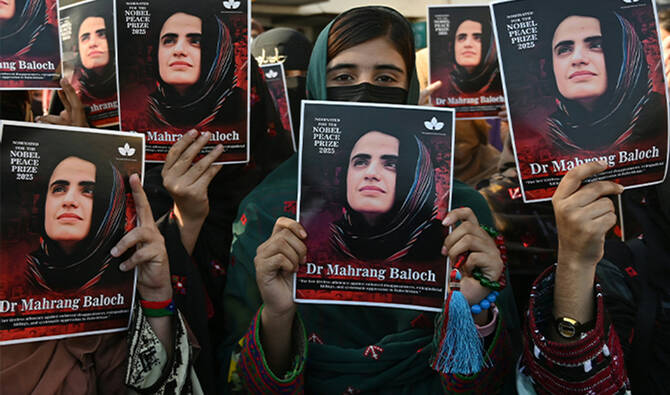

ISLAMABAD: Pakistan’s Dr. Mahrang Baloch has risen to become the young face of a decades-old movement against rights abuses since she discovered her father’s tortured body when she was a teenager.
The 32-year-old, who was arrested last month, is now one of the country’s most recognizable protest leaders representing the ethnic Baloch minority.
“Our father made the decision for us when he dedicated himself to Baloch rights. And after him, we all embraced his philosophy and committed ourselves to this struggle,” Mahrang wrote to her family from the cell where she is being held in the provincial capital Quetta.
She was charged in March with terrorism, sedition and murder, according to the police charge sheet seen by AFP.
Balochistan province, a sparsely populated, rugged region that borders Iran and Afghanistan, is the poorest in the country despite being rich in untapped hydrocarbons and minerals.
Security forces are fighting a decades-long insurgency by Baloch separatist militants, led by the Balochistan Liberation Army, which accuses authorities and outsiders, including Chinese investors, of exploiting the region.
Rights groups say the violence has been countered with a severe crackdown by authorities that has swept up innocent people. State authorities deny involvement in rights abuses in the province.
According to Voice for Baloch Missing Persons, an NGO, 18,000 people have disappeared in the province since 2000, figures disputed by the authorities.
Mahrang founded the Baloch Unity Committee (BYC) after her brother disappeared for four months in 2018 to mobilize the relatives of victims of alleged extrajudicial executions, enforced disappearances, and other arbitrary arrests.
“Mahrang is the child of resistance against brutal state oppression,” former senator Afrasiab Khattak told AFP.
A spokesperson for the Balochistan government told AFP that “activists are making claims without any grounds” about rights abuses and enforced disappearances.
“SHE CARRIES THEIR PAIN”
Mahrang first began campaigning after the disappearance of her father, defying tribal tradition in a region where less than one in three women can read and write to leave home and demand answers from the authorities.
“We could see her blocking the roads crying and pleading for her father, even when there was a police vehicle coming, she was still standing bravely in front of every obstacle,” said Naseem Baloch, president of the Baloch National Movement, who has been in exile in Europe since 2011.
The bullet-riddled body of Mahrang’s father was finally identified one July night in 2011, scarred by torture and wearing the same clothes he was kidnapped in.
“My brother fainted when he saw him,” her 26-year-old sister Nadia told AFP. “Mahrang then replaced our father. She helped our mother feed us with her medical scholarships and continued her fight for the Baluchi cause.”
Not only did she carry on the struggle, she radically changed the Baloch movement, according to her classmates.
“Before, everyone was afraid to speak to the media, but Mahrang led the way and succeeded in having her brother released, so now families dare to denounce these kidnappings,” Naseem Baloch said.
Above all, Mahrang and Nadia Baloch did not hesitate to voice their accusations that the security services were behind her brother’s kidnapping.
Mahrang broke taboos as a student, too. She led protests against her Quetta university after staff were caught secretly filming women on campus to blackmail them.
With a father killed, a brother kidnapped and a childhood spent in poverty, Mahrang’s story resonates with families in rural Balochistan.
“People identify with Mahrang because she carries their pain,” her sister said.
Mohammad Gul, a 55-year-old relative, said: “Baloch people see her as a ray of hope — a true leader challenging those who are responsible.”
Baloch armed groups demand independence, sometimes with spectacular attacks such as a deadly train hostage-taking in March, but the BYC advocates non-violence and a negotiated solution within the framework of the federal state.
Mahrang gained international attention after leading a “Long Baloch March” of more than 1,600 kilometers (1,000 miles) from Balochistan to the national capital Islamabad to denounce the alleged extrajudicial execution of a young Baloch man.
Her activism earned her a place among Time Magazine’s 100 Most Promising People of 2024 — an award she was unable to receive because authorities prevented her from leaving the country.
Her marches are attended by thousands, almost exclusively women, who stage days-long sit-ins.
“They are less likely to be beaten, arrested, or kidnapped,” explained Ayesha Siddiqa, a political scientist now based in London.
However, many women protesters have been imprisoned in recent weeks.
Mahrang has already “prepared the family” to continue the fight, said her sister Nadia.
“Perhaps one day, she will be kidnapped or killed,” she said.


