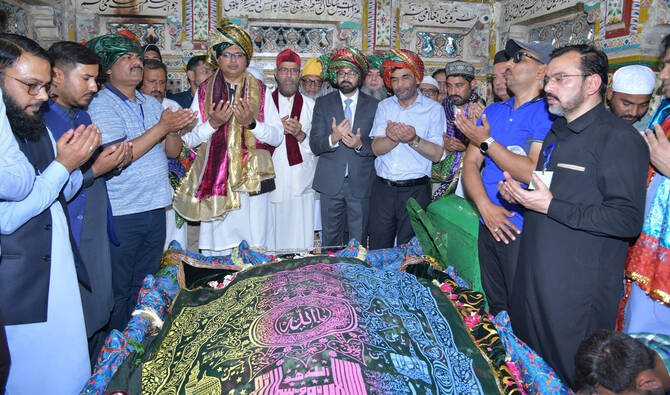
ISLAMABAD: A senior Pakistani diplomat on Wednesday paid tribute at the shrine of a 13th-century Muslim mystic in New Delhi, joining 178 devotees from his country who traveled to India to mark the saint’s death anniversary, even as diplomatic ties between the two countries remain strained.
Amir Khusro, a revered Sufi and disciple of Nizamuddin Aulia, is celebrated for shaping Indo-Islamic culture through his poetry, music and promotion of the Persian and Hindavi languages.
Despite the downgrading of bilateral relations since August 2019, when India revoked the special constitutional status of the disputed Himalayan region of Kashmir, religious tourism between the two countries has persisted.
“The Charge d’ Affaires of Pakistan to India, Mr. Saad Ahmad Warraich, laid the traditional chaddar [a decorative cloth] on behalf of the Government and people of Pakistan at the shrine of the famous mystic saint, Hazrat Amir Khusro (RA), in New Delhi, today,” the Pakistani High Commission said in a statement.
“A group of 178 Pakistani Zaireen [devotees] visiting India to participate in the 721 Urs celebrations of Hazrat Amir Khusro (RA) were also present on the occasion,” it added.
The Urs is an annual commemoration of a Sufi saint’s death anniversary, observed as a spiritual reunion with the divine.
According to the statement, the Pakistani diplomat and religious devotees were warmly received at the shrine by its caretaker.
The visit was organized under the 1974 Pakistan-India Protocol on Visits to Religious Shrines, which facilitates reciprocal religious tourism between the two countries.
The development comes as Pakistan recently issued nearly 6,000 visas to Indian Sikhs to visit Pakistan for the Baisakhi festival, one of Sikhism’s holiest celebrations, marking the spring harvest and the founding of the Khalsa in 1699.
Thousands of pilgrims gathered at Gurdwara Panja Sahib in the Pakistani city of Hasan Abdal, believed to bear the handprint of Guru Nanak, the founder of the Sikh faith.
Many Indian pilgrims remain in Pakistan, visiting other sacred sites including Nankana Sahib, the birthplace of Guru Nanak, and Gurdwara Darbar Sahib in Kartarpur.


Pakistani diplomat, 178 devotees visit Sufi shrine in Indian capital amid tense ties
https://arab.news/mhbtz
Pakistani diplomat, 178 devotees visit Sufi shrine in Indian capital amid tense ties

- Amir Khusro, a revered mystic, is celebrated for shaping Indo-Islamic culture through music and poetry
- Religious tourism between the two states has persisted despite their strained relations since August 2019

Pakistan says defense pact with Saudi Arabia elevated brotherly ties to ‘new heights’
- Pakistan, Saudi Arabia signed strategic defense pact last year pledging aggression against one will be treated as attack on both
- Deputy PM Ishaq Dar says enduring bonds with Islamic and Arab nations form vital pillar of Pakistan’s foreign policy
ISLAMABAD: Deputy Prime Minister Ishaq Dar said on Wednesday that Pakistan’s defense pact with Saudi Arabia elevated its brotherly ties with the Kingdom to “new heights,” stressing that close ties with Arab and Islamic nations form a key pillar of Islamabad’s foreign policy.
Pakistan and Saudi Arabia signed a Strategic Mutual Defense Agreement on Sept. 17 last year, pledging that aggression against one country would be treated as an attack on both, enhancing joint deterrence and formalizing decades of military and security cooperation.
Both nations agreed in October 2025 to launch an economic cooperation framework to strengthen trade and investment ties.
“In the Middle East, our landmark Strategic Mutual Defense Agreement with Saudi Arabia has elevated our brotherly ties to new heights,” Dar said while speaking at the Pakistan Governance Forum 2026 event in Islamabad.
The Pakistani deputy prime minister was speaking on the topic “Navigating International Relations Amidst Changing Geo-Politics.”
Dar noted that Pakistan has reinforced partnerships with other Middle Eastern nations such as the UAE, Qatar, Jordan, Oman, Egypt and Bahrain. He said these partnerships have yielded “concrete agreements” in investment, agriculture, infrastructure, and energy sectors.
“Our enduring bonds with Islamic and Arab nations form a vital pillar of our foreign policy, and we will continue to expand our partnerships across Asia, Latin America, and Africa,” he said.
Dar pointed out that the presidents of Kazakhstan, Uzbekistan and Kyrgyzstan have undertaken visits to Pakistan in recent months, reflecting Central Asian nations’ desire to boost cooperation with Islamabad.
On South Asia, the Pakistani deputy PM said Pakistan has successfully transformed its fraternal ties with Bangladesh into “a substantive partnership.”
“Similarly, the trilateral mechanism involving China, Pakistan, and Bangladesh has been launched with a view to expanding and deepening regional cooperation and synergy,” the Pakistani minister said.
He said Islamabad has strengthened its “all-weather” partnership with China via the second phase of the multi-billion-dollar China-Pakistan Economic Corridor agreement and “unwavering support” from both sides for each other’s core interests.
Dar said Pakistan had also reinvigorated its partnership with the US, advancing cooperation in trade, technology, investment, and regional stability.
“This calibrated approach has enhanced our ability to navigate complexity with skill and confidence, ensuring that our national interests are served without compromising our core foreign policy principles,” he said.


